
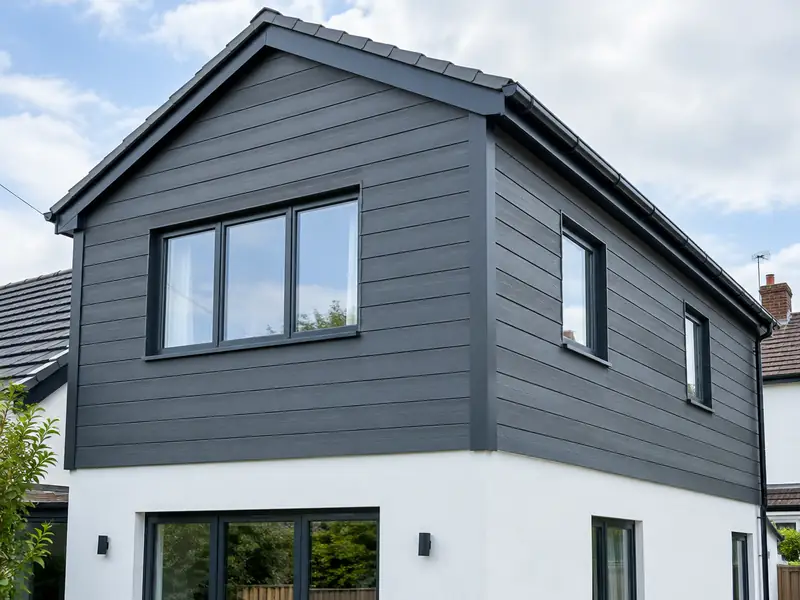
Cladding is a protective outer layer of boards or panels, such as timber, composite, fibre cement or uPVC, fixed to battens on the outside of a wall to change its appearance, shed rain and, where insulation is added, reduce heat loss.
We take on cladding throughout Bishops Stortford and the surrounding CM23 postcodes, as well as in Harlow, Hoddesdon and Hertford. The guide range for this work in the East of England is £5,200–£12,500 including VAT; where your project falls depends on its size, the materials you pick and how easy the site is to reach. A free survey turns that range into a fixed figure.
- Guide price
- £5,200–£12,500 inc VAT
- Time on site
- 3 days to 3 weeks depending on area
- Postcodes
- CM23
- Planning rules
- England
- Local area
- Hertfordshire
- Survey
- Free, with a written quote
Cladding prices in Bishops Stortford
Use the table to gauge the cost of cladding in Bishops Stortford before we visit. Figures include VAT and are scaled for the East of England, coming out about 5% above the national guide, which gives £5,200–£12,500 overall. After a free survey, you receive a fixed written price.
| Type of job | What it usually involves | Guide in Bishops Stortford |
|---|---|---|
| Feature area or dormer | A gable, dormer, bay or small feature wall in uPVC, timber or composite. | £1,600–£5,200 |
| Extension or upper storey | About 40–60m² of timber, composite or fibre cement with membrane and battens. | £5,200–£12,500 |
| Whole house | Cladding most elevations of a house, often with added insulation. | £12,500–£31,500 |
Your price depends mostly on:
- Cladding material and board profile
- Insulation behind the cladding
- Window reveals, corners and roof junctions to detail
- Scaffolding, access and distance from boundaries
What do you get?
- Survey of the wall, boundaries, damp and window details
- Breather membrane and treated battens fixed to the wall
- Insulation behind the cladding where agreed
- Cavity barriers and fire-stopping where regulations require
- Cladding boards fixed with suitable stainless or coated fixings
- Waste removal and a clean site on completion
Local housing and cladding
Hertfordshire is home to the first garden cities, Letchworth and Welwyn Garden City, and the post-war new towns of Stevenage, Hatfield and Hemel Hempstead. Watford and St Albans have Victorian terraces and Georgian streets, interwar semis line the commuter suburbs, and brick-and-flint cottages appear in Chiltern villages to the west.
Generally dry with chalk and clay soils; clay areas can move in long dry spells, and mature trees near houses need considering for foundations.
So when we survey a Bishops Stortford property for cladding, the first step is working out how it was built and what has been changed since.
Do you need permission in Bishops Stortford?
England, Wales, Scotland and Northern Ireland each handle planning a little differently. Bishops Stortford comes under England, covered below, and we raise any questions with the council before your quote is finalised.
In England, re-rendering or cladding a house is often allowed without planning permission, but stone, render, timber, plastic or tile cladding is not permitted development in conservation areas, and listed buildings need consent.
If you render or re-clad more than 25% of an external wall, Building Regulations usually require the wall’s insulation to be improved where that is practical, and building control should be notified.
Rules change and every property is different, so we check the planning history and constraints for your address before we quote.
What happens after you get in touch?
Survey and measure
First, someone visits your home in Bishops Stortford to see the space, take measurements and note anything that could affect the work, such as access or the condition of what is there. There is no charge for this visit.
Quote in writing
The quote arrives in writing, not over the phone. It covers the full scope, the finishes you've chosen, any exclusions and the payment schedule, with a fixed price tied to that specification.
Getting ready
Preparation matters as much as the build. We agree access, parking and working hours with you, order materials in good time, and confirm any permissions so the job isn't held up once it starts.
On site to finish
The job proceeds in the order set out in the programme, with dust and debris kept under control. Finally we tidy away, inspect the work together and pass the finished project over to you with its paperwork.
How we work
Frequently asked questions
How much does house cladding cost?
Cladding around 40–60m² of wall, such as an extension or upper storey, costs £5,200–£12,500, including membrane, battens and trims. As a guide, allow roughly £80–£180 per square metre plus fixed costs for scaffolding and set-up. uPVC and softwood sit at the lower end, while hardwood, composite and fibre cement cost more. Adding insulation increases the price. We confirm a fixed figure after the survey.
Do you cover Harlow, Hoddesdon and Hertford?
Yes. As well as Bishops Stortford, we cover Harlow, Hoddesdon and Hertford and the rest of Hertfordshire. Our coverage is UK-wide, so the process is the same wherever you are: a free site survey, a quote in writing that fixes the price for the agreed scope, and one point of contact while the work is planned and carried out.
How long will cladding take?
On a typical home, allow 3 days to 3 weeks depending on area. Larger projects, older buildings and extra work found once things are opened up can extend that, while simpler jobs may be shorter. Your quote includes an estimate of time on site, and your point of contact keeps you updated on the programme as the work progresses.
Are there fire-safety rules for cladding?
Building regulations limit the fire-spread performance of cladding on walls close to a boundary and on taller buildings, which can rule out some timber or composite products in those positions. Cavity barriers behind the cladding also help stop fire spreading through the gap. Fibre cement is non-combustible. We check boundary distances and product data before recommending a material.
Which cladding material needs the least maintenance?
Fibre cement, composite and uPVC cladding need the least upkeep, usually just an occasional wash. Thermally modified and hardwood timber can be left to weather naturally to a silver-grey, which needs no treatment, but keeping the original colour means re-staining every few years. Painted timber needs repainting regularly. We explain the long-term care of each option.
Nearby towns
Addresses in CM23 are all covered for Bishops Stortford, along with Harlow, Hoddesdon and Hertford close by. Give us your postcode when you get in touch and we will confirm the details.