
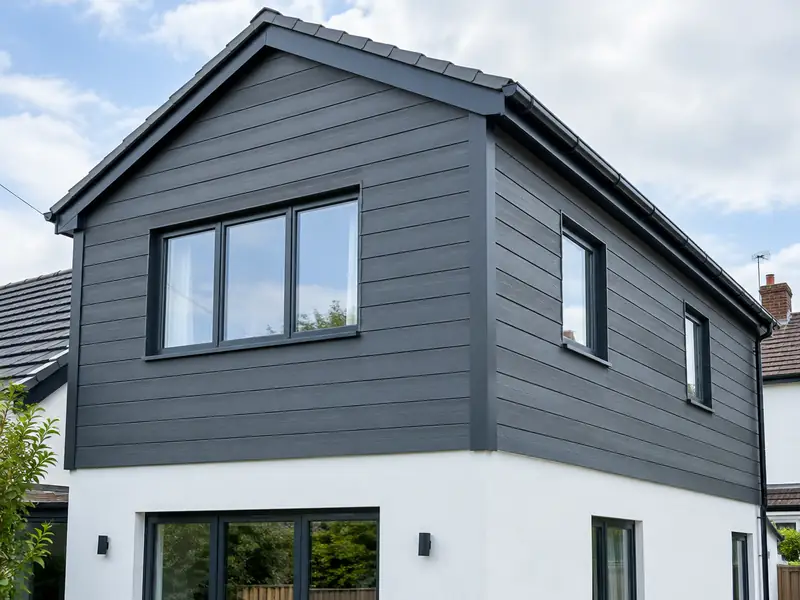
Cladding is a protective outer layer of boards or panels, such as timber, composite, fibre cement or uPVC, fixed to battens on the outside of a wall to change its appearance, shed rain and, where insulation is added, reduce heat loss.
Canterbury sits within our coverage for cladding, as do neighbouring Whitstable, Herne Bay and Faversham. Before giving a price we want to see the property: the condition of what's there now, the access, and anything that might need extra work. The guide range for the South East is £5,600–£13,500 including VAT, and your written quote will spell out exactly what that covers.
- Guide price
- £5,600–£13,500 inc VAT
- Time on site
- 3 days to 3 weeks depending on area
- Postcodes
- CT1, CT2, CT5 and CT6
- Planning rules
- England
- Local area
- Kent
- Survey
- Free, with a written quote
How much does cladding cost in Canterbury?
Budgeting for cladding in Canterbury? The numbers below include VAT and are adjusted for the South East, where costs are about 12% above the national guide. The headline range is £5,600–£13,500. Nothing is final until we have measured up at a free survey and agreed the specification with you.
| Type of job | What it usually involves | Guide in Canterbury |
|---|---|---|
| Feature area or dormer | A gable, dormer, bay or small feature wall in uPVC, timber or composite. | £1,700–£5,600 |
| Extension or upper storey | About 40–60m² of timber, composite or fibre cement with membrane and battens. | £5,600–£13,500 |
| Whole house | Cladding most elevations of a house, often with added insulation. | £13,500–£33,500 |
What moves the price up or down:
- Cladding material and board profile
- Insulation behind the cladding
- Window reveals, corners and roof junctions to detail
- Scaffolding, access and distance from boundaries
What’s included?
- Scaffolding or access towers as needed
- Breather membrane and treated battens fixed to the wall
- Insulation behind the cladding where agreed
- Cavity barriers and fire-stopping where regulations require
- Cladding boards fixed with suitable stainless or coated fixings
- Waste removal and a clean site on completion
What are homes like around Canterbury?
Kent's older buildings include oast houses, weatherboarded cottages, Wealden timber-framed houses and Kentish ragstone walls. Medway towns have long rows of Victorian terraces, Margate and Ramsgate have Regency and Victorian seafronts, and Ashford, Maidstone and Dartford have seen large new estates alongside interwar and post-war housing.
Victorian terraces suit loft rooms and rear extensions; weatherboarded and timber-framed buildings may need cladding repairs and lime work. Newer estate homes often take garage conversions, porches and landscaping.
Whatever era your Canterbury home dates from, we plan cladding around how it is actually built rather than a one-size-fits-all specification.
Permissions for cladding in Canterbury
Because Canterbury falls under England's rules, the guidance below is the version relevant to you. Before sending a price, we check your property's position with the council.
In England, re-rendering or cladding a house is often allowed without planning permission, but stone, render, timber, plastic or tile cladding is not permitted development in conservation areas, and listed buildings need consent.
If you render or re-clad more than 25% of an external wall, Building Regulations usually require the wall’s insulation to be improved where that is practical, and building control should be notified.
Rules change and every property is different, so we check the planning history and constraints for your address before we quote.
What happens after you get in touch?
A visit to your home
Book a visit and we'll come to you. The survey covers measurements, the state of what's there now and any obvious constraints, so the price that follows is based on your actual home, not an average.
Price and scope agreed
You get the price in writing, itemised so you can see where the money goes. As long as the specification stays the same, that is the price you pay for cladding.
Dates and permissions
Preparation matters as much as the build. We agree access, parking and working hours with you, order materials in good time, and confirm any permissions so the job isn't held up once it starts.
Build and hand over
Work goes ahead as scheduled and you deal with one contact throughout. When the last trade leaves, we clear and clean the site, talk you through what has been done and pass on any certificates and care instructions.
How we work
Questions about cladding in Canterbury
Which cladding material needs the least maintenance?
Fibre cement, composite and uPVC cladding need the least upkeep, usually just an occasional wash. Thermally modified and hardwood timber can be left to weather naturally to a silver-grey, which needs no treatment, but keeping the original colour means re-staining every few years. Painted timber needs repainting regularly. We explain the long-term care of each option.
How long does cladding take to install?
Cladding a small dormer or gable usually takes a few days, an extension or upper storey around one to two weeks, and a whole house two to three weeks or more. Scaffolding, insulation and detailing around many windows add time. Timber boards may need to acclimatise on site first. We give you a programme with the written quote.
Can cladding improve insulation?
Cladding can improve insulation if insulation boards are fixed to the wall behind the battens, which reduces heat loss and can help with cold or damp internal walls. This adds thickness, so window reveals, sills and roof edges need careful detailing. Cladding alone, without insulation, adds very little warmth. We can price both options so you can compare.
Is the price fixed?
Yes, for the specification we agree. Your written quote sets out exactly what is included at a fixed price. It only changes if you ask for something different, or if a problem the survey could not reasonably reveal later needs extra work. In either case we explain the change and confirm it in writing before going ahead.
Can I stay at home during the work?
In most cases, yes. Most people can live at home throughout, and we plan the work to keep disruption down by protecting floors, agreeing working hours and keeping access routes clear. Bigger jobs affecting kitchens, bathrooms or heating may mean a short spell with reduced facilities, and we talk this through with you at the survey.
Near Canterbury
Homes across CT1, CT2, CT5 and CT6 in Canterbury are within our coverage, as are those in Whitstable, Herne Bay and Faversham. If you are just outside these areas, ask anyway, because we work right across the UK.