
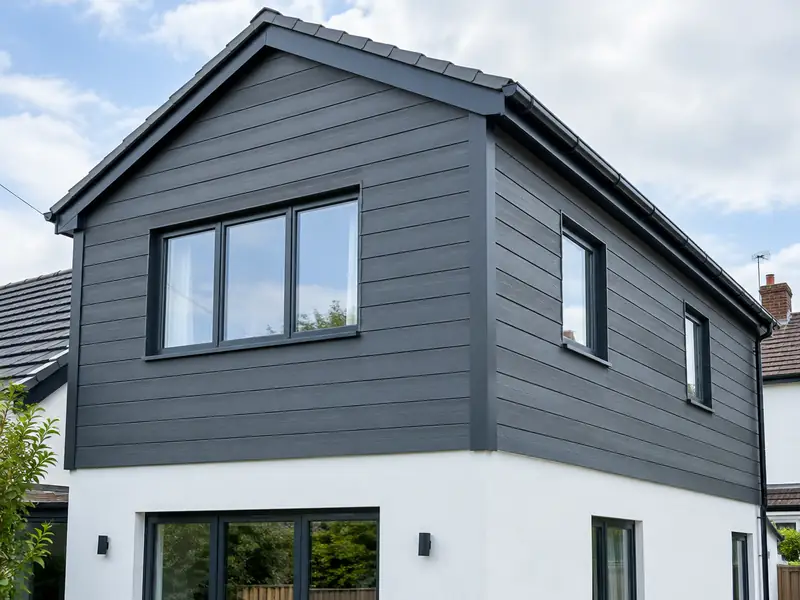
Cladding is a protective outer layer of boards or panels, such as timber, composite, fibre cement or uPVC, fixed to battens on the outside of a wall to change its appearance, shed rain and, where insulation is added, reduce heat loss.
Planning cladding for a home in Catford means making a handful of decisions about materials, layout, finish and timing. We help you work through them at a free survey, then confirm in writing what it will cost for the options you pick. Most projects of this type need 3 days to 3 weeks depending on area, and we cover every SE4, SE6, SE12 and SE13 address as well as the rest of London.
- Guide price
- £6,500–£15,500 inc VAT
- Time on site
- 3 days to 3 weeks depending on area
- Postcodes
- SE4, SE6, SE12, SE13 and SE23
- Planning rules
- England
- Local area
- Greater London
- Survey
- Free, with a written quote
What should you budget for cladding in Catford?
Prices for cladding vary from house to house, but in Catford most projects fall within £6,500–£15,500 including VAT. That reflects costs in London, about 30% above the national guide. Treat the table as a budgeting aid; the written figure follows a survey we carry out for free.
| Type of job | What it usually involves | Guide in Catford |
|---|---|---|
| Feature area or dormer | A gable, dormer, bay or small feature wall in uPVC, timber or composite. | £1,950–£6,500 |
| Extension or upper storey | About 40–60m² of timber, composite or fibre cement with membrane and battens. | £6,500–£15,500 |
| Whole house | Cladding most elevations of a house, often with added insulation. | £15,500–£39,000 |
What moves the price up or down:
- Wall area to be clad and the height of the building
- Cladding material and board profile
- Insulation behind the cladding
- Window reveals, corners and roof junctions to detail
What do you get?
- Scaffolding or access towers as needed
- Insulation behind the cladding where agreed
- Cavity barriers and fire-stopping where regulations require
- Cladding boards fixed with suitable stainless or coated fixings
- Corner trims, window reveals and ventilated top and bottom edges
- Waste removal and a clean site on completion
What are homes like around Catford?
London's housing is dominated by Victorian and Edwardian terraces, often in yellow London stock brick, with Georgian terraces in central districts and mansion blocks across many inner areas. Outer boroughs have large belts of interwar semis, and there are extensive post-war council estates. Many houses have been split into flats, and conservation areas are widespread.
London Clay shrinks and swells with the seasons, and street trees close to houses can contribute to movement, which affects foundation design.
That variety is why a guide price for cladding in Catford is only a starting point; the survey shows what your particular property needs.
Permissions for cladding in Catford
Planning law differs across the UK. For a home in Catford, it is the England rules below that count, and we check them with the council ahead of any quote.
In England, re-rendering or cladding a house is often allowed without planning permission, but stone, render, timber, plastic or tile cladding is not permitted development in conservation areas, and listed buildings need consent.
If you render or re-clad more than 25% of an external wall, Building Regulations usually require the wall’s insulation to be improved where that is practical, and building control should be notified.
Rules change and every property is different, so we check the planning history and constraints for your address before we quote.
The four stages
We look at the job
First, someone visits your home in Catford to see the space, take measurements and note anything that could affect the work, such as access or the condition of what is there. There is no charge for this visit.
Quote in writing
We turn the survey notes into a written quote. The price is fixed for the specification we agree, and the document sets out materials, scope and payment stages in plain language.
Dates and permissions
We handle the paperwork side: checking whether planning permission or building control approval is needed, submitting applications where they are, and scheduling the trades and materials around your dates.
Build and hand over
Our trades complete cladding while your point of contact keeps you updated. When everything is finished, we clear the site, take away waste and go through the result with you before handover.
How we work
Frequently asked questions
How much does house cladding cost?
Cladding around 40–60m² of wall, such as an extension or upper storey, costs £6,500–£15,500, including membrane, battens and trims. As a guide, allow roughly £80–£180 per square metre plus fixed costs for scaffolding and set-up. uPVC and softwood sit at the lower end, while hardwood, composite and fibre cement cost more. Adding insulation increases the price. We confirm a fixed figure after the survey.
Are there fire-safety rules for cladding?
Building regulations limit the fire-spread performance of cladding on walls close to a boundary and on taller buildings, which can rule out some timber or composite products in those positions. Cavity barriers behind the cladding also help stop fire spreading through the gap. Fibre cement is non-combustible. We check boundary distances and product data before recommending a material.
Which postcodes in Catford do you cover?
We cover SE4, SE6, SE12 and SE13, along with the rest of London. If your postcode is not listed, get in touch anyway: our coverage is UK-wide, and we can usually arrange a survey wherever you live. Enter your postcode in the guide-price tool or contact form and we will confirm.
Can I stay at home during the work?
In most cases, yes. Most people can live at home throughout, and we plan the work to keep disruption down by protecting floors, agreeing working hours and keeping access routes clear. Bigger jobs affecting kitchens, bathrooms or heating may mean a short spell with reduced facilities, and we talk this through with you at the survey.
Which cladding material needs the least maintenance?
Fibre cement, composite and uPVC cladding need the least upkeep, usually just an occasional wash. Thermally modified and hardwood timber can be left to weather naturally to a silver-grey, which needs no treatment, but keeping the original colour means re-staining every few years. Painted timber needs repainting regularly. We explain the long-term care of each option.
Nearby towns
Whether you're in the centre of Catford or on its outskirts, SE4, SE6, SE12 and SE13 addresses are covered. We extend the same service, and the same fixed-price approach, to Blackheath, Greenwich and Beckenham.