
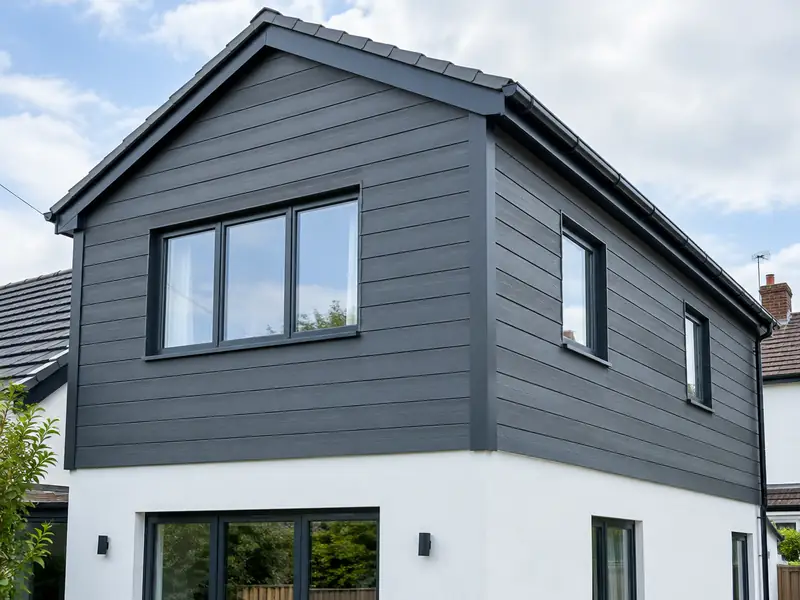
Cladding is a protective outer layer of boards or panels, such as timber, composite, fibre cement or uPVC, fixed to battens on the outside of a wall to change its appearance, shed rain and, where insulation is added, reduce heat loss.
If you live in Notting Hill and are weighing up cladding, the starting point is a visit to measure up and talk through what you want, which costs nothing. We cover homes across W8, W9, W10 and W11, and a typical project of this kind in London lands somewhere in the £6,500–£15,500 bracket, including VAT. The exact figure depends on size, access and the finish you choose.
- Guide price
- £6,500–£15,500 inc VAT
- Time on site
- 3 days to 3 weeks depending on area
- Postcodes
- W8, W9, W10, W11 and W12
- Planning rules
- England
- Local area
- Greater London
- Survey
- Free, with a written quote
How much does cladding cost in Notting Hill?
What will cladding cost in Notting Hill? Our guide range is £6,500–£15,500 including VAT. That figure is adjusted for London, about 30% above the national guide, and is intended for planning a budget. A firm written price for your chosen specification follows a free survey at your home.
| Type of job | What it usually involves | Guide in Notting Hill |
|---|---|---|
| Feature area or dormer | A gable, dormer, bay or small feature wall in uPVC, timber or composite. | £1,950–£6,500 |
| Extension or upper storey | About 40–60m² of timber, composite or fibre cement with membrane and battens. | £6,500–£15,500 |
| Whole house | Cladding most elevations of a house, often with added insulation. | £15,500–£39,000 |
The main things that change the figure:
- Wall area to be clad and the height of the building
- Cladding material and board profile
- Insulation behind the cladding
- Window reveals, corners and roof junctions to detail
Scope of the work
- Survey of the wall, boundaries, damp and window details
- Scaffolding or access towers as needed
- Breather membrane and treated battens fixed to the wall
- Cavity barriers and fire-stopping where regulations require
- Cladding boards fixed with suitable stainless or coated fixings
- Waste removal and a clean site on completion
Homes in London
London's housing is dominated by Victorian and Edwardian terraces, often in yellow London stock brick, with Georgian terraces in central districts and mansion blocks across many inner areas. Outer boroughs have large belts of interwar semis, and there are extensive post-war council estates. Many houses have been split into flats, and conservation areas are widespread.
Terraces suit side-return extensions and rear dormer loft conversions; interwar semis commonly take hip-to-gable lofts. Shared party walls, restricted parking and conservation rules often shape the plans and the programme.
These patterns matter for cladding: older walls, roofs and floors in Notting Hill can need different materials or extra preparation compared with newer homes.
Do you need permission in Notting Hill?
For anyone in Notting Hill, the relevant framework is England's. The summary below is general, so we always contact the council about your address before putting a price in writing.
In England, re-rendering or cladding a house is often allowed without planning permission, but stone, render, timber, plastic or tile cladding is not permitted development in conservation areas, and listed buildings need consent.
If you render or re-clad more than 25% of an external wall, Building Regulations usually require the wall’s insulation to be improved where that is practical, and building control should be notified.
Rules change and every property is different, so we check the planning history and constraints for your address before we quote.
What happens after you get in touch?
Survey and measure
A free survey comes first. It gives us what we need to price cladding properly, including dimensions, existing materials and access for deliveries, and gives you the chance to ask anything you like.
Price and scope agreed
The quote arrives in writing, not over the phone. It covers the full scope, the finishes you've chosen, any exclusions and the payment schedule, with a fixed price tied to that specification.
Getting ready
Once you accept, we agree start dates, order materials and deal with any planning, building control or neighbour notices the job needs. You'll know who is coming and when before work begins.
Finish and handover
Our trades complete cladding while your point of contact keeps you updated. When everything is finished, we clear the site, take away waste and go through the result with you before handover.
Working with SK Home Improvements
Cladding in Notting Hill: questions
Can you combine cladding with other work?
Yes. Because we manage several trades under one contract, we can plan cladding alongside other work on your Notting Hill home, such as new windows with rendering, or a kitchen refit with an extension. Combining jobs can reduce repeat set-up such as scaffolding, skips and access, and every element is listed and priced in the same written quote.
Are there fire-safety rules for cladding?
Building regulations limit the fire-spread performance of cladding on walls close to a boundary and on taller buildings, which can rule out some timber or composite products in those positions. Cavity barriers behind the cladding also help stop fire spreading through the gap. Fibre cement is non-combustible. We check boundary distances and product data before recommending a material.
Can I stay at home during the work?
In most cases, yes. Most people can live at home throughout, and we plan the work to keep disruption down by protecting floors, agreeing working hours and keeping access routes clear. Bigger jobs affecting kitchens, bathrooms or heating may mean a short spell with reduced facilities, and we talk this through with you at the survey.
Can cladding improve insulation?
Cladding can improve insulation if insulation boards are fixed to the wall behind the battens, which reduces heat loss and can help with cold or damp internal walls. This adds thickness, so window reveals, sills and roof edges need careful detailing. Cladding alone, without insulation, adds very little warmth. We can price both options so you can compare.
Which cladding material needs the least maintenance?
Fibre cement, composite and uPVC cladding need the least upkeep, usually just an occasional wash. Thermally modified and hardwood timber can be left to weather naturally to a silver-grey, which needs no treatment, but keeping the original colour means re-staining every few years. Painted timber needs repainting regularly. We explain the long-term care of each option.
Near Notting Hill
Live in Notting Hill? Our coverage takes in the W8, W9, W10 and W11 postcode areas and reaches out to Shepherds Bush, Willesden and Fulham, so homes on the outskirts and in the next town along are included.