
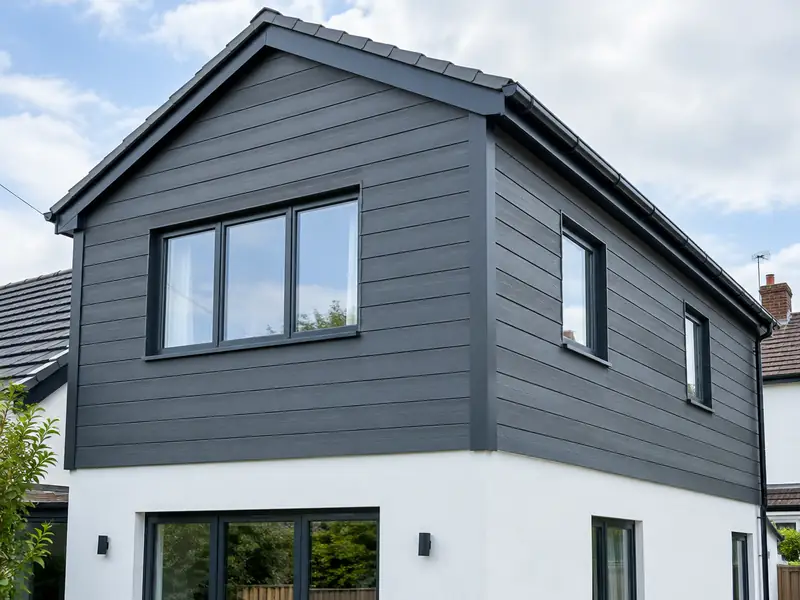
Cladding is a protective outer layer of boards or panels, such as timber, composite, fibre cement or uPVC, fixed to battens on the outside of a wall to change its appearance, shed rain and, where insulation is added, reduce heat loss.
Whatever prompted you to look into cladding, whether wear and tear, a growing family or plans to move, we can survey your Maesteg home and give you a price in writing. Homes in Wales typically come in at £4,600–£11,000, VAT included, for this kind of work. We also cover Briton Ferry, Neath and Bridgend, and the same steps apply wherever you are in Mid Glamorgan.
- Guide price
- £4,600–£11,000 inc VAT
- Time on site
- 3 days to 3 weeks depending on area
- Postcodes
- CF34
- Planning rules
- Wales
- Local area
- Bridgend
- Survey
- Free, with a written quote
Cladding prices in Maesteg
Prices for cladding vary from house to house, but in Maesteg most projects fall within £4,600–£11,000 including VAT. That reflects costs in Wales, about 8% below the national guide. Treat the table as a budgeting aid; the written figure follows a survey we carry out for free.
| Type of job | What it usually involves | Guide in Maesteg |
|---|---|---|
| Feature area or dormer | A gable, dormer, bay or small feature wall in uPVC, timber or composite. | £1,400–£4,600 |
| Extension or upper storey | About 40–60m² of timber, composite or fibre cement with membrane and battens. | £4,600–£11,000 |
| Whole house | Cladding most elevations of a house, often with added insulation. | £11,000–£27,500 |
The main things that change the figure:
- Wall area to be clad and the height of the building
- Cladding material and board profile
- Window reveals, corners and roof junctions to detail
- Scaffolding, access and distance from boundaries
Scope of the work
- Survey of the wall, boundaries, damp and window details
- Scaffolding or access towers as needed
- Breather membrane and treated battens fixed to the wall
- Insulation behind the cladding where agreed
- Corner trims, window reveals and ventilated top and bottom edges
- Waste removal and a clean site on completion
Local housing and cladding
The Rhondda, Cynon and Merthyr valleys are lined with stone terraces built for mining families, stepped along steep hillsides. Pontypridd, Caerphilly and Merthyr Tydfil have Victorian centres, and Bridgend has grown with large modern estates alongside interwar and post-war housing.
The valleys get heavy rainfall and steep, sloping sites are common, so drainage, retaining walls and render specification matter.
That variety is why a guide price for cladding in Maesteg is only a starting point; the survey shows what your particular property needs.
Permissions for cladding in Maesteg
Homes in Maesteg come under the regulations for Wales, summarised below. We don't rely on general rules alone: we confirm the position for your address with the council before a quote goes out.
In Wales, rendering or cladding may need planning permission in conservation areas, and listed buildings need consent.
Building Regulations in Wales can require insulation upgrades when a large part of an external wall is renovated.
Rules change and every property is different, so we check the planning history and constraints for your address before we quote.
From survey to handover
A visit to your home
We begin by looking at the job in person. During the free survey we discuss options, materials and budget for cladding, and photograph or measure anything the quote needs to reflect.
Your fixed price
We turn the survey notes into a written quote. The price is fixed for the specification we agree, and the document sets out materials, scope and payment stages in plain language.
Getting ready
With the quote agreed, we book the work in and handle preparation: permissions where needed, building control notifications, material orders and access arrangements for your Maesteg property.
Finish and handover
On site, the agreed plan is followed and any change is put in writing first. At completion we do a final clean, go through the snagging list with you and leave you with the relevant documents.
Why homeowners choose us
Frequently asked questions
How long will cladding take?
On a typical home, allow 3 days to 3 weeks depending on area. Larger projects, older buildings and extra work found once things are opened up can extend that, while simpler jobs may be shorter. Your quote includes an estimate of time on site, and your point of contact keeps you updated on the programme as the work progresses.
Which cladding material needs the least maintenance?
Fibre cement, composite and uPVC cladding need the least upkeep, usually just an occasional wash. Thermally modified and hardwood timber can be left to weather naturally to a silver-grey, which needs no treatment, but keeping the original colour means re-staining every few years. Painted timber needs repainting regularly. We explain the long-term care of each option.
Do I need planning permission to clad my house?
Whether cladding needs planning permission depends on the material and how it changes the look of the house, your home's location, whether it is listed or in a conservation area, and which UK nation you live in. In England, cladding is generally permitted development only if the materials look similar to the existing house, and it is not permitted development in conservation areas. We check before quoting.
How much does house cladding cost?
Cladding around 40–60m² of wall, such as an extension or upper storey, costs £4,600–£11,000, including membrane, battens and trims. As a guide, allow roughly £80–£180 per square metre plus fixed costs for scaffolding and set-up. uPVC and softwood sit at the lower end, while hardwood, composite and fibre cement cost more. Adding insulation increases the price. We confirm a fixed figure after the survey.
How much will cladding cost in Maesteg?
As a guide, expect to pay £4,600–£11,000 including VAT for cladding in Maesteg. That range is adjusted for Wales, which runs about 8% below the national guide. Where your project lands depends on size, materials, access and the condition of what is already there. We confirm a fixed price in writing after a free survey of your home.
Also covering areas around Maesteg
Addresses in CF34 are all covered for Maesteg, along with Briton Ferry, Neath and Bridgend close by. Give us your postcode when you get in touch and we will confirm the details.