
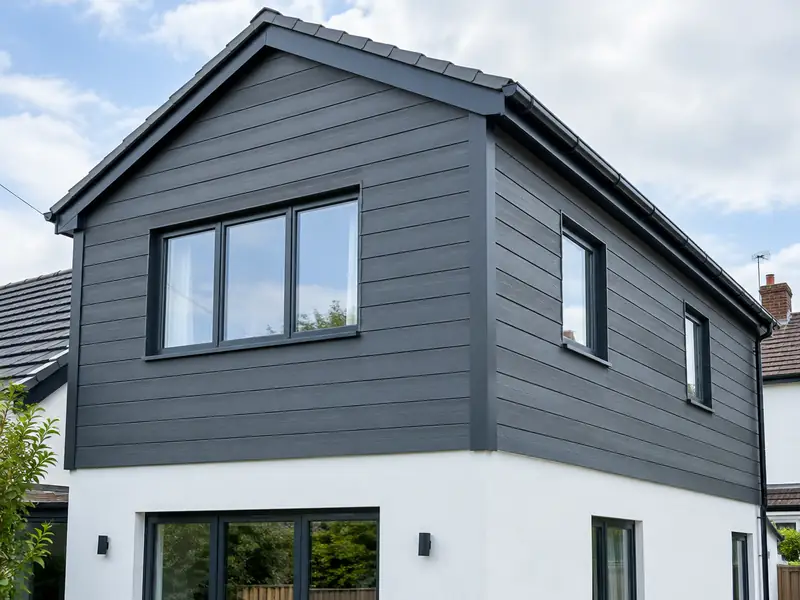
Cladding is a protective outer layer of boards or panels, such as timber, composite, fibre cement or uPVC, fixed to battens on the outside of a wall to change its appearance, shed rain and, where insulation is added, reduce heat loss.
Whatever prompted you to look into cladding, whether wear and tear, a growing family or plans to move, we can survey your Norwich home and give you a price in writing. Homes in the East of England typically come in at £5,200–£12,500, VAT included, for this kind of work. We also cover Bowthorpe, Dereham and Great Yarmouth, and the same steps apply wherever you are in Norfolk.
- Guide price
- £5,200–£12,500 inc VAT
- Time on site
- 3 days to 3 weeks depending on area
- Postcodes
- NR1, NR2, NR3, NR4 and NR6
- Planning rules
- England
- Local area
- Norfolk
- Survey
- Free, with a written quote
Cladding prices in Norwich
Budgeting for cladding in Norwich? The numbers below include VAT and are adjusted for the East of England, where costs are about 5% above the national guide. The headline range is £5,200–£12,500. Nothing is final until we have measured up at a free survey and agreed the specification with you.
| Type of job | What it usually involves | Guide in Norwich |
|---|---|---|
| Feature area or dormer | A gable, dormer, bay or small feature wall in uPVC, timber or composite. | £1,600–£5,200 |
| Extension or upper storey | About 40–60m² of timber, composite or fibre cement with membrane and battens. | £5,200–£12,500 |
| Whole house | Cladding most elevations of a house, often with added insulation. | £12,500–£31,500 |
The main things that change the figure:
- Wall area to be clad and the height of the building
- Cladding material and board profile
- Insulation behind the cladding
- Window reveals, corners and roof junctions to detail
What’s included?
- Survey of the wall, boundaries, damp and window details
- Scaffolding or access towers as needed
- Breather membrane and treated battens fixed to the wall
- Insulation behind the cladding where agreed
- Cavity barriers and fire-stopping where regulations require
- Corner trims, window reveals and ventilated top and bottom edges
Homes in Norfolk
Flint is everywhere in Norfolk, often combined with brick quoins and red or black-glazed pantile roofs. Norwich has Victorian terraces and interwar suburbs around its medieval centre, Norfolk reed thatch survives across the county, carrstone is used in the west, and coastal towns such as Great Yarmouth and Cromer have Victorian terraces and newer bungalows.
Flint walls often need lime repointing and careful repairs, and pantile roofs need matching tiles. Norwich terraces suit loft conversions and rear extensions, while coastal bungalows commonly take loft rooms, porches and new windows.
That mix of housing shapes how we approach cladding in Norwich: the age and construction of your home affect the materials, the method and, in the end, the price.
Do you need permission in Norwich?
Homes in Norwich come under the regulations for England, summarised below. We don't rely on general rules alone: we confirm the position for your address with the council before a quote goes out.
In England, re-rendering or cladding a house is often allowed without planning permission, but stone, render, timber, plastic or tile cladding is not permitted development in conservation areas, and listed buildings need consent.
If you render or re-clad more than 25% of an external wall, Building Regulations usually require the wall’s insulation to be improved where that is practical, and building control should be notified.
Rules change and every property is different, so we check the planning history and constraints for your address before we quote.
How does the job run?
A visit to your home
We begin by looking at the job in person. During the free survey we discuss options, materials and budget for cladding, and photograph or measure anything the quote needs to reflect.
Written quote
Next you receive a written quote with a fixed price for the agreed specification. It lists what is included, what is not, and how payments are staged, so you can compare it properly.
Booking the work
Preparation matters as much as the build. We agree access, parking and working hours with you, order materials in good time, and confirm any permissions so the job isn't held up once it starts.
Finish and handover
On site, the agreed plan is followed and any change is put in writing first. At completion we do a final clean, go through the snagging list with you and leave you with the relevant documents.
How we work
Common questions
Will timber cladding change colour?
Untreated timber cladding naturally weathers to a silver-grey over a year or two as sunlight breaks down the surface. The change can be uneven at first, especially under eaves where rain does not reach. If you want to keep the original colour, a UV-protective stain or oil is needed and must be renewed every few years. Pre-weathered and coated boards are also available.
Can I stay at home during the work?
In most cases, yes. Most people can live at home throughout, and we plan the work to keep disruption down by protecting floors, agreeing working hours and keeping access routes clear. Bigger jobs affecting kitchens, bathrooms or heating may mean a short spell with reduced facilities, and we talk this through with you at the survey.
Is the price fixed?
Yes, for the specification we agree. Your written quote sets out exactly what is included at a fixed price. It only changes if you ask for something different, or if a problem the survey could not reasonably reveal later needs extra work. In either case we explain the change and confirm it in writing before going ahead.
How long does cladding take to install?
Cladding a small dormer or gable usually takes a few days, an extension or upper storey around one to two weeks, and a whole house two to three weeks or more. Scaffolding, insulation and detailing around many windows add time. Timber boards may need to acclimatise on site first. We give you a programme with the written quote.
Do I need planning permission to clad my house?
Whether cladding needs planning permission depends on the material and how it changes the look of the house, your home's location, whether it is listed or in a conservation area, and which UK nation you live in. In England, cladding is generally permitted development only if the materials look similar to the existing house, and it is not permitted development in conservation areas. We check before quoting.
Nearby towns
Norwich and its NR1, NR2, NR3 and NR4 postcodes are part of our coverage. Homeowners in Bowthorpe, Dereham and Great Yarmouth can also book a free survey with us and receive a written price for their job.