
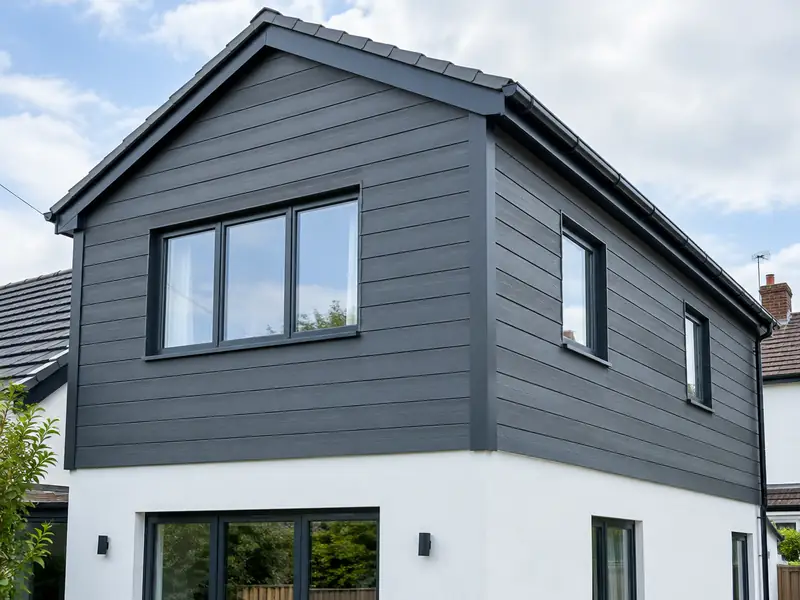
Cladding is a protective outer layer of boards or panels, such as timber, composite, fibre cement or uPVC, fixed to battens on the outside of a wall to change its appearance, shed rain and, where insulation is added, reduce heat loss.
For a homeowner in Northampton, planning cladding tends to begin with two questions: what will it cost, and how disruptive will it be? Our guide range is £4,800–£11,500 including VAT, and a typical job runs to 3 days to 3 weeks depending on area. Both numbers firm up once we have seen the property, measured up and agreed exactly what is included.
- Guide price
- £4,800–£11,500 inc VAT
- Time on site
- 3 days to 3 weeks depending on area
- Postcodes
- NN1, NN2, NN3, NN4 and NN7
- Planning rules
- England
- Local area
- Northamptonshire
- Survey
- Free, with a written quote
Cladding prices in Northampton
What will cladding cost in Northampton? Our guide range is £4,800–£11,500 including VAT. That figure is adjusted for the East Midlands, about 4% below the national guide, and is intended for planning a budget. A firm written price for your chosen specification follows a free survey at your home.
| Type of job | What it usually involves | Guide in Northampton |
|---|---|---|
| Feature area or dormer | A gable, dormer, bay or small feature wall in uPVC, timber or composite. | £1,450–£4,800 |
| Extension or upper storey | About 40–60m² of timber, composite or fibre cement with membrane and battens. | £4,800–£11,500 |
| Whole house | Cladding most elevations of a house, often with added insulation. | £11,500–£29,000 |
Expect these to shape the final quote:
- Wall area to be clad and the height of the building
- Insulation behind the cladding
- Window reveals, corners and roof junctions to detail
- Scaffolding, access and distance from boundaries
What’s included?
- Survey of the wall, boundaries, damp and window details
- Breather membrane and treated battens fixed to the wall
- Cavity barriers and fire-stopping where regulations require
- Cladding boards fixed with suitable stainless or coated fixings
- Corner trims, window reveals and ventilated top and bottom edges
- Waste removal and a clean site on completion
Building in Northampton
Orange-brown ironstone is the signature material of many Northamptonshire villages, with limestone and Collyweston stone-slate roofs in the north-east. Northampton has Victorian terraces from its shoemaking era, Corby expanded as a post-war steel town, and Wellingborough, Kettering and Daventry have interwar, post-war and recent estates.
Ironstone cottages often need lime repairs and careful repointing. Terraces suit loft conversions and kitchen extensions, while estate homes commonly take garage conversions, porches and driveways.
Building traditions across Northamptonshire also raise conservation and planning questions, so we check those for cladding in Northampton at the survey stage.
Planning and building rules in Northampton
Each UK nation sets its own consent rules, and Northampton is in England. What follows is a plain summary; we check the specifics for your property with the council before pricing anything.
In England, re-rendering or cladding a house is often allowed without planning permission, but stone, render, timber, plastic or tile cladding is not permitted development in conservation areas, and listed buildings need consent.
If you render or re-clad more than 25% of an external wall, Building Regulations usually require the wall’s insulation to be improved where that is practical, and building control should be notified.
Rules change and every property is different, so we check the planning history and constraints for your address before we quote.
The four stages
We look at the job
A free survey comes first. It gives us what we need to price cladding properly, including dimensions, existing materials and access for deliveries, and gives you the chance to ask anything you like.
Your fixed price
We turn the survey notes into a written quote. The price is fixed for the specification we agree, and the document sets out materials, scope and payment stages in plain language.
Dates and permissions
Next comes planning the work itself. We set a start date that suits you, line up the right trades, and make sure any approvals for cladding are in place before the first day on site.
Build and hand over
The job proceeds in the order set out in the programme, with dust and debris kept under control. Finally we tidy away, inspect the work together and pass the finished project over to you with its paperwork.
Working with SK Home Improvements
Frequently asked questions
Can cladding improve insulation?
Cladding can improve insulation if insulation boards are fixed to the wall behind the battens, which reduces heat loss and can help with cold or damp internal walls. This adds thickness, so window reveals, sills and roof edges need careful detailing. Cladding alone, without insulation, adds very little warmth. We can price both options so you can compare.
Is the price fixed?
Yes, for the specification we agree. Your written quote sets out exactly what is included at a fixed price. It only changes if you ask for something different, or if a problem the survey could not reasonably reveal later needs extra work. In either case we explain the change and confirm it in writing before going ahead.
How long does cladding take to install?
Cladding a small dormer or gable usually takes a few days, an extension or upper storey around one to two weeks, and a whole house two to three weeks or more. Scaffolding, insulation and detailing around many windows add time. Timber boards may need to acclimatise on site first. We give you a programme with the written quote.
How long will cladding take?
On a typical home, allow 3 days to 3 weeks depending on area. Larger projects, older buildings and extra work found once things are opened up can extend that, while simpler jobs may be shorter. Your quote includes an estimate of time on site, and your point of contact keeps you updated on the programme as the work progresses.
Which cladding material needs the least maintenance?
Fibre cement, composite and uPVC cladding need the least upkeep, usually just an occasional wash. Thermally modified and hardwood timber can be left to weather naturally to a silver-grey, which needs no treatment, but keeping the original colour means re-staining every few years. Painted timber needs repainting regularly. We explain the long-term care of each option.
Near Northampton
Whether you're in the centre of Northampton or on its outskirts, NN1, NN2, NN3 and NN4 addresses are covered. We extend the same service, and the same fixed-price approach, to Wellingborough, Daventry and Rushden.