
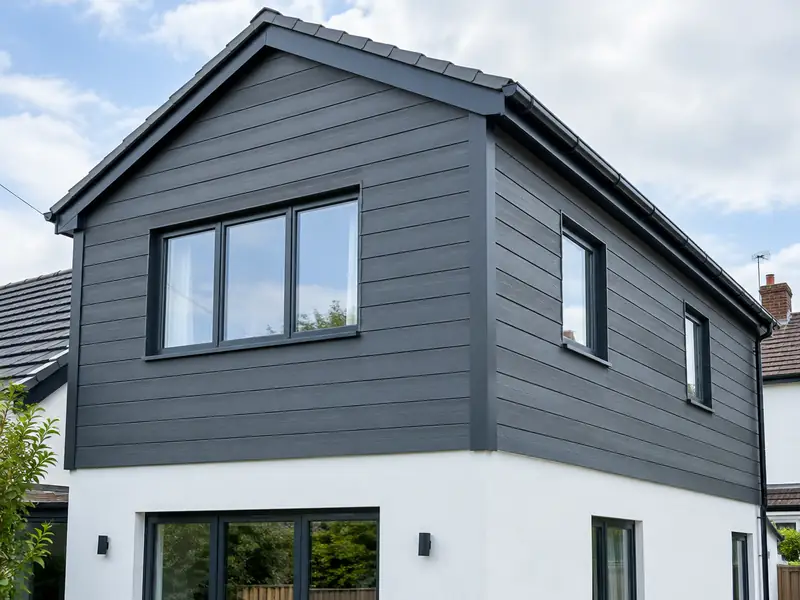
Cladding is a protective outer layer of boards or panels, such as timber, composite, fibre cement or uPVC, fixed to battens on the outside of a wall to change its appearance, shed rain and, where insulation is added, reduce heat loss.
If you have cladding on your list for a property in Newtown, we can help from the first measurements to the final clean-up. For a typical home, plan for 3 days to 3 weeks depending on area, though larger or more complex jobs take longer. We cover postcodes SY16 and nearby Welshpool, Oswestry and Shrewsbury, and every quote we send is fixed for the scope described in it.
- Guide price
- £4,600–£11,000 inc VAT
- Time on site
- 3 days to 3 weeks depending on area
- Postcodes
- SY16
- Planning rules
- Wales
- Local area
- Powys
- Survey
- Free, with a written quote
Cladding prices in Newtown
Below is a breakdown of typical costs for cladding in Newtown. Because rates in Wales are about 8% below the national guide, the overall guide comes to £4,600–£11,000, including VAT. Size, materials and access move the figure, and a free-of-charge survey settles it.
| Type of job | What it usually involves | Guide in Newtown |
|---|---|---|
| Feature area or dormer | A gable, dormer, bay or small feature wall in uPVC, timber or composite. | £1,400–£4,600 |
| Extension or upper storey | About 40–60m² of timber, composite or fibre cement with membrane and battens. | £4,600–£11,000 |
| Whole house | Cladding most elevations of a house, often with added insulation. | £11,000–£27,500 |
Expect these to shape the final quote:
- Wall area to be clad and the height of the building
- Cladding material and board profile
- Insulation behind the cladding
- Scaffolding, access and distance from boundaries
Scope of the work
- Scaffolding or access towers as needed
- Breather membrane and treated battens fixed to the wall
- Insulation behind the cladding where agreed
- Cladding boards fixed with suitable stainless or coated fixings
- Corner trims, window reveals and ventilated top and bottom edges
- Waste removal and a clean site on completion
Building in Newtown
Powys is largely rural, with stone farmhouses and cottages under slate roofs, and timber-framed black-and-white buildings in Montgomeryshire towns near the English border. Brecon has Georgian streets, Llandrindod Wells has Victorian spa-town villas, and towns such as Newtown and Welshpool mix older centres with post-war and newer estates.
Stone and timber-framed homes need breathable lime finishes and careful roof repairs. Rural homes commonly take extensions, porches and driveways, and town terraces suit loft conversions and window replacement.
If your house in Newtown fits one of these patterns, it helps us anticipate what cladding will involve, though we always confirm the details on site.
Permissions for cladding in Newtown
Newtown is in Wales, so the planning and building rules set out below are the ones that apply. We confirm the details with the council before we quote.
In Wales, rendering or cladding may need planning permission in conservation areas, and listed buildings need consent.
Building Regulations in Wales can require insulation upgrades when a large part of an external wall is renovated.
Rules change and every property is different, so we check the planning history and constraints for your address before we quote.
What happens after you get in touch?
We look at the job
We arrange a free site survey on a date convenient to you. We measure up, look at the existing structure and access, and discuss your plans for cladding so the price reflects your home.
Your fixed price
You get the price in writing, itemised so you can see where the money goes. As long as the specification stays the same, that is the price you pay for cladding.
Plan and prepare
We handle the paperwork side: checking whether planning permission or building control approval is needed, submitting applications where they are, and scheduling the trades and materials around your dates.
Build and hand over
The job proceeds in the order set out in the programme, with dust and debris kept under control. Finally we tidy away, inspect the work together and pass the finished project over to you with its paperwork.
Why homeowners choose us
Common questions
How long will cladding take?
On a typical home, allow 3 days to 3 weeks depending on area. Larger projects, older buildings and extra work found once things are opened up can extend that, while simpler jobs may be shorter. Your quote includes an estimate of time on site, and your point of contact keeps you updated on the programme as the work progresses.
Which cladding material needs the least maintenance?
Fibre cement, composite and uPVC cladding need the least upkeep, usually just an occasional wash. Thermally modified and hardwood timber can be left to weather naturally to a silver-grey, which needs no treatment, but keeping the original colour means re-staining every few years. Painted timber needs repainting regularly. We explain the long-term care of each option.
Who do I deal with during the job?
One point of contact manages your project from survey to handover. They schedule the trades working under our contract, keep you updated on progress, and are the person to call with any question. You don't need to coordinate builders, electricians or decorators separately, because that is part of what we do.
Can you clad over existing render or brick?
Cladding is usually fixed over existing render or brick using battens, as long as the wall is sound and dry. Loose render may need removing first so the fixings hold. The battens create a ventilated gap so any moisture can drain and dry. We check the wall during the survey and explain any preparation needed before cladding.
Do I need planning permission to clad my house?
Whether cladding needs planning permission depends on the material and how it changes the look of the house, your home's location, whether it is listed or in a conservation area, and which UK nation you live in. In England, cladding is generally permitted development only if the materials look similar to the existing house, and it is not permitted development in conservation areas. We check before quoting.
Near Newtown
We welcome enquiries from all SY16 postcodes in Newtown, plus Welshpool, Oswestry and Shrewsbury. Each one gets the same survey at no charge and a written price fixed for the work described.