
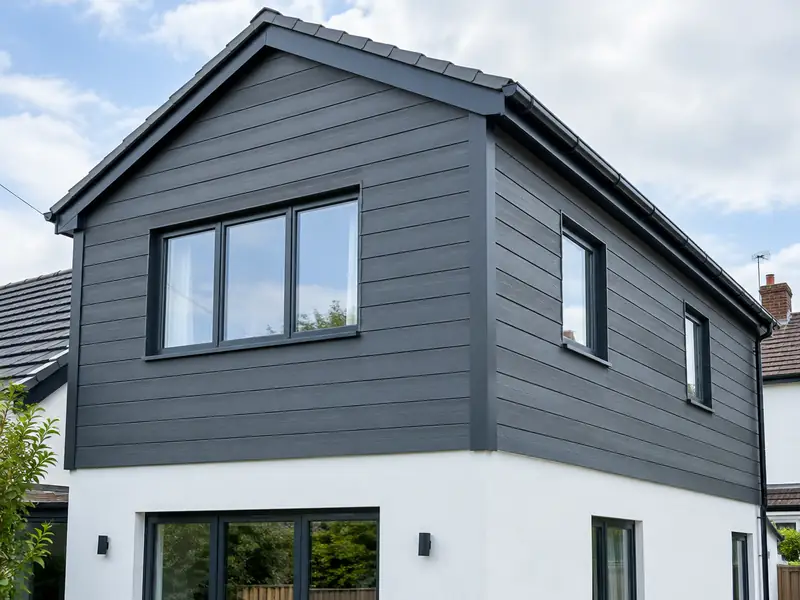
Cladding is a protective outer layer of boards or panels, such as timber, composite, fibre cement or uPVC, fixed to battens on the outside of a wall to change its appearance, shed rain and, where insulation is added, reduce heat loss.
For a homeowner in Erskine, planning cladding tends to begin with two questions: what will it cost, and how disruptive will it be? Our guide range is £4,800–£11,500 including VAT, and a typical job runs to 3 days to 3 weeks depending on area. Both numbers firm up once we have seen the property, measured up and agreed exactly what is included.
- Guide price
- £4,800–£11,500 inc VAT
- Time on site
- 3 days to 3 weeks depending on area
- Postcodes
- G60, G81, PA7 and PA8
- Planning rules
- Scotland
- Local area
- Renfrewshire
- Survey
- Free, with a written quote
How much does cladding cost in Erskine?
No two jobs cost exactly the same, but the ranges below give a fair picture of cladding in Erskine. Pricing for Scotland runs about 4% below the national guide, and the overall guide is £4,800–£11,500 with VAT included. We'll confirm your figure after surveying the property for free.
| Type of job | What it usually involves | Guide in Erskine |
|---|---|---|
| Feature area or dormer | A gable, dormer, bay or small feature wall in uPVC, timber or composite. | £1,450–£4,800 |
| Extension or upper storey | About 40–60m² of timber, composite or fibre cement with membrane and battens. | £4,800–£11,500 |
| Whole house | Cladding most elevations of a house, often with added insulation. | £11,500–£29,000 |
Your price depends mostly on:
- Cladding material and board profile
- Insulation behind the cladding
- Window reveals, corners and roof junctions to detail
- Scaffolding, access and distance from boundaries
What do you get?
- Survey of the wall, boundaries, damp and window details
- Scaffolding or access towers as needed
- Breather membrane and treated battens fixed to the wall
- Cavity barriers and fire-stopping where regulations require
- Cladding boards fixed with suitable stainless or coated fixings
- Waste removal and a clean site on completion
What are homes like around Erskine?
Paisley has sandstone tenements and terraces from its textile era, Greenock and Port Glasgow have tenements and housing climbing the hills above the Clyde, and Gourock and Kilmacolm have Victorian villas. Post-war estates and newer private housing surround the towns, and roughcast is a common finish.
Roughcast and tenement buildings commonly need re-rendering, window replacement and roof work. Villas suit kitchen extensions and landscaping, and semis often take loft conversions and driveways.
That mix of housing shapes how we approach cladding in Erskine: the age and construction of your home affect the materials, the method and, in the end, the price.
Planning and building rules in Erskine
Erskine is in Scotland, so the planning and building rules set out below are the ones that apply. We confirm the details with the council before we quote.
In Scotland, changing the external finish of a house in a conservation area or on a listed building needs consent; elsewhere, like-for-like re-rendering is usually treated as repair.
Large-scale re-cladding or external insulation can need a building warrant; like-for-like render repairs normally do not.
Rules change and every property is different, so we check the planning history and constraints for your address before we quote.
The four stages
Free site survey
First, someone visits your home in Erskine to see the space, take measurements and note anything that could affect the work, such as access or the condition of what is there. There is no charge for this visit.
Written quote
We put everything into a written, fixed-price quote: the specification, what's excluded, staged payments and the expected time on site. Take whatever time you need to decide; there's no pressure to commit.
Plan and prepare
We handle the paperwork side: checking whether planning permission or building control approval is needed, submitting applications where they are, and scheduling the trades and materials around your dates.
The work itself
Work goes ahead as scheduled and you deal with one contact throughout. When the last trade leaves, we clear and clean the site, talk you through what has been done and pass on any certificates and care instructions.
What you can expect from us
Common questions
Do you cover Clydebank, Renfrew and Bearsden?
Yes. As well as Erskine, we cover Clydebank, Renfrew and Bearsden and the rest of Renfrewshire and Inverclyde. Our coverage is UK-wide, so the process is the same wherever you are: a free site survey, a quote in writing that fixes the price for the agreed scope, and one point of contact while the work is planned and carried out.
How long will cladding take?
On a typical home, allow 3 days to 3 weeks depending on area. Larger projects, older buildings and extra work found once things are opened up can extend that, while simpler jobs may be shorter. Your quote includes an estimate of time on site, and your point of contact keeps you updated on the programme as the work progresses.
Do I need planning permission to clad my house?
Whether cladding needs planning permission depends on the material and how it changes the look of the house, your home's location, whether it is listed or in a conservation area, and which UK nation you live in. In England, cladding is generally permitted development only if the materials look similar to the existing house, and it is not permitted development in conservation areas. We check before quoting.
Will timber cladding change colour?
Untreated timber cladding naturally weathers to a silver-grey over a year or two as sunlight breaks down the surface. The change can be uneven at first, especially under eaves where rain does not reach. If you want to keep the original colour, a UV-protective stain or oil is needed and must be renewed every few years. Pre-weathered and coated boards are also available.
Which cladding material needs the least maintenance?
Fibre cement, composite and uPVC cladding need the least upkeep, usually just an occasional wash. Thermally modified and hardwood timber can be left to weather naturally to a silver-grey, which needs no treatment, but keeping the original colour means re-staining every few years. Painted timber needs repainting regularly. We explain the long-term care of each option.
Near Erskine
If your address falls within G60, G81, PA7 and PA8, we cover it. The same goes for neighbouring Clydebank, Renfrew and Bearsden, which we include alongside Erskine when arranging surveys and quotes.