
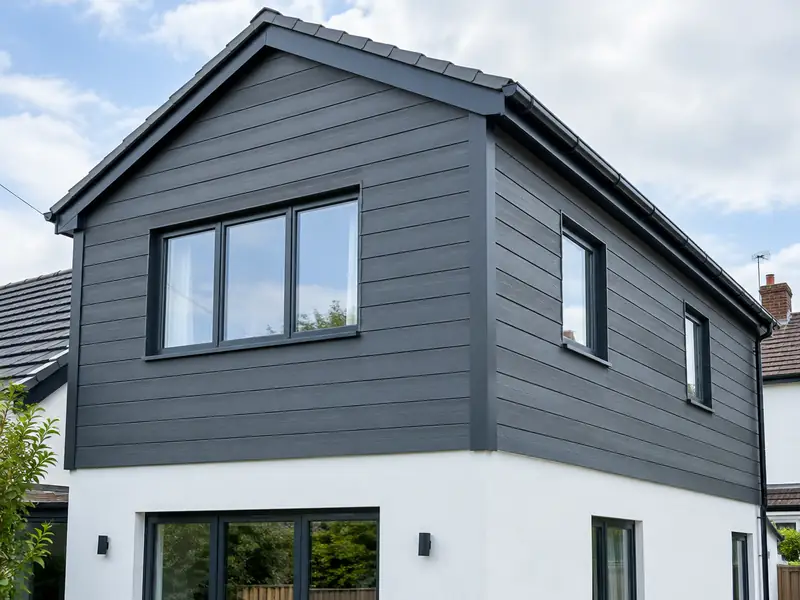
Cladding is a protective outer layer of boards or panels, such as timber, composite, fibre cement or uPVC, fixed to battens on the outside of a wall to change its appearance, shed rain and, where insulation is added, reduce heat loss.
Whatever prompted you to look into cladding, whether wear and tear, a growing family or plans to move, we can survey your Barry home and give you a price in writing. Homes in Wales typically come in at £4,600–£11,000, VAT included, for this kind of work. We also cover Penarth, Cardiff and Llantwit Major, and the same steps apply wherever you are in South Glamorgan.
- Guide price
- £4,600–£11,000 inc VAT
- Time on site
- 3 days to 3 weeks depending on area
- Postcodes
- CF62 and CF63
- Planning rules
- Wales
- Local area
- The Vale of Glamorgan
- Survey
- Free, with a written quote
How much does cladding cost in Barry?
Prices for cladding vary from house to house, but in Barry most projects fall within £4,600–£11,000 including VAT. That reflects costs in Wales, about 8% below the national guide. Treat the table as a budgeting aid; the written figure follows a survey we carry out for free.
| Type of job | What it usually involves | Guide in Barry |
|---|---|---|
| Feature area or dormer | A gable, dormer, bay or small feature wall in uPVC, timber or composite. | £1,400–£4,600 |
| Extension or upper storey | About 40–60m² of timber, composite or fibre cement with membrane and battens. | £4,600–£11,000 |
| Whole house | Cladding most elevations of a house, often with added insulation. | £11,000–£27,500 |
What moves the price up or down:
- Wall area to be clad and the height of the building
- Insulation behind the cladding
- Window reveals, corners and roof junctions to detail
- Scaffolding, access and distance from boundaries
What does the job include in Barry?
- Scaffolding or access towers as needed
- Breather membrane and treated battens fixed to the wall
- Insulation behind the cladding where agreed
- Cladding boards fixed with suitable stainless or coated fixings
- Corner trims, window reveals and ventilated top and bottom edges
- Waste removal and a clean site on completion
What are homes like around Barry?
Cardiff has large areas of bay-fronted Victorian and Edwardian terraces in districts such as Roath, Canton and Cathays, plus interwar suburbs, post-war estates and modern flats around Cardiff Bay. Penarth has Victorian villas, Barry mixes terraces with newer estates, and Vale of Glamorgan villages are often built of local limestone.
Terraces commonly suit loft conversions, side-return and rear extensions, and bay window renewal. Suburban semis take side extensions and driveways, and stone village homes need lime-based repairs.
In Barry, as elsewhere in South Glamorgan, we take the building's age and construction into account before recommending anything, because both can change what is involved in cladding.
Permissions for cladding in Barry
Homes in Barry come under the regulations for Wales, summarised below. We don't rely on general rules alone: we confirm the position for your address with the council before a quote goes out.
In Wales, rendering or cladding may need planning permission in conservation areas, and listed buildings need consent.
Building Regulations in Wales can require insulation upgrades when a large part of an external wall is renovated.
Rules change and every property is different, so we check the planning history and constraints for your address before we quote.
What happens after you get in touch?
A visit to your home
First, someone visits your home in Barry to see the space, take measurements and note anything that could affect the work, such as access or the condition of what is there. There is no charge for this visit.
Quote in writing
We put everything into a written, fixed-price quote: the specification, what's excluded, staged payments and the expected time on site. Take whatever time you need to decide; there's no pressure to commit.
Booking the work
We handle the paperwork side: checking whether planning permission or building control approval is needed, submitting applications where they are, and scheduling the trades and materials around your dates.
Build and hand over
Work goes ahead as scheduled and you deal with one contact throughout. When the last trade leaves, we clear and clean the site, talk you through what has been done and pass on any certificates and care instructions.
How we work
Frequently asked questions
Can cladding improve insulation?
Cladding can improve insulation if insulation boards are fixed to the wall behind the battens, which reduces heat loss and can help with cold or damp internal walls. This adds thickness, so window reveals, sills and roof edges need careful detailing. Cladding alone, without insulation, adds very little warmth. We can price both options so you can compare.
Is the price fixed?
Yes, for the specification we agree. Your written quote sets out exactly what is included at a fixed price. It only changes if you ask for something different, or if a problem the survey could not reasonably reveal later needs extra work. In either case we explain the change and confirm it in writing before going ahead.
How much does house cladding cost?
Cladding around 40–60m² of wall, such as an extension or upper storey, costs £4,600–£11,000, including membrane, battens and trims. As a guide, allow roughly £80–£180 per square metre plus fixed costs for scaffolding and set-up. uPVC and softwood sit at the lower end, while hardwood, composite and fibre cement cost more. Adding insulation increases the price. We confirm a fixed figure after the survey.
Which postcodes in Barry do you cover?
We cover CF62 and CF63, along with the rest of South Glamorgan. If your postcode is not listed, get in touch anyway: our coverage is UK-wide, and we can usually arrange a survey wherever you live. Enter your postcode in the guide-price tool or contact form and we will confirm.
Are there fire-safety rules for cladding?
Building regulations limit the fire-spread performance of cladding on walls close to a boundary and on taller buildings, which can rule out some timber or composite products in those positions. Cavity barriers behind the cladding also help stop fire spreading through the gap. Fibre cement is non-combustible. We check boundary distances and product data before recommending a material.
Nearby towns
Live in Barry? Our coverage takes in the CF62 and CF63 postcode areas and reaches out to Penarth, Cardiff and Llantwit Major, so homes on the outskirts and in the next town along are included.