
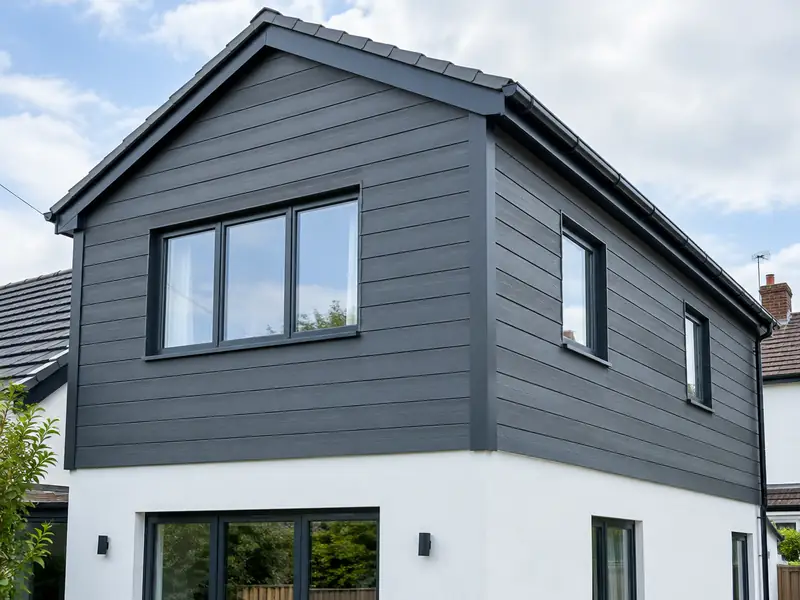
Cladding is a protective outer layer of boards or panels, such as timber, composite, fibre cement or uPVC, fixed to battens on the outside of a wall to change its appearance, shed rain and, where insulation is added, reduce heat loss.
Homeowners in Liversedge usually consider cladding for one of a few reasons: something has worn out, the house no longer suits the way they live, or they are getting it ready to sell. We visit, agree a specification and put a fixed price in writing. Most jobs like this take 3 days to 3 weeks depending on area, and we work across West Yorkshire, including Heckmondwike, Cleckheaton and Mirfield.
- Guide price
- £4,700–£11,500 inc VAT
- Time on site
- 3 days to 3 weeks depending on area
- Postcodes
- BD19, WF13, WF14, WF15 and WF16
- Planning rules
- England
- Local area
- Kirklees
- Survey
- Free, with a written quote
Cladding prices in Liversedge
Prices for cladding vary from house to house, but in Liversedge most projects fall within £4,700–£11,500 including VAT. That reflects costs in Yorkshire and the Humber, about 6% below the national guide. Treat the table as a budgeting aid; the written figure follows a survey we carry out for free.
| Type of job | What it usually involves | Guide in Liversedge |
|---|---|---|
| Feature area or dormer | A gable, dormer, bay or small feature wall in uPVC, timber or composite. | £1,400–£4,700 |
| Extension or upper storey | About 40–60m² of timber, composite or fibre cement with membrane and battens. | £4,700–£11,500 |
| Whole house | Cladding most elevations of a house, often with added insulation. | £11,500–£28,000 |
The main things that change the figure:
- Wall area to be clad and the height of the building
- Cladding material and board profile
- Insulation behind the cladding
- Window reveals, corners and roof junctions to detail
What does the job include in Liversedge?
- Survey of the wall, boundaries, damp and window details
- Breather membrane and treated battens fixed to the wall
- Insulation behind the cladding where agreed
- Cladding boards fixed with suitable stainless or coated fixings
- Corner trims, window reveals and ventilated top and bottom edges
- Waste removal and a clean site on completion
Homes in West Yorkshire
Leeds and Bradford are known for back-to-back and through terraces, many in sandstone or millstone grit, with stone-slate roofs on older properties. Halifax, Huddersfield and the Calder valley have mill-town stone terraces climbing steep hillsides, and interwar semis, post-war estates and newer housing surround the larger towns.
Back-to-backs and through terraces often suit dormer loft conversions and careful kitchen layouts. Stone properties commonly need repointing with suitable mortar, roof repairs and window replacement, and hillside plots can need retaining walls.
Whatever era your Liversedge home dates from, we plan cladding around how it is actually built rather than a one-size-fits-all specification.
Planning and building rules in Liversedge
Homes in Liversedge come under the regulations for England, summarised below. We don't rely on general rules alone: we confirm the position for your address with the council before a quote goes out.
In England, re-rendering or cladding a house is often allowed without planning permission, but stone, render, timber, plastic or tile cladding is not permitted development in conservation areas, and listed buildings need consent.
If you render or re-clad more than 25% of an external wall, Building Regulations usually require the wall’s insulation to be improved where that is practical, and building control should be notified.
Rules change and every property is different, so we check the planning history and constraints for your address before we quote.
What happens after you get in touch?
We look at the job
First, someone visits your home in Liversedge to see the space, take measurements and note anything that could affect the work, such as access or the condition of what is there. There is no charge for this visit.
Written quote
You get the price in writing, itemised so you can see where the money goes. As long as the specification stays the same, that is the price you pay for cladding.
Dates and permissions
Before anyone starts, we confirm the programme in writing, check whether consents are required and arrange deliveries. If a skip or scaffolding on the road needs a permit, we apply for it.
The work itself
Our trades complete cladding while your point of contact keeps you updated. When everything is finished, we clear the site, take away waste and go through the result with you before handover.
How we work
Questions about cladding in Liversedge
How much does house cladding cost?
Cladding around 40–60m² of wall, such as an extension or upper storey, costs £4,700–£11,500, including membrane, battens and trims. As a guide, allow roughly £80–£180 per square metre plus fixed costs for scaffolding and set-up. uPVC and softwood sit at the lower end, while hardwood, composite and fibre cement cost more. Adding insulation increases the price. We confirm a fixed figure after the survey.
How long will cladding take?
On a typical home, allow 3 days to 3 weeks depending on area. Larger projects, older buildings and extra work found once things are opened up can extend that, while simpler jobs may be shorter. Your quote includes an estimate of time on site, and your point of contact keeps you updated on the programme as the work progresses.
Do you cover Heckmondwike, Cleckheaton and Mirfield?
Yes. As well as Liversedge, we cover Heckmondwike, Cleckheaton and Mirfield and the rest of West Yorkshire. Our coverage is UK-wide, so the process is the same wherever you are: a free site survey, a quote in writing that fixes the price for the agreed scope, and one point of contact while the work is planned and carried out.
Do I need planning permission to clad my house?
Whether cladding needs planning permission depends on the material and how it changes the look of the house, your home's location, whether it is listed or in a conservation area, and which UK nation you live in. In England, cladding is generally permitted development only if the materials look similar to the existing house, and it is not permitted development in conservation areas. We check before quoting.
Can you clad over existing render or brick?
Cladding is usually fixed over existing render or brick using battens, as long as the wall is sound and dry. Loose render may need removing first so the fixings hold. The battens create a ventilated gap so any moisture can drain and dry. We check the wall during the survey and explain any preparation needed before cladding.
Also covering areas around Liversedge
Addresses in BD19, WF13, WF14 and WF15 are all covered for Liversedge, along with Heckmondwike, Cleckheaton and Mirfield close by. Give us your postcode when you get in touch and we will confirm the details.