
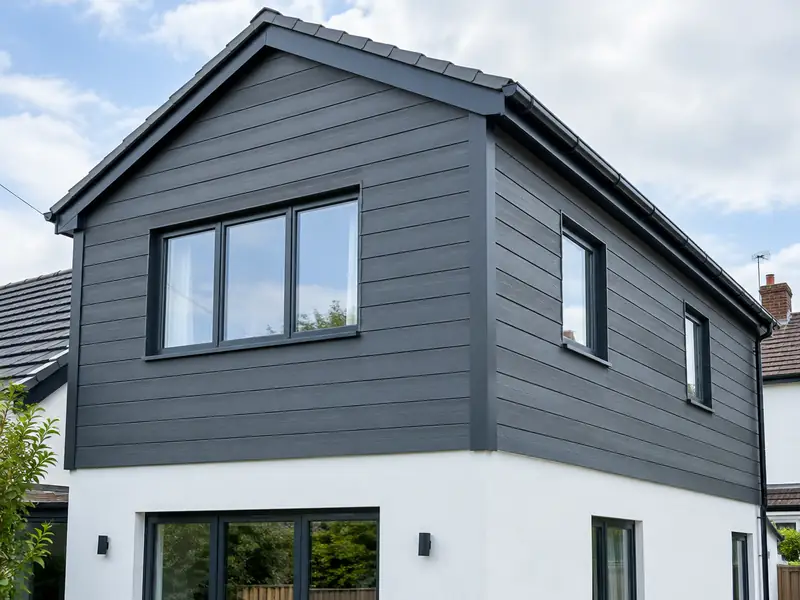
Cladding is a protective outer layer of boards or panels, such as timber, composite, fibre cement or uPVC, fixed to battens on the outside of a wall to change its appearance, shed rain and, where insulation is added, reduce heat loss.
We arrange cladding for homeowners in Salisbury and the wider Wiltshire. The job is planned, priced and managed by us and carried out by tradespeople engaged under our contract, so there is one agreement and one contact. On a typical home the work takes 3 days to 3 weeks depending on area, and guide pricing in the South West is £5,100–£12,000, VAT included.
- Guide price
- £5,100–£12,000 inc VAT
- Time on site
- 3 days to 3 weeks depending on area
- Postcodes
- SP1 and SP2
- Planning rules
- England
- Local area
- Wiltshire
- Survey
- Free, with a written quote
Cladding prices in Salisbury
What should you budget for cladding in Salisbury? Use the figures below as a starting point. Prices in the South West sit about 2% above the national guide, so the range here is £5,100–£12,000 including VAT. Your fixed price comes in writing once we've surveyed the property, at no charge.
| Type of job | What it usually involves | Guide in Salisbury |
|---|---|---|
| Feature area or dormer | A gable, dormer, bay or small feature wall in uPVC, timber or composite. | £1,550–£5,100 |
| Extension or upper storey | About 40–60m² of timber, composite or fibre cement with membrane and battens. | £5,100–£12,000 |
| Whole house | Cladding most elevations of a house, often with added insulation. | £12,000–£30,500 |
Your price depends mostly on:
- Wall area to be clad and the height of the building
- Cladding material and board profile
- Window reveals, corners and roof junctions to detail
- Scaffolding, access and distance from boundaries
What’s included?
- Survey of the wall, boundaries, damp and window details
- Breather membrane and treated battens fixed to the wall
- Insulation behind the cladding where agreed
- Cavity barriers and fire-stopping where regulations require
- Cladding boards fixed with suitable stainless or coated fixings
- Corner trims, window reveals and ventilated top and bottom edges
Homes in Wiltshire
Salisbury has medieval and Georgian streets, the north-west around Corsham and Bradford on Avon uses Bath stone, and chalk and flint appear on the downland. Swindon has railway-village terraces and very large post-war and modern estates, and many Wiltshire villages have thatched cottages, some with chalk cob walls.
Cob and Bath stone walls need breathable, lime-based repairs, and thatched cottages may need careful roof work. Swindon's railway terraces suit loft rooms and rear extensions, while its large estates often add garage conversions, driveways and landscaping.
With that background in mind, here is how we typically handle cladding for homes in Salisbury, from the first visit to the finished result.
Planning and building rules in Salisbury
The notes below cover England, which is where Salisbury sits. Rules change and every property is different, so we speak to the council before pricing your job.
In England, re-rendering or cladding a house is often allowed without planning permission, but stone, render, timber, plastic or tile cladding is not permitted development in conservation areas, and listed buildings need consent.
If you render or re-clad more than 25% of an external wall, Building Regulations usually require the wall’s insulation to be improved where that is practical, and building control should be notified.
Rules change and every property is different, so we check the planning history and constraints for your address before we quote.
How does the job run?
Survey and measure
We begin by looking at the job in person. During the free survey we discuss options, materials and budget for cladding, and photograph or measure anything the quote needs to reflect.
Quote in writing
We turn the survey notes into a written quote. The price is fixed for the specification we agree, and the document sets out materials, scope and payment stages in plain language.
Dates and permissions
With the quote agreed, we book the work in and handle preparation: permissions where needed, building control notifications, material orders and access arrangements for your Salisbury property.
Build and hand over
Our trades complete cladding while your point of contact keeps you updated. When everything is finished, we clear the site, take away waste and go through the result with you before handover.
How we work
Questions about cladding in Salisbury
Will timber cladding change colour?
Untreated timber cladding naturally weathers to a silver-grey over a year or two as sunlight breaks down the surface. The change can be uneven at first, especially under eaves where rain does not reach. If you want to keep the original colour, a UV-protective stain or oil is needed and must be renewed every few years. Pre-weathered and coated boards are also available.
Do you cover Andover, Totton and Southampton?
Yes. As well as Salisbury, we cover Andover, Totton and Southampton and the rest of Wiltshire. Our coverage is UK-wide, so the process is the same wherever you are: a free site survey, a quote in writing that fixes the price for the agreed scope, and one point of contact while the work is planned and carried out.
Do I need planning permission to clad my house?
Whether cladding needs planning permission depends on the material and how it changes the look of the house, your home's location, whether it is listed or in a conservation area, and which UK nation you live in. In England, cladding is generally permitted development only if the materials look similar to the existing house, and it is not permitted development in conservation areas. We check before quoting.
Are there fire-safety rules for cladding?
Building regulations limit the fire-spread performance of cladding on walls close to a boundary and on taller buildings, which can rule out some timber or composite products in those positions. Cavity barriers behind the cladding also help stop fire spreading through the gap. Fibre cement is non-combustible. We check boundary distances and product data before recommending a material.
What happens at the survey?
We visit your home at a time that suits you, look at the area involved, take measurements and check access, condition and any services that might be affected. We talk through what you want from cladding, explain the options and answer questions. There is no charge and no obligation; afterwards we send a written quote.
Nearby towns
We survey and quote throughout Salisbury's SP1 and SP2 postcodes and in surrounding places such as Andover, Totton and Southampton. The process and pricing approach are identical in each of them.