
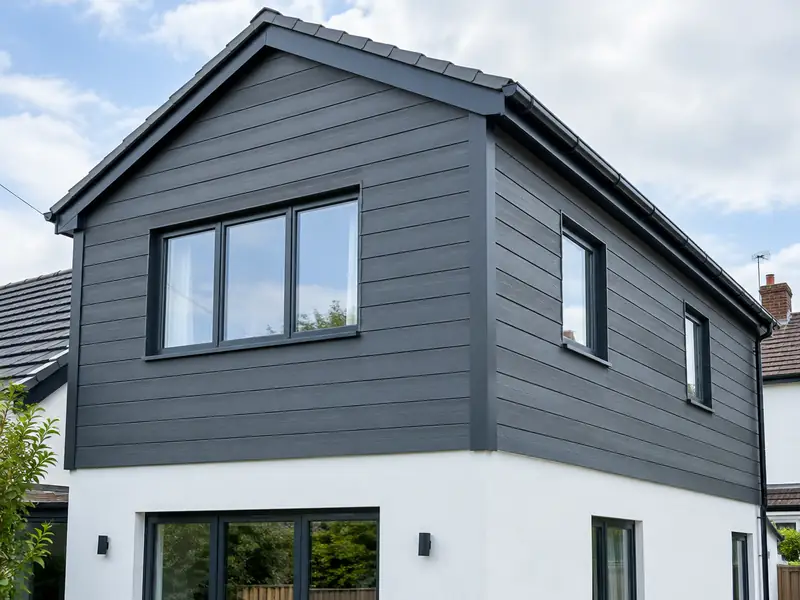
Cladding is a protective outer layer of boards or panels, such as timber, composite, fibre cement or uPVC, fixed to battens on the outside of a wall to change its appearance, shed rain and, where insulation is added, reduce heat loss.
Whether you live in one of the larger towns, such as Worcester, Redditch, Kidderminster and Great Malvern, or somewhere quieter in Worcestershire, the way we handle cladding is identical. We survey, agree the specification with you, and confirm a fixed price on paper. Everything is planned under the regulations in force in England, and guide costs in the West Midlands sit at £4,900–£12,000 with VAT.
- Guide price
- £4,900–£12,000 inc VAT
- Time on site
- 3 days to 3 weeks depending on area
- Planning rules
- England
- Price level
- About 2% below the national guide
- Towns listed
- 8
- Survey
- Free, with a written quote
How much does cladding cost in Worcestershire?
Budgeting for cladding in Worcestershire? The numbers below include VAT and are adjusted for the West Midlands, where costs are about 2% below the national guide. The headline range is £4,900–£12,000. Nothing is final until we have measured up at a free survey and agreed the specification with you.
| Type of job | What it usually involves | Guide in Worcestershire |
|---|---|---|
| Feature area or dormer | A gable, dormer, bay or small feature wall in uPVC, timber or composite. | £1,450–£4,900 |
| Extension or upper storey | About 40–60m² of timber, composite or fibre cement with membrane and battens. | £4,900–£12,000 |
| Whole house | Cladding most elevations of a house, often with added insulation. | £12,000–£29,500 |
Your price depends mostly on:
- Wall area to be clad and the height of the building
- Cladding material and board profile
- Insulation behind the cladding
- Window reveals, corners and roof junctions to detail
Scope of the work
- Scaffolding or access towers as needed
- Breather membrane and treated battens fixed to the wall
- Insulation behind the cladding where agreed
- Cavity barriers and fire-stopping where regulations require
- Cladding boards fixed with suitable stainless or coated fixings
- Waste removal and a clean site on completion
Housing across Worcestershire
Worcester has Georgian and Victorian streets and interwar suburbs, black-and-white timber framing survives in many villages, and Malvern has Victorian villas, some built in Malvern stone. Redditch was expanded as a new town from the 1960s, Kidderminster has carpet-era terraces, and Bromsgrove and Evesham mix older centres with newer estates.
Timber-framed and stone buildings call for lime plaster and careful repairs. Terraces suit loft conversions and rear extensions, and new-town homes often take window, roofline and cladding renewal.
The Severn and Teme flood regularly, and the Malvern Hills are more exposed to wind and rain than the Vale of Evesham.
Do you need permission in Worcestershire?
As Worcestershire is in England, read the following with that system of planning and building control in mind. We check what applies to your house with the council before you receive a quote.
In England, re-rendering or cladding a house is often allowed without planning permission, but stone, render, timber, plastic or tile cladding is not permitted development in conservation areas, and listed buildings need consent.
If you render or re-clad more than 25% of an external wall, Building Regulations usually require the wall’s insulation to be improved where that is practical, and building control should be notified.
Rules change and every property is different, so we check the planning history and constraints for your address before we quote.
The four stages
We look at the job
Book a visit and we'll come to you. The survey covers measurements, the state of what's there now and any obvious constraints, so the price that follows is based on your actual home, not an average.
Price and scope agreed
After the survey we send a quote for cladding that fixes the price for the scope we've agreed. If you want to change materials or scope, we revise it in writing before anything is booked.
Booking the work
Before anyone starts, we confirm the programme in writing, check whether consents are required and arrange deliveries. If a skip or scaffolding on the road needs a permit, we apply for it.
Finish and handover
The work is carried out to the agreed specification, with floors and furniture protected and the site kept tidy. At the end we clean up, walk through the finished job with you and hand over any certificates.
How we work
Questions about cladding in Worcestershire
Can you combine cladding with other work?
Yes. Because we manage several trades under one contract, we can plan cladding alongside other work on your Worcestershire home, such as new windows with rendering, or a kitchen refit with an extension. Combining jobs can reduce repeat set-up such as scaffolding, skips and access, and every element is listed and priced in the same written quote.
Can cladding improve insulation?
Cladding can improve insulation if insulation boards are fixed to the wall behind the battens, which reduces heat loss and can help with cold or damp internal walls. This adds thickness, so window reveals, sills and roof edges need careful detailing. Cladding alone, without insulation, adds very little warmth. We can price both options so you can compare.
Are there fire-safety rules for cladding?
Building regulations limit the fire-spread performance of cladding on walls close to a boundary and on taller buildings, which can rule out some timber or composite products in those positions. Cavity barriers behind the cladding also help stop fire spreading through the gap. Fibre cement is non-combustible. We check boundary distances and product data before recommending a material.
Do I need planning permission in Worcestershire?
It depends on the work, the size of the project, your property type and whether the building is listed or in a conservation area. Worcestershire is in England, so England's rules apply. Many smaller jobs need no planning application, but some still need building control approval. We check what applies to your address before quoting.
Can you clad over existing render or brick?
Cladding is usually fixed over existing render or brick using battens, as long as the wall is sound and dry. Loose render may need removing first so the fixings hold. The battens create a ventilated gap so any moisture can drain and dry. We check the wall during the survey and explain any preparation needed before cladding.
Towns in Worcestershire
Homes in all of the following Worcestershire towns can get a written quote for cladding. Open a town page to see prices and the postcodes we cover.