
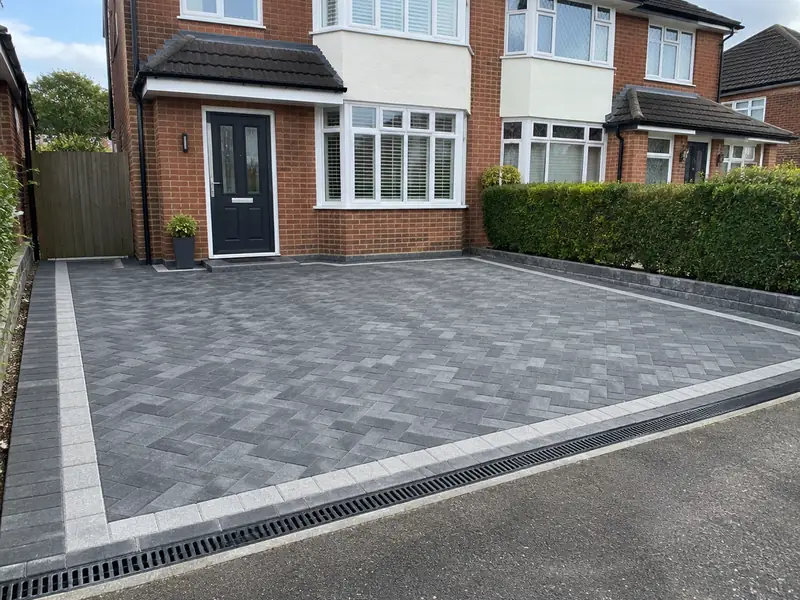
A new driveway is a hard-wearing surface for parking, such as block paving, resin bound gravel, tarmac or gravel, laid on an excavated and compacted sub-base with edging and drainage designed to carry vehicle loads and handle rainwater.
If you are planning a new driveway anywhere in Ayrshire, including Kilmarnock, Ayr, Irvine and Kilwinning, we can visit, measure up and talk through the options. The planning and building regulations we work to are those for Scotland, and we check them for your address before quoting. Prices remain guide figures for Scotland, at £3,800–£8,600 including VAT, until the survey is done.
- Guide price
- £3,800–£8,600 inc VAT
- Time on site
- 3–7 days on site
- Planning rules
- Scotland
- Price level
- About 4% below the national guide
- Towns listed
- 4
- Survey
- Free, with a written quote
How much does a new driveway cost in Ayrshire?
What should you budget for a new driveway in Ayrshire? Use the figures below as a starting point. Prices in Scotland sit about 4% below the national guide, so the range here is £3,800–£8,600 including VAT. Your fixed price comes in writing once we've surveyed the property, at no charge.
| Type of job | What it usually involves | Guide in Ayrshire |
|---|---|---|
| Gravel or tarmac | A typical 40–50m² drive in gravel on a grid, or tarmac with block edging. | £1,900–£4,800 |
| Block paving or resin bound | A typical 40–50m² drive with sub-base, edging and drainage. | £3,800–£8,600 |
| Large or premium driveway | Larger drives, natural stone, walls, steps or a new dropped kerb. | £7,700–£15,500 |
The main things that change the figure:
- Driveway area and the depth of excavation needed
- Surface: gravel, tarmac, block paving, resin or stone
- Edging, steps, walls and manhole adjustments
- Access for machinery and removal of spoil
What do you get?
- Survey of levels, drainage, manholes and access
- Excavation and removal of the old surface and soil
- Edging kerbs or restraints to hold the surface in place
- Drainage channels or soakaway where needed
- Manhole covers raised or replaced to new levels
- New surface laid, compacted and finished
Homes in Ayrshire
Ayr, Kilmarnock and the coastal towns from Largs to Girvan have Victorian sandstone villas and terraces, with red sandstone common in older buildings. Former mining villages have rows of cottages, Irvine was developed as a new town from the 1960s, and harled post-war houses and newer estates are found across the area.
Sandstone homes need careful repointing and stone repairs, and harled houses commonly need re-rendering. Villas and semis suit extensions and loft conversions, and coastal homes often take window and roofline renewal.
The Firth of Clyde coast is exposed to westerly winds, salt and frequent rain, which affects render, roofs and window seals.
Do you need permission in Ayrshire?
Because Ayrshire falls under Scotland's rules, the guidance below is the version relevant to you. Before sending a price, we check your property's position with the council.
In Scotland, a hard surface in front of a house is usually permitted development if it is permeable or drains within the property. A dropped kerb or road opening needs consent from the council as roads authority.
A building warrant is not normally needed for a driveway.
Rules change and every property is different, so we check the planning history and constraints for your address before we quote.
From survey to handover
Free site survey
It starts with a survey at the property, free of charge. We check condition, access and services, ask how you want the finished result to look, and answer any questions you have about a new driveway.
Written quote
After the survey we send a quote for a new driveway that fixes the price for the scope we've agreed. If you want to change materials or scope, we revise it in writing before anything is booked.
Plan and prepare
Once you accept, we agree start dates, order materials and deal with any planning, building control or neighbour notices the job needs. You'll know who is coming and when before work begins.
Finish and handover
The job proceeds in the order set out in the programme, with dust and debris kept under control. Finally we tidy away, inspect the work together and pass the finished project over to you with its paperwork.
How we work
Questions about a new driveway in Ayrshire
How long does it take to lay a driveway?
Laying a typical driveway takes around three to seven days, depending on size, surface and ground conditions. Excavation and sub-base usually take the first few days, then edging, drainage and the surface. Resin needs dry weather and time to cure, and you will usually need to keep cars off for a short period afterwards. We confirm timings and access arrangements with your quote.
Can I use my car during the work?
You will not be able to park on the driveway while it is being dug out and laid, so plan to park on the street or nearby for the duration. We keep a safe pedestrian route to your front door where possible. After completion, block paving and tarmac can usually be driven on straight away, while resin and concrete need a short curing period first.
Which postcodes in Ayrshire do you cover?
We cover KA1, KA7, KA11 and KA13, along with the rest of Ayrshire. If your postcode is not listed, get in touch anyway: our coverage is UK-wide, and we can usually arrange a survey wherever you live. Enter your postcode in the guide-price tool or contact form and we will confirm.
What is a sub-base and why does it matter?
The sub-base is the layer of crushed, compacted stone beneath the driveway surface that spreads the weight of vehicles into the ground. Most driveway failures, such as sinking, rutting and loose blocks, come from a sub-base that is too thin or poorly compacted. We excavate to the right depth for your soil and compact the sub-base in layers before laying the surface.
Do you cover Kilmarnock, Ayr and Irvine?
Yes. As well as Ayrshire, we cover Kilmarnock, Ayr and Irvine and the rest of Ayrshire. Our coverage is UK-wide, so the process is the same wherever you are: a free site survey, a quote in writing that fixes the price for the agreed scope, and one point of contact while the work is planned and carried out.
Towns in Ayrshire
These are the towns in Ayrshire where you can book a free survey for a new driveway. Each has its own page with guide prices and coverage details.