
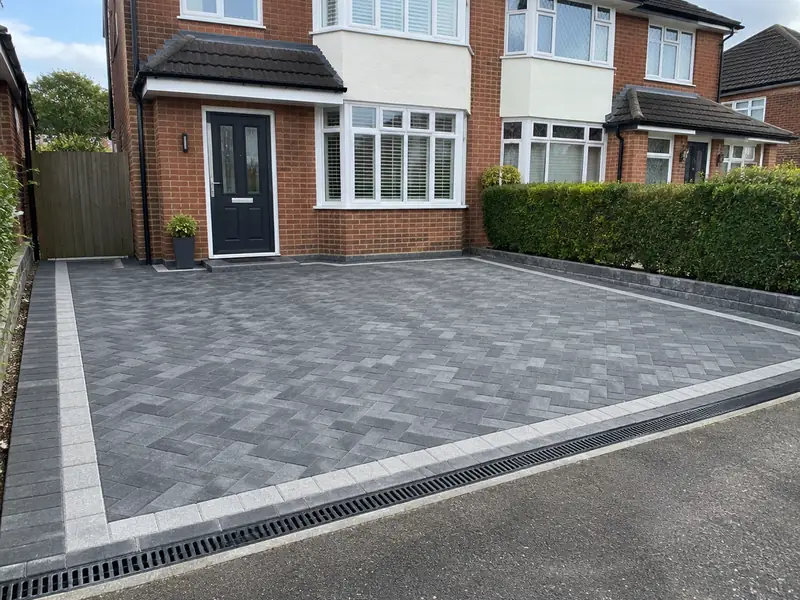
A new driveway is a hard-wearing surface for parking, such as block paving, resin bound gravel, tarmac or gravel, laid on an excavated and compacted sub-base with edging and drainage designed to carry vehicle loads and handle rainwater.
Thinking about a new driveway in Belfast? We take charge of the whole project, co-ordinating every trade involved, and one person keeps you updated. Guide prices for Northern Ireland sit at £3,400–£7,700 including VAT, and a typical job takes 3–7 days on site. Your own figure depends on what the survey finds and the specification you settle on.
- Guide price
- £3,400–£7,700 inc VAT
- Time on site
- 3–7 days on site
- Postcodes
- BT1, BT2, BT6, BT7 and BT12
- Planning rules
- Northern Ireland
- Local area
- County Antrim
- Survey
- Free, with a written quote
How much does a new driveway cost in Belfast?
Here is how the guide price for a new driveway breaks down in Belfast. We start from national figures and adjust for Northern Ireland, which comes out about 14% below the national guide. The resulting range, VAT included, is £3,400–£7,700, and a survey, at no cost to you, firms it up.
| Type of job | What it usually involves | Guide in Belfast |
|---|---|---|
| Gravel or tarmac | A typical 40–50m² drive in gravel on a grid, or tarmac with block edging. | £1,700–£4,300 |
| Block paving or resin bound | A typical 40–50m² drive with sub-base, edging and drainage. | £3,400–£7,700 |
| Large or premium driveway | Larger drives, natural stone, walls, steps or a new dropped kerb. | £6,900–£14,000 |
What moves the price up or down:
- Driveway area and the depth of excavation needed
- Drainage, soakaways and changes in level
- Edging, steps, walls and manhole adjustments
- Access for machinery and removal of spoil
Scope of the work
- Survey of levels, drainage, manholes and access
- Excavation and removal of the old surface and soil
- Edging kerbs or restraints to hold the surface in place
- Manhole covers raised or replaced to new levels
- New surface laid, compacted and finished
- Site cleared and waste removed
Building in Belfast
Belfast has long rows of red-brick Victorian terraces, Edwardian villas in the north and south of the city and large post-war estates, while towns such as Ballymena, Antrim, Larne and Carrickfergus mix terraces, semis and newer developments. Dark basalt appears in older rural buildings, and pebbledash or roughcast is a very common finish.
Terraces suit loft conversions and rear extensions, and many need window and roof renewal. Pebbledashed homes commonly need re-rendering, and detached rural houses often take extensions, porches and driveways.
If your house in Belfast fits one of these patterns, it helps us anticipate what a new driveway will involve, though we always confirm the details on site.
Permissions for a new driveway in Belfast
Homes in Belfast come under the regulations for Northern Ireland, summarised below. We don't rely on general rules alone: we confirm the position for your address with the council before a quote goes out.
In Northern Ireland, hard surfaces around a house are often permitted development, but check that surface water drains within your property. A dropped kerb needs consent from DfI Roads.
Building control approval is not normally needed for a driveway.
Rules change and every property is different, so we check the planning history and constraints for your address before we quote.
What happens after you get in touch?
A visit to your home
We arrange a free site survey on a date convenient to you. We measure up, look at the existing structure and access, and discuss your plans for a new driveway so the price reflects your home.
Your fixed price
You get the price in writing, itemised so you can see where the money goes. As long as the specification stays the same, that is the price you pay for a new driveway.
Getting ready
Before anyone starts, we confirm the programme in writing, check whether consents are required and arrange deliveries. If a skip or scaffolding on the road needs a permit, we apply for it.
The work itself
The work is carried out to the agreed specification, with floors and furniture protected and the site kept tidy. At the end we clean up, walk through the finished job with you and hand over any certificates.
How we work
Common questions
How do you stop a driveway flooding?
A driveway stays dry when rainwater can drain away rather than pooling or running towards the house. Permeable surfaces such as resin bound gravel or permeable block paving let water soak through to the ground. Non-permeable surfaces need falls directing water to a channel drain, soakaway or garden border. We check levels and drainage during the survey and design the falls accordingly.
Do you cover Castlereagh, Newtownabbey and Lisburn?
Yes. As well as Belfast, we cover Castlereagh, Newtownabbey and Lisburn and the rest of County Antrim. Our coverage is UK-wide, so the process is the same wherever you are: a free site survey, a quote in writing that fixes the price for the agreed scope, and one point of contact while the work is planned and carried out.
How long does it take to lay a driveway?
Laying a typical driveway takes around three to seven days, depending on size, surface and ground conditions. Excavation and sub-base usually take the first few days, then edging, drainage and the surface. Resin needs dry weather and time to cure, and you will usually need to keep cars off for a short period afterwards. We confirm timings and access arrangements with your quote.
What is a sub-base and why does it matter?
The sub-base is the layer of crushed, compacted stone beneath the driveway surface that spreads the weight of vehicles into the ground. Most driveway failures, such as sinking, rutting and loose blocks, come from a sub-base that is too thin or poorly compacted. We excavate to the right depth for your soil and compact the sub-base in layers before laying the surface.
Can I stay at home during the work?
In most cases, yes. Most people can live at home throughout, and we plan the work to keep disruption down by protecting floors, agreeing working hours and keeping access routes clear. Bigger jobs affecting kitchens, bathrooms or heating may mean a short spell with reduced facilities, and we talk this through with you at the survey.
Nearby towns
We cover every part of Belfast, including BT1, BT2, BT6 and BT7, and nearby Castlereagh, Newtownabbey and Lisburn. Wherever you are within that patch, the survey is free and the quote comes to you in writing.