
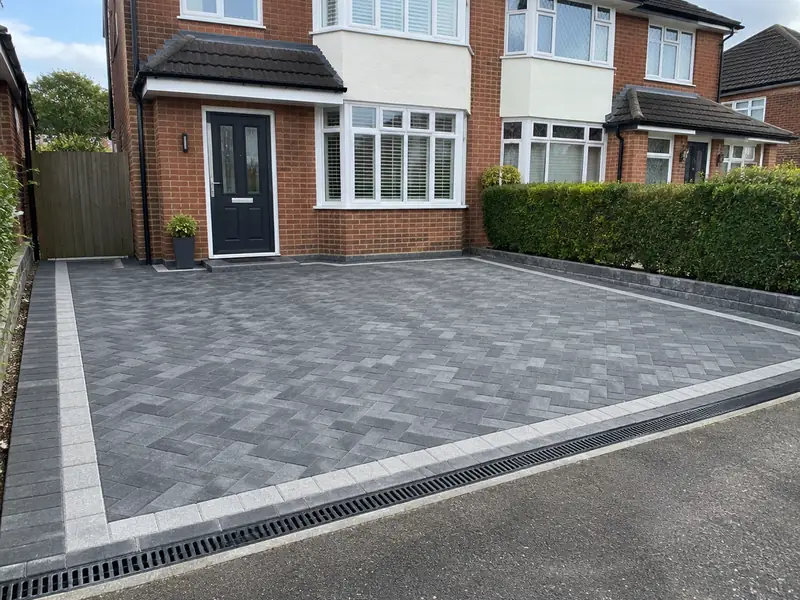
A new driveway is a hard-wearing surface for parking, such as block paving, resin bound gravel, tarmac or gravel, laid on an excavated and compacted sub-base with edging and drainage designed to carry vehicle loads and handle rainwater.
We take on a new driveway throughout Derby and the surrounding DE1, DE21, DE22 and DE23 postcodes, as well as in Belper, Ilkeston and Heanor. The guide range for this work in the East Midlands is £3,800–£8,600 including VAT; where your project falls depends on its size, the materials you pick and how easy the site is to reach. A free survey turns that range into a fixed figure.
- Guide price
- £3,800–£8,600 inc VAT
- Time on site
- 3–7 days on site
- Postcodes
- DE1, DE21, DE22, DE23 and DE24
- Planning rules
- England
- Local area
- Derbyshire
- Survey
- Free, with a written quote
What should you budget for a new driveway in Derby?
Every figure below is a guide for a new driveway in Derby, inclusive of VAT. Regional pricing for the East Midlands works out about 4% below the national guide, and the overall span is £3,800–£8,600. The survey costs you nothing, and after it we commit to a firm price for your specification in writing.
| Type of job | What it usually involves | Guide in Derby |
|---|---|---|
| Gravel or tarmac | A typical 40–50m² drive in gravel on a grid, or tarmac with block edging. | £1,900–£4,800 |
| Block paving or resin bound | A typical 40–50m² drive with sub-base, edging and drainage. | £3,800–£8,600 |
| Large or premium driveway | Larger drives, natural stone, walls, steps or a new dropped kerb. | £7,700–£15,500 |
The main things that change the figure:
- Driveway area and the depth of excavation needed
- Drainage, soakaways and changes in level
- Edging, steps, walls and manhole adjustments
- Access for machinery and removal of spoil
What do you get?
- Survey of levels, drainage, manholes and access
- Weed membrane and compacted MOT Type 1 sub-base
- Edging kerbs or restraints to hold the surface in place
- Drainage channels or soakaway where needed
- New surface laid, compacted and finished
- Site cleared and waste removed
Local housing and a new driveway
Derby has wide areas of Victorian red-brick terraces and interwar semis, while Peak District villages use gritstone and limestone under stone-slate or Welsh slate roofs. Former mining towns in the north-east of the county have brick terraces and post-war housing built for mining communities, and modern estates have grown around Derby, Chesterfield and the M1 corridor.
Brick terraces frequently suit loft conversions and rear extensions, and many need repointing. Stone properties in the Peak may call for lime work and planning-sensitive windows, while interwar and estate homes commonly take side extensions and garage conversions.
None of this holds for every street in Derby, which is why we look at your actual house before pricing a new driveway rather than assuming from its age alone.
Planning and building rules in Derby
The notes below cover England, which is where Derby sits. Rules change and every property is different, so we speak to the council before pricing your job.
In England, a new or replacement front-garden surface over 5 m² needs planning permission unless it is permeable or drains to a lawn or border within your property. A new dropped kerb needs consent from the council’s highways team, and access onto a classified road may need planning permission.
Building Regulations do not usually apply to driveways, but drainage must not discharge onto the road or a neighbour’s land.
Rules change and every property is different, so we check the planning history and constraints for your address before we quote.
The four stages
Free site survey
We begin by looking at the job in person. During the free survey we discuss options, materials and budget for a new driveway, and photograph or measure anything the quote needs to reflect.
Price and scope agreed
After the survey we send a quote for a new driveway that fixes the price for the scope we've agreed. If you want to change materials or scope, we revise it in writing before anything is booked.
Dates and permissions
Before anyone starts, we confirm the programme in writing, check whether consents are required and arrange deliveries. If a skip or scaffolding on the road needs a permit, we apply for it.
Build and hand over
During the work we protect the areas around it and tidy up at the end of each day. Once complete, we check the finish, remove our materials and hand over paperwork such as building control sign-off where it applies.
What you can expect from us
Frequently asked questions
How long does it take to lay a driveway?
Laying a typical driveway takes around three to seven days, depending on size, surface and ground conditions. Excavation and sub-base usually take the first few days, then edging, drainage and the surface. Resin needs dry weather and time to cure, and you will usually need to keep cars off for a short period afterwards. We confirm timings and access arrangements with your quote.
How long will a new driveway take?
On a typical home, allow 3–7 days on site. Larger projects, older buildings and extra work found once things are opened up can extend that, while simpler jobs may be shorter. Your quote includes an estimate of time on site, and your point of contact keeps you updated on the programme as the work progresses.
Is the price fixed?
Yes, for the specification we agree. Your written quote sets out exactly what is included at a fixed price. It only changes if you ask for something different, or if a problem the survey could not reasonably reveal later needs extra work. In either case we explain the change and confirm it in writing before going ahead.
What is a sub-base and why does it matter?
The sub-base is the layer of crushed, compacted stone beneath the driveway surface that spreads the weight of vehicles into the ground. Most driveway failures, such as sinking, rutting and loose blocks, come from a sub-base that is too thin or poorly compacted. We excavate to the right depth for your soil and compact the sub-base in layers before laying the surface.
Which driveway surface is easiest to maintain?
Resin bound gravel is one of the easiest surfaces to maintain, because it is smooth, porous and resists weeds, needing only an occasional sweep and wash. Block paving needs re-sanding joints and occasional weed control. Tarmac needs little upkeep but can soften in heat. Gravel needs raking and topping up. We explain the upkeep of each surface before you choose.
Nearby towns
Whether you're in the centre of Derby or on its outskirts, DE1, DE21, DE22 and DE23 addresses are covered. We extend the same service, and the same fixed-price approach, to Belper, Ilkeston and Heanor.