
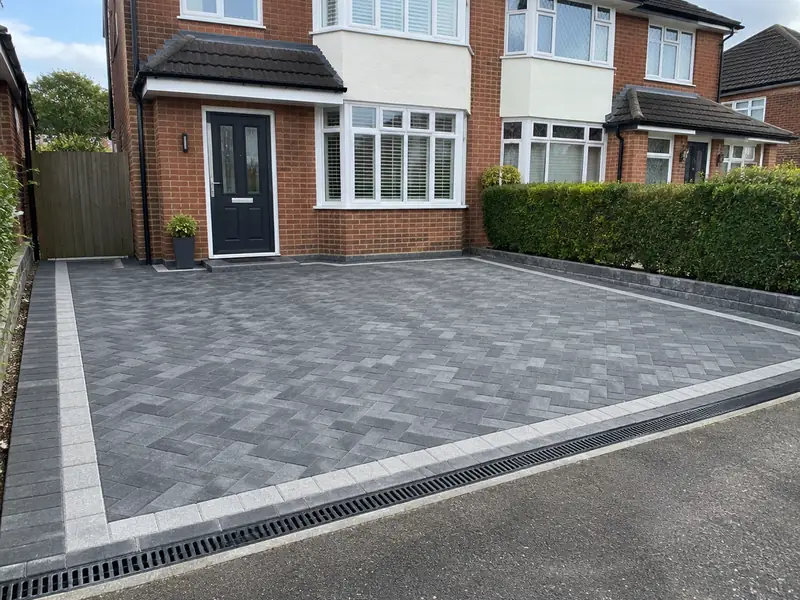
A new driveway is a hard-wearing surface for parking, such as block paving, resin bound gravel, tarmac or gravel, laid on an excavated and compacted sub-base with edging and drainage designed to carry vehicle loads and handle rainwater.
If you live in Eastbourne and are weighing up a new driveway, the starting point is a visit to measure up and talk through what you want, which costs nothing. We cover homes across BN20, BN21 and BN23, and a typical project of this kind in the South East lands somewhere in the £4,500–£10,000 bracket, including VAT. The exact figure depends on size, access and the finish you choose.
- Guide price
- £4,500–£10,000 inc VAT
- Time on site
- 3–7 days on site
- Postcodes
- BN20, BN21 and BN23
- Planning rules
- England
- Local area
- East Sussex
- Survey
- Free, with a written quote
What should you budget for a new driveway in Eastbourne?
No two jobs cost exactly the same, but the ranges below give a fair picture of a new driveway in Eastbourne. Pricing for the South East runs about 12% above the national guide, and the overall guide is £4,500–£10,000 with VAT included. We'll confirm your figure after surveying the property for free.
| Type of job | What it usually involves | Guide in Eastbourne |
|---|---|---|
| Gravel or tarmac | A typical 40–50m² drive in gravel on a grid, or tarmac with block edging. | £2,200–£5,600 |
| Block paving or resin bound | A typical 40–50m² drive with sub-base, edging and drainage. | £4,500–£10,000 |
| Large or premium driveway | Larger drives, natural stone, walls, steps or a new dropped kerb. | £9,000–£18,000 |
Your price depends mostly on:
- Driveway area and the depth of excavation needed
- Surface: gravel, tarmac, block paving, resin or stone
- Drainage, soakaways and changes in level
- Access for machinery and removal of spoil
What do you get?
- Survey of levels, drainage, manholes and access
- Weed membrane and compacted MOT Type 1 sub-base
- Edging kerbs or restraints to hold the surface in place
- Manhole covers raised or replaced to new levels
- New surface laid, compacted and finished
- Site cleared and waste removed
Local housing and a new driveway
Brighton and Hove are known for Regency stucco terraces and bow-fronted houses, alongside Victorian terraces climbing the hills. Lewes and Brighton have mathematical tiles and flint walls, Eastbourne has large Victorian and Edwardian villas, and Wealden villages use tile-hanging, weatherboarding and timber frames. Interwar suburbs and newer estates fill out most towns.
Seafront homes face salt-laden south-westerly winds and driving rain, while Wealden clay can shrink and swell, affecting extension foundations.
With that background in mind, here is how we typically handle a new driveway for homes in Eastbourne, from the first visit to the finished result.
Do you need permission in Eastbourne?
Planning law differs across the UK. For a home in Eastbourne, it is the England rules below that count, and we check them with the council ahead of any quote.
In England, a new or replacement front-garden surface over 5 m² needs planning permission unless it is permeable or drains to a lawn or border within your property. A new dropped kerb needs consent from the council’s highways team, and access onto a classified road may need planning permission.
Building Regulations do not usually apply to driveways, but drainage must not discharge onto the road or a neighbour’s land.
Rules change and every property is different, so we check the planning history and constraints for your address before we quote.
What happens after you get in touch?
We look at the job
It starts with a survey at the property, free of charge. We check condition, access and services, ask how you want the finished result to look, and answer any questions you have about a new driveway.
Written quote
The quote arrives in writing, not over the phone. It covers the full scope, the finishes you've chosen, any exclusions and the payment schedule, with a fixed price tied to that specification.
Getting ready
Once you accept, we agree start dates, order materials and deal with any planning, building control or neighbour notices the job needs. You'll know who is coming and when before work begins.
The work itself
Our trades complete a new driveway while your point of contact keeps you updated. When everything is finished, we clear the site, take away waste and go through the result with you before handover.
What you can expect from us
Common questions
Do I need permission for a dropped kerb?
A dropped kerb lets vehicles cross the pavement onto your drive, and creating or widening one needs consent from your local highways authority. They usually check visibility, the distance from junctions and trees, and whether there is enough space to park off the road. Many councils carry out the kerb work themselves or use approved contractors. We can help with the application.
What is a sub-base and why does it matter?
The sub-base is the layer of crushed, compacted stone beneath the driveway surface that spreads the weight of vehicles into the ground. Most driveway failures, such as sinking, rutting and loose blocks, come from a sub-base that is too thin or poorly compacted. We excavate to the right depth for your soil and compact the sub-base in layers before laying the surface.
What happens at the survey?
We visit your home at a time that suits you, look at the area involved, take measurements and check access, condition and any services that might be affected. We talk through what you want from a new driveway, explain the options and answer questions. There is no charge and no obligation; afterwards we send a written quote.
Which driveway surface is easiest to maintain?
Resin bound gravel is one of the easiest surfaces to maintain, because it is smooth, porous and resists weeds, needing only an occasional sweep and wash. Block paving needs re-sanding joints and occasional weed control. Tarmac needs little upkeep but can soften in heat. Gravel needs raking and topping up. We explain the upkeep of each surface before you choose.
Do I need planning permission in Eastbourne?
It depends on the work, the size of the project, your property type and whether the building is listed or in a conservation area. Eastbourne is in England, so England's rules apply. Many smaller jobs need no planning application, but some still need building control approval. We check what applies to your address before quoting.
Also covering areas around Eastbourne
We cover every part of Eastbourne, including BN20, BN21 and BN23, and nearby Hailsham, Seaford and Bexhill-on-Sea. Wherever you are within that patch, the survey is free and the quote comes to you in writing.