
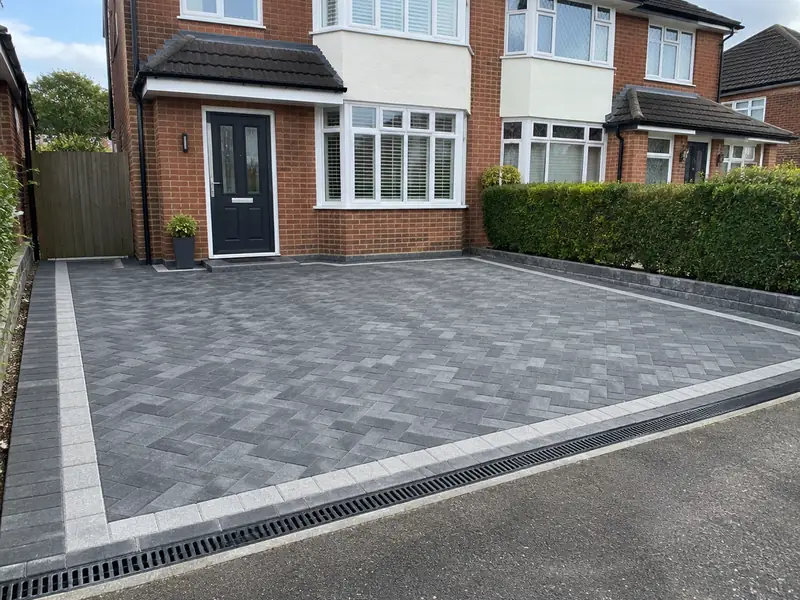
A new driveway is a hard-wearing surface for parking, such as block paving, resin bound gravel, tarmac or gravel, laid on an excavated and compacted sub-base with edging and drainage designed to carry vehicle loads and handle rainwater.
In Gloucester, as anywhere in Gloucestershire, the price of a new driveway is driven mainly by size, materials and access. Across the South West our guide sits at £4,100–£9,200 with VAT, but restricted parking, a narrow side passage or extra preparation can move the figure either way. That is why every price we give follows a visit to the house.
- Guide price
- £4,100–£9,200 inc VAT
- Time on site
- 3–7 days on site
- Postcodes
- GL1, GL2 and GL4
- Planning rules
- England
- Local area
- Gloucestershire
- Survey
- Free, with a written quote
What should you budget for a new driveway in Gloucester?
In Gloucester, guide figures for a new driveway sit at £4,100–£9,200, VAT included. We set them using rates for the South West, currently about 2% above the national guide. The table shows what pushes a project towards either end of the range; your own price is set after a free survey.
| Type of job | What it usually involves | Guide in Gloucester |
|---|---|---|
| Gravel or tarmac | A typical 40–50m² drive in gravel on a grid, or tarmac with block edging. | £2,000–£5,100 |
| Block paving or resin bound | A typical 40–50m² drive with sub-base, edging and drainage. | £4,100–£9,200 |
| Large or premium driveway | Larger drives, natural stone, walls, steps or a new dropped kerb. | £8,200–£16,500 |
What moves the price up or down:
- Driveway area and the depth of excavation needed
- Surface: gravel, tarmac, block paving, resin or stone
- Edging, steps, walls and manhole adjustments
- Access for machinery and removal of spoil
What’s included?
- Survey of levels, drainage, manholes and access
- Excavation and removal of the old surface and soil
- Edging kerbs or restraints to hold the surface in place
- Drainage channels or soakaway where needed
- Manhole covers raised or replaced to new levels
- New surface laid, compacted and finished
Local housing and a new driveway
Golden Cotswold limestone defines towns and villages such as Cirencester, Stow and Tetbury, often with stone-slate roofs. Cheltenham is known for Regency stucco terraces and villas, Gloucester has Victorian brick terraces and interwar estates, the Stroud valleys have mill-era stone cottages, and the Forest of Dean uses its own sandstone.
Cotswold stone homes often need lime pointing, stone repairs and windows that suit conservation areas. Regency houses may call for render and decorating, while brick terraces and estate homes suit loft rooms and extensions.
Knowing the typical building types in Gloucestershire helps, but a survey of your own home in Gloucester is what decides the right approach to a new driveway.
Do you need permission in Gloucester?
Planning law differs across the UK. For a home in Gloucester, it is the England rules below that count, and we check them with the council ahead of any quote.
In England, a new or replacement front-garden surface over 5 m² needs planning permission unless it is permeable or drains to a lawn or border within your property. A new dropped kerb needs consent from the council’s highways team, and access onto a classified road may need planning permission.
Building Regulations do not usually apply to driveways, but drainage must not discharge onto the road or a neighbour’s land.
Rules change and every property is different, so we check the planning history and constraints for your address before we quote.
What happens after you get in touch?
A visit to your home
We arrange a free site survey on a date convenient to you. We measure up, look at the existing structure and access, and discuss your plans for a new driveway so the price reflects your home.
Quote in writing
The quote arrives in writing, not over the phone. It covers the full scope, the finishes you've chosen, any exclusions and the payment schedule, with a fixed price tied to that specification.
Plan and prepare
Before anyone starts, we confirm the programme in writing, check whether consents are required and arrange deliveries. If a skip or scaffolding on the road needs a permit, we apply for it.
The work itself
Our trades complete a new driveway while your point of contact keeps you updated. When everything is finished, we clear the site, take away waste and go through the result with you before handover.
Why homeowners choose us
Frequently asked questions
What is a sub-base and why does it matter?
The sub-base is the layer of crushed, compacted stone beneath the driveway surface that spreads the weight of vehicles into the ground. Most driveway failures, such as sinking, rutting and loose blocks, come from a sub-base that is too thin or poorly compacted. We excavate to the right depth for your soil and compact the sub-base in layers before laying the surface.
Do you cover Cheltenham, Stroud and Tewkesbury?
Yes. As well as Gloucester, we cover Cheltenham, Stroud and Tewkesbury and the rest of Gloucestershire. Our coverage is UK-wide, so the process is the same wherever you are: a free site survey, a quote in writing that fixes the price for the agreed scope, and one point of contact while the work is planned and carried out.
Do I need planning permission for a driveway?
Whether a driveway needs planning permission depends on its size, surface and drainage, your home's location, whether it is listed or in a conservation area, and which UK nation you are in. In England, a new or replacement front driveway over 5m² needs permission unless it uses a permeable surface or drains to a lawn or border. We check the rules and design to suit.
How much will a new driveway cost in Gloucester?
As a guide, expect to pay £4,100–£9,200 including VAT for a new driveway in Gloucester. That range is adjusted for the South West, which runs about 2% above the national guide. Where your project lands depends on size, materials, access and the condition of what is already there. We confirm a fixed price in writing after a free survey of your home.
Which driveway surface is easiest to maintain?
Resin bound gravel is one of the easiest surfaces to maintain, because it is smooth, porous and resists weeds, needing only an occasional sweep and wash. Block paving needs re-sanding joints and occasional weed control. Tarmac needs little upkeep but can soften in heat. Gravel needs raking and topping up. We explain the upkeep of each surface before you choose.
Also covering areas around Gloucester
Whether you're in the centre of Gloucester or on its outskirts, GL1, GL2 and GL4 addresses are covered. We extend the same service, and the same fixed-price approach, to Cheltenham, Stroud and Tewkesbury.