
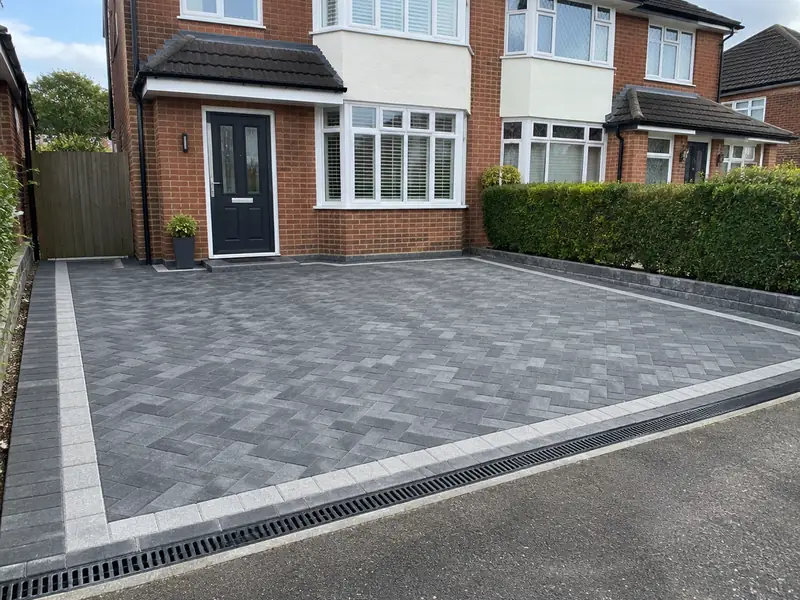
A new driveway is a hard-wearing surface for parking, such as block paving, resin bound gravel, tarmac or gravel, laid on an excavated and compacted sub-base with edging and drainage designed to carry vehicle loads and handle rainwater.
From Newport, Gwent, Cwmbran, Pontypool and Ebbw Vale to the quieter corners of Gwent, homeowners can book a free survey for a new driveway. We look at the building, agree the scope, then send a quote in writing that fixes the cost of that scope. Work follows the rules for Wales, and our published range for Wales, £3,700–£8,300 with VAT, gives you a sense of budget before we visit.
- Guide price
- £3,700–£8,300 inc VAT
- Time on site
- 3–7 days on site
- Planning rules
- Wales
- Price level
- About 8% below the national guide
- Towns listed
- 4
- Survey
- Free, with a written quote
How much does a new driveway cost in Gwent?
To help you plan, we show what a new driveway typically costs in Gwent instead of holding figures back for a sales call. The range is £3,700–£8,300 with VAT, using rates in Wales that are about 8% below the national guide. A free survey then fixes your actual price.
| Type of job | What it usually involves | Guide in Gwent |
|---|---|---|
| Gravel or tarmac | A typical 40–50m² drive in gravel on a grid, or tarmac with block edging. | £1,850–£4,600 |
| Block paving or resin bound | A typical 40–50m² drive with sub-base, edging and drainage. | £3,700–£8,300 |
| Large or premium driveway | Larger drives, natural stone, walls, steps or a new dropped kerb. | £7,400–£14,500 |
The main things that change the figure:
- Driveway area and the depth of excavation needed
- Surface: gravel, tarmac, block paving, resin or stone
- Drainage, soakaways and changes in level
- Edging, steps, walls and manhole adjustments
What’s included?
- Survey of levels, drainage, manholes and access
- Weed membrane and compacted MOT Type 1 sub-base
- Edging kerbs or restraints to hold the surface in place
- Drainage channels or soakaway where needed
- New surface laid, compacted and finished
- Site cleared and waste removed
Housing across Gwent
Newport has Victorian and Edwardian terraces and interwar suburbs, while valley towns such as Ebbw Vale, Abertillery and Blaenavon have stone terraces stepped along steep hillsides. Monmouth and Abergavenny keep Georgian centres, and Cwmbran was built as a post-war new town with planned estates.
Valley terraces commonly need repointing, roof work and window replacement, and steep plots can make extensions more involved. Newport terraces suit loft rooms, while Cwmbran homes often take garage conversions and cladding upgrades.
The valleys are among the wettest parts of south Wales, and steep sites, old mine workings and retaining walls all affect building work.
Planning and building rules in Gwent
Which rules apply depends on where you live. For Gwent, the answer is Wales, and the points below reflect that; we verify them with the council before quoting.
In Wales, hard surfaces in front gardens need to be permeable or drain within the property to avoid planning permission. Larger schemes can also need approval from the council’s SuDS Approving Body (SAB), and a dropped kerb needs highways consent.
Building Regulations do not usually apply, but drainage design matters.
Rules change and every property is different, so we check the planning history and constraints for your address before we quote.
From survey to handover
We look at the job
We arrange a free site survey on a date convenient to you. We measure up, look at the existing structure and access, and discuss your plans for a new driveway so the price reflects your home.
Written quote
Next you receive a written quote with a fixed price for the agreed specification. It lists what is included, what is not, and how payments are staged, so you can compare it properly.
Getting ready
Next comes planning the work itself. We set a start date that suits you, line up the right trades, and make sure any approvals for a new driveway are in place before the first day on site.
On site to finish
Our trades complete a new driveway while your point of contact keeps you updated. When everything is finished, we clear the site, take away waste and go through the result with you before handover.
What you can expect from us
Questions about a new driveway in Gwent
Do I need planning permission for a driveway?
Whether a driveway needs planning permission depends on its size, surface and drainage, your home's location, whether it is listed or in a conservation area, and which UK nation you are in. In England, a new or replacement front driveway over 5m² needs permission unless it uses a permeable surface or drains to a lawn or border. We check the rules and design to suit.
Which driveway surface is easiest to maintain?
Resin bound gravel is one of the easiest surfaces to maintain, because it is smooth, porous and resists weeds, needing only an occasional sweep and wash. Block paving needs re-sanding joints and occasional weed control. Tarmac needs little upkeep but can soften in heat. Gravel needs raking and topping up. We explain the upkeep of each surface before you choose.
How much does a new driveway cost?
A typical 40–50m² block paved or resin bound driveway costs £3,700–£8,300, including excavation, sub-base, edging and drainage. As a guide, allow roughly £70–£150 per square metre plus fixed costs for machinery and waste. Gravel and tarmac cost less, while natural stone, steps and walls cost more. A new dropped kerb is a separate cost. We confirm a fixed price after measuring.
Is the price fixed?
Yes, for the specification we agree. Your written quote sets out exactly what is included at a fixed price. It only changes if you ask for something different, or if a problem the survey could not reasonably reveal later needs extra work. In either case we explain the change and confirm it in writing before going ahead.
Can you combine a new driveway with other work?
Yes. Because we manage several trades under one contract, we can plan a new driveway alongside other work on your Gwent home, such as new windows with rendering, or a kitchen refit with an extension. Combining jobs can reduce repeat set-up such as scaffolding, skips and access, and every element is listed and priced in the same written quote.
Towns in Gwent
We offer a new driveway in each of the towns below, all within Gwent. Select yours for guide prices, postcodes covered and nearby places.