
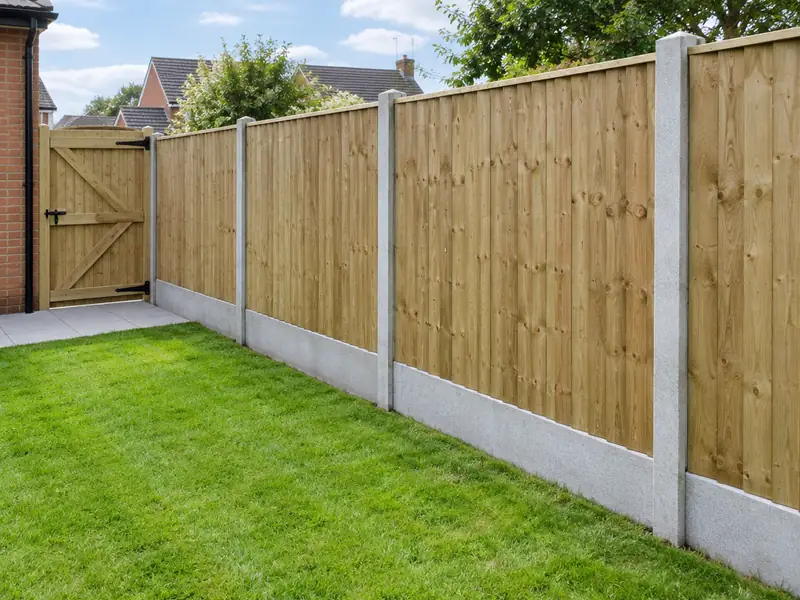
Fencing installation is setting fence posts into the ground, usually in concrete, and fixing panels or boards between them to mark a boundary, add privacy or keep children and pets in, with gates fitted where access is needed.
Homeowners in Bedford usually consider new fencing and gates for one of a few reasons: something has worn out, the house no longer suits the way they live, or they are getting it ready to sell. We visit, agree a specification and put a fixed price in writing. Most jobs like this take 1–3 days for a typical garden, and we work across Bedfordshire, including Kempston, Ampthill and St Neots.
- Guide price
- £1,250–£3,200 inc VAT
- Time on site
- 1–3 days for a typical garden
- Postcodes
- MK40 and MK41
- Planning rules
- England
- Local area
- Bedford Borough
- Survey
- Free, with a written quote
How much do new fencing and gates cost in Bedford?
Use the table to gauge the cost of new fencing and gates in Bedford before we visit. Figures include VAT and are scaled for the East of England, coming out about 5% above the national guide, which gives £1,250–£3,200 overall. After a free survey, you receive a fixed written price.
| Type of job | What it usually involves | Guide in Bedford |
|---|---|---|
| Repairs or a short run | Replacing a few panels and posts, or a short run of up to about 6m. | £300–£950 |
| Typical garden boundary | About 20m of panel or closeboard fencing with concrete posts and gravel boards. | £1,250–£3,200 |
| Composite or long runs with gates | Composite or premium fencing, longer runs, or a driveway gate. | £3,200–£7,400 |
Expect these to shape the final quote:
- Total length and height of fencing
- Fence style and material: panels, closeboard or composite
- Post type: concrete, timber or aluminium
- Number, size and type of gates
What do you get?
- Measured survey of each fence run, levels and slopes
- Concrete or timber posts set in concrete
- Panels or boards fixed level or stepped to follow the ground
- Post caps and capping rails where specified
- Gates hung with hinges, latches and locks
- Site cleared and waste removed
Local housing and new fencing and gates
Bedfordshire has a long brick-making history, and brick dominates: Victorian terraces in Bedford and Luton, interwar semis, large post-war estates around Luton and Dunstable, and newer developments near Bedford and Biggleswade. Villages in the north of the county keep limestone cottages, with timber framing and thatch scattered across older settlements.
Bedfordshire is relatively dry, and its clay soils can shrink in long, dry summers, so foundation depth and nearby trees matter for extensions.
For new fencing and gates in Bedford, this means checking things like wall construction, roof structure and existing services before we put a figure on paper.
Do you need permission in Bedford?
Because Bedford falls under England's rules, the guidance below is the version relevant to you. Before sending a price, we check your property's position with the council.
In England, fences, walls and gates up to 2 m high are usually permitted development, or up to 1 m where they are next to a road used by vehicles or its footpath. Listed buildings, conservation areas and estates with planning conditions can be stricter.
Building Regulations do not apply to ordinary garden fences, but boundary lines should be agreed with your neighbour first.
Rules change and every property is different, so we check the planning history and constraints for your address before we quote.
From survey to handover
We look at the job
Book a visit and we'll come to you. The survey covers measurements, the state of what's there now and any obvious constraints, so the price that follows is based on your actual home, not an average.
Quote in writing
We turn the survey notes into a written quote. The price is fixed for the specification we agree, and the document sets out materials, scope and payment stages in plain language.
Dates and permissions
Before anyone starts, we confirm the programme in writing, check whether consents are required and arrange deliveries. If a skip or scaffolding on the road needs a permit, we apply for it.
Build and hand over
The work is carried out to the agreed specification, with floors and furniture protected and the site kept tidy. At the end we clean up, walk through the finished job with you and hand over any certificates.
What you can expect from us
Fencing and gates in Bedford: questions
Do I need planning permission in Bedford?
It depends on the work, the size of the project, your property type and whether the building is listed or in a conservation area. Bedford is in England, so England's rules apply. Many smaller jobs need no planning application, but some still need building control approval. We check what applies to your address before quoting.
What kind of gate do I need?
The right gate depends on its job. A side gate for access to the back garden is usually timber or metal, around 0.9m to 1m wide, with a secure lock. Driveway gates are wider, often in pairs, and need strong posts. Composite and metal gates resist warping. We measure the opening, check posts and suggest hinges, latches and locks for security.
How long does it take to replace a fence?
Replacing a typical 20m garden fence usually takes one to two days, including taking down the old fence, setting posts in concrete and fitting panels or boards. Longer runs, slopes, hard ground and gates take longer. Post concrete needs time to set before panels are fully loaded. We give you an expected timeline with your quote.
How do you fence a sloping garden?
On a sloping garden, fence panels are usually stepped, so each panel is level and set slightly higher or lower than the one before, with the gap below filled by a gravel board. Closeboard fences can instead follow the slope, giving a smooth top line. The choice depends on how steep the slope is and the look you want. We discuss both at the survey.
Do you cover Kempston, Ampthill and St Neots?
Yes. As well as Bedford, we cover Kempston, Ampthill and St Neots and the rest of Bedfordshire. Our coverage is UK-wide, so the process is the same wherever you are: a free site survey, a quote in writing that fixes the price for the agreed scope, and one point of contact while the work is planned and carried out.
Nearby towns
Bedford and its MK40 and MK41 postcodes are part of our coverage. Homeowners in Kempston, Ampthill and St Neots can also book a free survey with us and receive a written price for their job.