
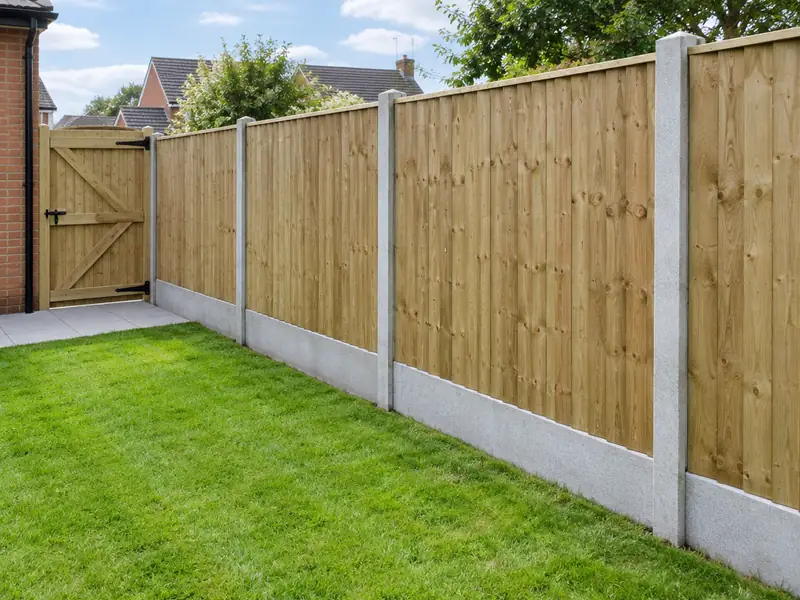
Fencing installation is setting fence posts into the ground, usually in concrete, and fixing panels or boards between them to mark a boundary, add privacy or keep children and pets in, with gates fitted where access is needed.
Thinking about new fencing and gates in Chesham? We take charge of the whole project, co-ordinating every trade involved, and one person keeps you updated. Guide prices for the South East sit at £1,350–£3,400 including VAT, and a typical job takes 1–3 days for a typical garden. Your own figure depends on what the survey finds and the specification you settle on.
- Guide price
- £1,350–£3,400 inc VAT
- Time on site
- 1–3 days for a typical garden
- Postcodes
- HP5
- Planning rules
- England
- Local area
- Buckinghamshire
- Survey
- Free, with a written quote
Fencing and gates prices in Chesham
Prices for new fencing and gates vary from house to house, but in Chesham most projects fall within £1,350–£3,400 including VAT. That reflects costs in the South East, about 12% above the national guide. Treat the table as a budgeting aid; the written figure follows a survey we carry out for free.
| Type of job | What it usually involves | Guide in Chesham |
|---|---|---|
| Repairs or a short run | Replacing a few panels and posts, or a short run of up to about 6m. | £350–£1,000 |
| Typical garden boundary | About 20m of panel or closeboard fencing with concrete posts and gravel boards. | £1,350–£3,400 |
| Composite or long runs with gates | Composite or premium fencing, longer runs, or a driveway gate. | £3,400–£7,800 |
Your price depends mostly on:
- Total length and height of fencing
- Post type: concrete, timber or aluminium
- Ground conditions, slopes and removal of the old fence
- Number, size and type of gates
What do you get?
- Measured survey of each fence run, levels and slopes
- Concrete or timber gravel boards to keep panels off the soil
- Panels or boards fixed level or stepped to follow the ground
- Post caps and capping rails where specified
- Gates hung with hinges, latches and locks
- Site cleared and waste removed
Local housing and new fencing and gates
Buckinghamshire runs from Chiltern villages of brick and flint, through Metroland interwar semis around Amersham and Chesham, to Victorian terraces in High Wycombe and Aylesbury. Milton Keynes adds estates built from the 1970s onwards in brick, render and timber frame, and new housing continues to spread around its edges.
The Chiltern hills are more exposed than the vale below, and clay-with-flints soils make drainage design and footing depth worth checking early.
If your house in Chesham fits one of these patterns, it helps us anticipate what new fencing and gates will involve, though we always confirm the details on site.
Permissions for new fencing and gates in Chesham
Chesham is in England, so the planning and building rules set out below are the ones that apply. We confirm the details with the council before we quote.
In England, fences, walls and gates up to 2 m high are usually permitted development, or up to 1 m where they are next to a road used by vehicles or its footpath. Listed buildings, conservation areas and estates with planning conditions can be stricter.
Building Regulations do not apply to ordinary garden fences, but boundary lines should be agreed with your neighbour first.
Rules change and every property is different, so we check the planning history and constraints for your address before we quote.
What happens after you get in touch?
We look at the job
Book a visit and we'll come to you. The survey covers measurements, the state of what's there now and any obvious constraints, so the price that follows is based on your actual home, not an average.
Quote in writing
We turn the survey notes into a written quote. The price is fixed for the specification we agree, and the document sets out materials, scope and payment stages in plain language.
Plan and prepare
Once you accept, we agree start dates, order materials and deal with any planning, building control or neighbour notices the job needs. You'll know who is coming and when before work begins.
Build and hand over
The work is carried out to the agreed specification, with floors and furniture protected and the site kept tidy. At the end we clean up, walk through the finished job with you and hand over any certificates.
Why homeowners choose us
Common questions
How high can my fence be?
Fence height limits depend on planning rules, your home's location, whether it is listed or in a conservation area, and which UK nation you live in. In England, fences up to 2m high are usually permitted development, reduced to 1m next to a road used by vehicles. Higher fences need planning permission. We check the rules for your boundary before quoting.
Are concrete posts better than timber?
Concrete posts do not rot and are the most durable choice for panel fences, especially on exposed sites. They are heavier and more utilitarian in appearance. Timber posts look more natural and suit closeboard and featheredge fences, but they eventually rot at ground level, even when treated. Aluminium posts suit composite systems. We recommend posts based on your fence style and exposure.
Is the price fixed?
Yes, for the specification we agree. Your written quote sets out exactly what is included at a fixed price. It only changes if you ask for something different, or if a problem the survey could not reasonably reveal later needs extra work. In either case we explain the change and confirm it in writing before going ahead.
How long does it take to replace a fence?
Replacing a typical 20m garden fence usually takes one to two days, including taking down the old fence, setting posts in concrete and fitting panels or boards. Longer runs, slopes, hard ground and gates take longer. Post concrete needs time to set before panels are fully loaded. We give you an expected timeline with your quote.
Do you cover Amersham, Berkhamsted and Chalfont Saint Peter?
Yes. As well as Chesham, we cover Amersham, Berkhamsted and Chalfont Saint Peter and the rest of Buckinghamshire. Our coverage is UK-wide, so the process is the same wherever you are: a free site survey, a quote in writing that fixes the price for the agreed scope, and one point of contact while the work is planned and carried out.
Nearby towns
Addresses in HP5 are all covered for Chesham, along with Amersham, Berkhamsted and Chalfont Saint Peter close by. Give us your postcode when you get in touch and we will confirm the details.