
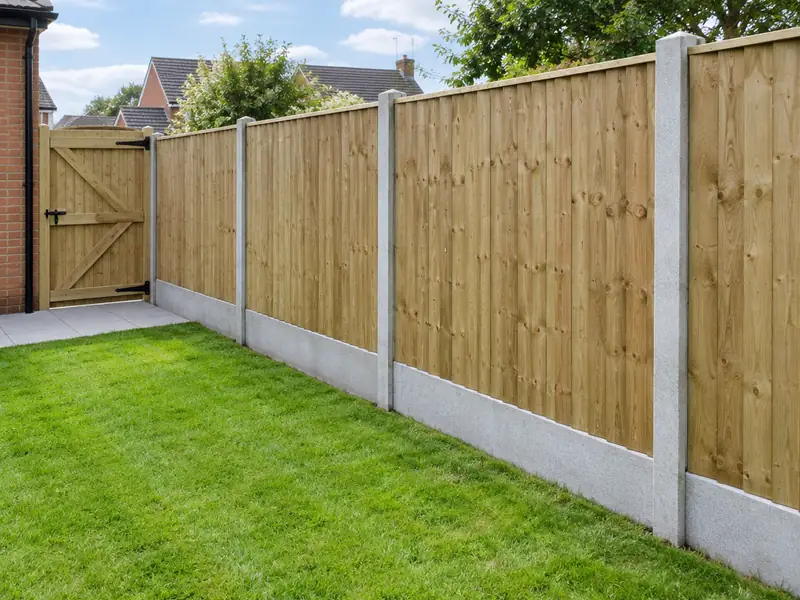
Fencing installation is setting fence posts into the ground, usually in concrete, and fixing panels or boards between them to mark a boundary, add privacy or keep children and pets in, with gates fitted where access is needed.
Milton Keynes sits within our coverage for new fencing and gates, as do neighbouring Bletchley, Leighton Buzzard and Ampthill. Before giving a price we want to see the property: the condition of what's there now, the access, and anything that might need extra work. The guide range for the South East is £1,350–£3,400 including VAT, and your written quote will spell out exactly what that covers.
- Guide price
- £1,350–£3,400 inc VAT
- Time on site
- 1–3 days for a typical garden
- Postcodes
- MK5, MK6, MK9, MK13 and MK14
- Planning rules
- England
- Local area
- Buckinghamshire
- Survey
- Free, with a written quote
Fencing and gates prices in Milton Keynes
The costs listed here are typical for new fencing and gates around Milton Keynes and include VAT. They reflect labour and material costs in the South East, about 12% above the national guide, giving a range of £1,350–£3,400. Exact pricing depends on your home, so we only fix it once a free site survey is done.
| Type of job | What it usually involves | Guide in Milton Keynes |
|---|---|---|
| Repairs or a short run | Replacing a few panels and posts, or a short run of up to about 6m. | £350–£1,000 |
| Typical garden boundary | About 20m of panel or closeboard fencing with concrete posts and gravel boards. | £1,350–£3,400 |
| Composite or long runs with gates | Composite or premium fencing, longer runs, or a driveway gate. | £3,400–£7,800 |
What moves the price up or down:
- Fence style and material: panels, closeboard or composite
- Post type: concrete, timber or aluminium
- Ground conditions, slopes and removal of the old fence
- Number, size and type of gates
What’s included?
- Removal and disposal of the old fence and posts
- Concrete or timber posts set in concrete
- Concrete or timber gravel boards to keep panels off the soil
- Panels or boards fixed level or stepped to follow the ground
- Post caps and capping rails where specified
- Site cleared and waste removed
Homes in Buckinghamshire
Buckinghamshire runs from Chiltern villages of brick and flint, through Metroland interwar semis around Amersham and Chesham, to Victorian terraces in High Wycombe and Aylesbury. Milton Keynes adds estates built from the 1970s onwards in brick, render and timber frame, and new housing continues to spread around its edges.
Chiltern cottages may need lime repairs and careful window choices in conservation areas. Interwar semis suit hip-to-gable lofts and rear extensions, while Milton Keynes homes often need roofline renewal, replacement doors and garage conversions.
With that background in mind, here is how we typically handle new fencing and gates for homes in Milton Keynes, from the first visit to the finished result.
Do you need permission in Milton Keynes?
The notes below cover England, which is where Milton Keynes sits. Rules change and every property is different, so we speak to the council before pricing your job.
In England, fences, walls and gates up to 2 m high are usually permitted development, or up to 1 m where they are next to a road used by vehicles or its footpath. Listed buildings, conservation areas and estates with planning conditions can be stricter.
Building Regulations do not apply to ordinary garden fences, but boundary lines should be agreed with your neighbour first.
Rules change and every property is different, so we check the planning history and constraints for your address before we quote.
What happens after you get in touch?
Survey and measure
It starts with a survey at the property, free of charge. We check condition, access and services, ask how you want the finished result to look, and answer any questions you have about new fencing and gates.
Your fixed price
After the survey we send a quote for new fencing and gates that fixes the price for the scope we've agreed. If you want to change materials or scope, we revise it in writing before anything is booked.
Dates and permissions
Next comes planning the work itself. We set a start date that suits you, line up the right trades, and make sure any approvals for new fencing and gates are in place before the first day on site.
On site to finish
The job proceeds in the order set out in the programme, with dust and debris kept under control. Finally we tidy away, inspect the work together and pass the finished project over to you with its paperwork.
How we work
Frequently asked questions
How high can my fence be?
Fence height limits depend on planning rules, your home's location, whether it is listed or in a conservation area, and which UK nation you live in. In England, fences up to 2m high are usually permitted development, reduced to 1m next to a road used by vehicles. Higher fences need planning permission. We check the rules for your boundary before quoting.
Is the price fixed?
Yes, for the specification we agree. Your written quote sets out exactly what is included at a fixed price. It only changes if you ask for something different, or if a problem the survey could not reasonably reveal later needs extra work. In either case we explain the change and confirm it in writing before going ahead.
How much does a new fence cost?
About 20m of new panel or closeboard fencing with concrete posts costs £1,350–£3,400, including removal of the old fence. As a guide, allow roughly £55–£130 per metre plus a small fixed cost for removal and waste. Lap panels sit at the lower end, while closeboard, slatted and composite fencing cost more. Gates, slopes and hard ground add to the price. We confirm a fixed price after measuring.
How long will new fencing and gates take?
On a typical home, allow 1–3 days for a typical garden. Larger projects, older buildings and extra work found once things are opened up can extend that, while simpler jobs may be shorter. Your quote includes an estimate of time on site, and your point of contact keeps you updated on the programme as the work progresses.
Are concrete posts better than timber?
Concrete posts do not rot and are the most durable choice for panel fences, especially on exposed sites. They are heavier and more utilitarian in appearance. Timber posts look more natural and suit closeboard and featheredge fences, but they eventually rot at ground level, even when treated. Aluminium posts suit composite systems. We recommend posts based on your fence style and exposure.
Near Milton Keynes
Addresses in MK5, MK6, MK9 and MK13 are all covered for Milton Keynes, along with Bletchley, Leighton Buzzard and Ampthill close by. Give us your postcode when you get in touch and we will confirm the details.