
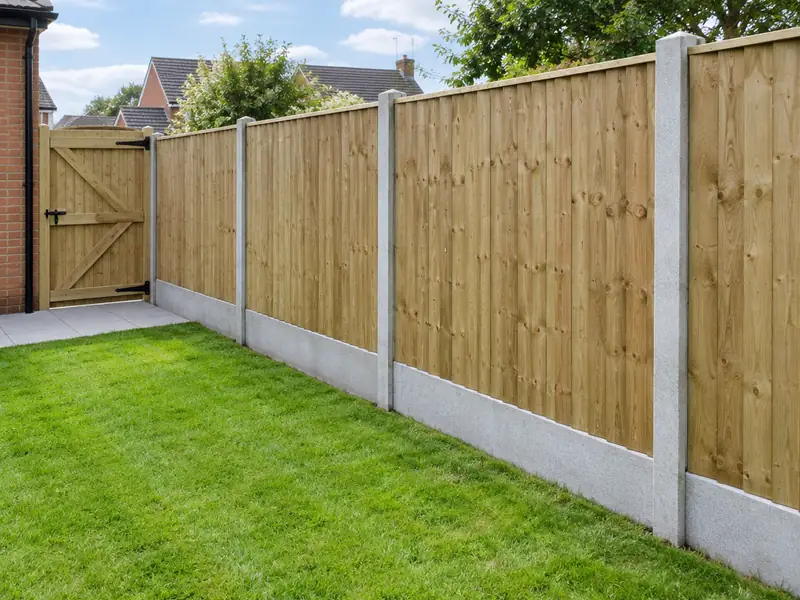
Fencing installation is setting fence posts into the ground, usually in concrete, and fixing panels or boards between them to mark a boundary, add privacy or keep children and pets in, with gates fitted where access is needed.
If you have new fencing and gates on your list for a property in Chester, we can help from the first measurements to the final clean-up. For a typical home, plan for 1–3 days for a typical garden, though larger or more complex jobs take longer. We cover postcodes CH1 and nearby Hawarden, Deeside and Ellesmere Port, and every quote we send is fixed for the scope described in it.
- Guide price
- £1,150–£2,800 inc VAT
- Time on site
- 1–3 days for a typical garden
- Postcodes
- CH1
- Planning rules
- England
- Local area
- Cheshire West and Chester
- Survey
- Free, with a written quote
What should you budget for new fencing and gates in Chester?
Use the table to gauge the cost of new fencing and gates in Chester before we visit. Figures include VAT and are scaled for the North West, coming out about 5% below the national guide, which gives £1,150–£2,800 overall. After a free survey, you receive a fixed written price.
| Type of job | What it usually involves | Guide in Chester |
|---|---|---|
| Repairs or a short run | Replacing a few panels and posts, or a short run of up to about 6m. | £300–£850 |
| Typical garden boundary | About 20m of panel or closeboard fencing with concrete posts and gravel boards. | £1,150–£2,800 |
| Composite or long runs with gates | Composite or premium fencing, longer runs, or a driveway gate. | £2,800–£6,600 |
The main things that change the figure:
- Fence style and material: panels, closeboard or composite
- Post type: concrete, timber or aluminium
- Ground conditions, slopes and removal of the old fence
- Number, size and type of gates
Scope of the work
- Concrete or timber posts set in concrete
- Concrete or timber gravel boards to keep panels off the soil
- Panels or boards fixed level or stepped to follow the ground
- Post caps and capping rails where specified
- Gates hung with hinges, latches and locks
- Site cleared and waste removed
Homes in Cheshire
Chester mixes Georgian and Victorian terraces with black-and-white revival frontages, and red sandstone shows up across the west of the county. Crewe has railway-era brick terraces, Macclesfield has mill workers' cottages, and Wilmslow, Knutsford and Alderley Edge are known for large detached homes. Interwar semis and newer estates surround Warrington and Northwich.
Terraced and mill-era cottages often need repointing, roof work and loft space. Larger detached homes commonly take on kitchen extensions, bifold doors and garden landscaping, while interwar semis suit side extensions and replacement windows.
Whatever era your Chester home dates from, we plan new fencing and gates around how it is actually built rather than a one-size-fits-all specification.
Permissions for new fencing and gates in Chester
As Chester is in England, read the following with that system of planning and building control in mind. We check what applies to your house with the council before you receive a quote.
In England, fences, walls and gates up to 2 m high are usually permitted development, or up to 1 m where they are next to a road used by vehicles or its footpath. Listed buildings, conservation areas and estates with planning conditions can be stricter.
Building Regulations do not apply to ordinary garden fences, but boundary lines should be agreed with your neighbour first.
Rules change and every property is different, so we check the planning history and constraints for your address before we quote.
How does the job run?
We look at the job
We arrange a free site survey on a date convenient to you. We measure up, look at the existing structure and access, and discuss your plans for new fencing and gates so the price reflects your home.
Written quote
After the survey we send a quote for new fencing and gates that fixes the price for the scope we've agreed. If you want to change materials or scope, we revise it in writing before anything is booked.
Dates and permissions
Next comes planning the work itself. We set a start date that suits you, line up the right trades, and make sure any approvals for new fencing and gates are in place before the first day on site.
Finish and handover
On site, the agreed plan is followed and any change is put in writing first. At completion we do a final clean, go through the snagging list with you and leave you with the relevant documents.
How we work
Questions about new fencing and gates in Chester
Who owns the fence between me and my neighbour?
Fence ownership is usually shown on the title plan or deeds, sometimes with a T mark on the side of the owner. If it is unclear, it may be shared. Even on your own boundary, it is sensible to talk to neighbours before replacing a fence, agree access and confirm the line. We fit the fence on the line you confirm and can face the good side outwards if you wish.
Can I stay at home during the work?
In most cases, yes. Most people can live at home throughout, and we plan the work to keep disruption down by protecting floors, agreeing working hours and keeping access routes clear. Bigger jobs affecting kitchens, bathrooms or heating may mean a short spell with reduced facilities, and we talk this through with you at the survey.
How long does it take to replace a fence?
Replacing a typical 20m garden fence usually takes one to two days, including taking down the old fence, setting posts in concrete and fitting panels or boards. Longer runs, slopes, hard ground and gates take longer. Post concrete needs time to set before panels are fully loaded. We give you an expected timeline with your quote.
Is the price fixed?
Yes, for the specification we agree. Your written quote sets out exactly what is included at a fixed price. It only changes if you ask for something different, or if a problem the survey could not reasonably reveal later needs extra work. In either case we explain the change and confirm it in writing before going ahead.
Are concrete posts better than timber?
Concrete posts do not rot and are the most durable choice for panel fences, especially on exposed sites. They are heavier and more utilitarian in appearance. Timber posts look more natural and suit closeboard and featheredge fences, but they eventually rot at ground level, even when treated. Aluminium posts suit composite systems. We recommend posts based on your fence style and exposure.
Near Chester
From CH1 to the edges of Chester and on into Hawarden, Deeside and Ellesmere Port, we can arrange a site visit and a written quote for your project, planned around dates that work for you.