
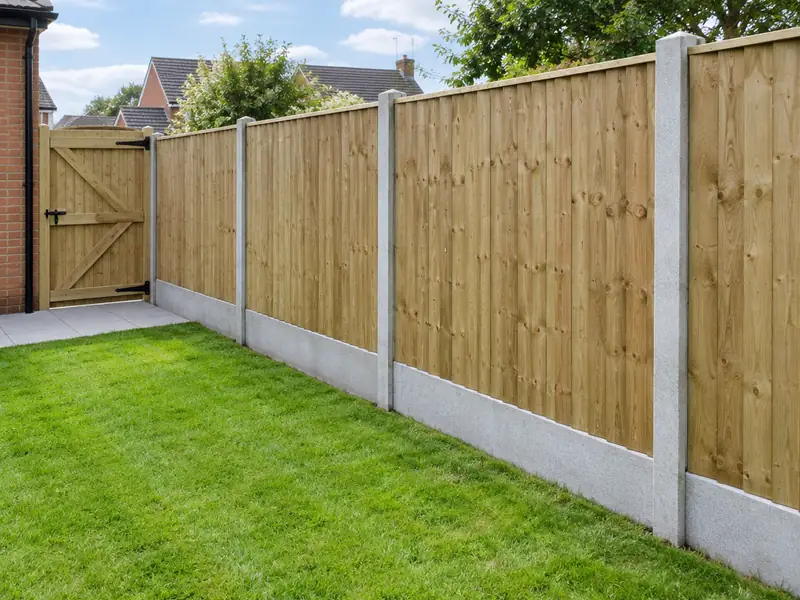
Fencing installation is setting fence posts into the ground, usually in concrete, and fixing panels or boards between them to mark a boundary, add privacy or keep children and pets in, with gates fitted where access is needed.
If you live in Wrexham and are weighing up new fencing and gates, the starting point is a visit to measure up and talk through what you want, which costs nothing. We cover homes across LL11 and LL13, and a typical project of this kind in Wales lands somewhere in the £1,100–£2,800 bracket, including VAT. The exact figure depends on size, access and the finish you choose.
- Guide price
- £1,100–£2,800 inc VAT
- Time on site
- 1–3 days for a typical garden
- Postcodes
- LL11 and LL13
- Planning rules
- Wales
- Local area
- Clwyd
- Survey
- Free, with a written quote
How much do new fencing and gates cost in Wrexham?
The costs listed here are typical for new fencing and gates around Wrexham and include VAT. They reflect labour and material costs in Wales, about 8% below the national guide, giving a range of £1,100–£2,800. Exact pricing depends on your home, so we only fix it once a free site survey is done.
| Type of job | What it usually involves | Guide in Wrexham |
|---|---|---|
| Repairs or a short run | Replacing a few panels and posts, or a short run of up to about 6m. | £300–£850 |
| Typical garden boundary | About 20m of panel or closeboard fencing with concrete posts and gravel boards. | £1,100–£2,800 |
| Composite or long runs with gates | Composite or premium fencing, longer runs, or a driveway gate. | £2,800–£6,400 |
What moves the price up or down:
- Total length and height of fencing
- Post type: concrete, timber or aluminium
- Ground conditions, slopes and removal of the old fence
- Number, size and type of gates
What does the job include in Wrexham?
- Measured survey of each fence run, levels and slopes
- Removal and disposal of the old fence and posts
- Panels or boards fixed level or stepped to follow the ground
- Post caps and capping rails where specified
- Gates hung with hinges, latches and locks
- Site cleared and waste removed
Local housing and new fencing and gates
Wrexham has Victorian terraces in red Ruabon brick, alongside interwar and post-war estates. The north coast resorts of Rhyl, Prestatyn and Colwyn Bay have Victorian villas, guest-house terraces and bungalows, while Denbighshire and Flintshire villages use local stone under Welsh slate roofs.
The north Wales coast is exposed to wind and salt from the Irish Sea, and the Clwydian hills inland are wetter and colder.
In Wrexham, as elsewhere in Clwyd, we take the building's age and construction into account before recommending anything, because both can change what is involved in new fencing and gates.
Permissions for new fencing and gates in Wrexham
Each UK nation sets its own consent rules, and Wrexham is in Wales. What follows is a plain summary; we check the specifics for your property with the council before pricing anything.
In Wales, fences, walls and gates up to 2 m high (1 m next to a road) are usually permitted development.
Building Regulations do not apply to ordinary fences.
Rules change and every property is different, so we check the planning history and constraints for your address before we quote.
What happens after you get in touch?
A visit to your home
It starts with a survey at the property, free of charge. We check condition, access and services, ask how you want the finished result to look, and answer any questions you have about new fencing and gates.
Quote in writing
We put everything into a written, fixed-price quote: the specification, what's excluded, staged payments and the expected time on site. Take whatever time you need to decide; there's no pressure to commit.
Getting ready
We handle the paperwork side: checking whether planning permission or building control approval is needed, submitting applications where they are, and scheduling the trades and materials around your dates.
On site to finish
The work is carried out to the agreed specification, with floors and furniture protected and the site kept tidy. At the end we clean up, walk through the finished job with you and hand over any certificates.
How we work
Common questions
How high can my fence be?
Fence height limits depend on planning rules, your home's location, whether it is listed or in a conservation area, and which UK nation you live in. In England, fences up to 2m high are usually permitted development, reduced to 1m next to a road used by vehicles. Higher fences need planning permission. We check the rules for your boundary before quoting.
How do you fence a sloping garden?
On a sloping garden, fence panels are usually stepped, so each panel is level and set slightly higher or lower than the one before, with the gap below filled by a gravel board. Closeboard fences can instead follow the slope, giving a smooth top line. The choice depends on how steep the slope is and the look you want. We discuss both at the survey.
Do I need planning permission in Wrexham?
It depends on the work, the size of the project, your property type and whether the building is listed or in a conservation area. Wrexham is in Wales, so Wales's rules apply. Many smaller jobs need no planning application, but some still need building control approval. We check what applies to your address before quoting.
Which postcodes in Wrexham do you cover?
We cover LL11 and LL13, along with the rest of Clwyd. If your postcode is not listed, get in touch anyway: our coverage is UK-wide, and we can usually arrange a survey wherever you live. Enter your postcode in the guide-price tool or contact form and we will confirm.
Are concrete posts better than timber?
Concrete posts do not rot and are the most durable choice for panel fences, especially on exposed sites. They are heavier and more utilitarian in appearance. Timber posts look more natural and suit closeboard and featheredge fences, but they eventually rot at ground level, even when treated. Aluminium posts suit composite systems. We recommend posts based on your fence style and exposure.
Near Wrexham
Live in Wrexham? Our coverage takes in the LL11 and LL13 postcode areas and reaches out to Brymbo, Rhosllannerchrugog and Buckley, so homes on the outskirts and in the next town along are included.