
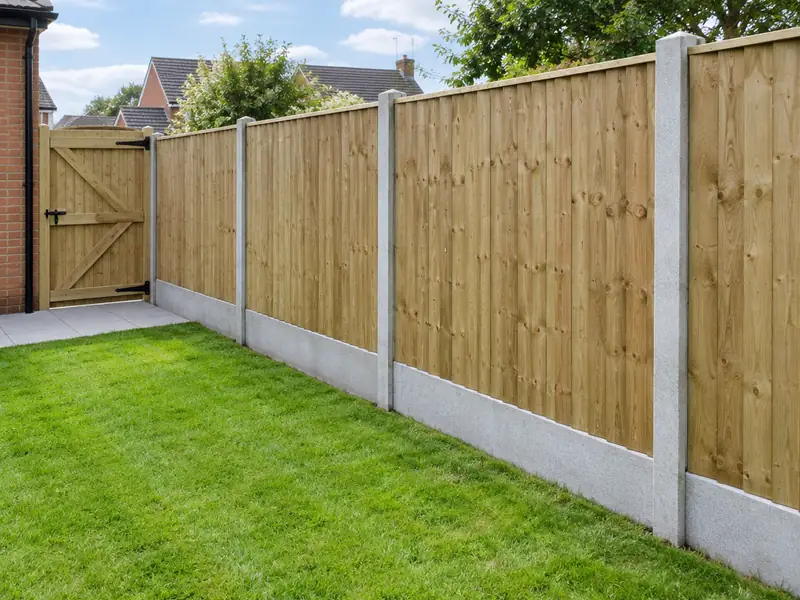
Fencing installation is setting fence posts into the ground, usually in concrete, and fixing panels or boards between them to mark a boundary, add privacy or keep children and pets in, with gates fitted where access is needed.
For a homeowner in Truro, planning new fencing and gates tends to begin with two questions: what will it cost, and how disruptive will it be? Our guide range is £1,200–£3,100 including VAT, and a typical job runs to 1–3 days for a typical garden. Both numbers firm up once we have seen the property, measured up and agreed exactly what is included.
- Guide price
- £1,200–£3,100 inc VAT
- Time on site
- 1–3 days for a typical garden
- Postcodes
- TR1
- Planning rules
- England
- Local area
- Cornwall
- Survey
- Free, with a written quote
How much do new fencing and gates cost in Truro?
Use the table to gauge the cost of new fencing and gates in Truro before we visit. Figures include VAT and are scaled for the South West, coming out about 2% above the national guide, which gives £1,200–£3,100 overall. After a free survey, you receive a fixed written price.
| Type of job | What it usually involves | Guide in Truro |
|---|---|---|
| Repairs or a short run | Replacing a few panels and posts, or a short run of up to about 6m. | £300–£900 |
| Typical garden boundary | About 20m of panel or closeboard fencing with concrete posts and gravel boards. | £1,200–£3,100 |
| Composite or long runs with gates | Composite or premium fencing, longer runs, or a driveway gate. | £3,100–£7,100 |
Your price depends mostly on:
- Total length and height of fencing
- Fence style and material: panels, closeboard or composite
- Ground conditions, slopes and removal of the old fence
- Number, size and type of gates
What do you get?
- Measured survey of each fence run, levels and slopes
- Concrete or timber posts set in concrete
- Concrete or timber gravel boards to keep panels off the soil
- Post caps and capping rails where specified
- Gates hung with hinges, latches and locks
- Site cleared and waste removed
Building in Truro
Older Cornish homes are often built of granite or slatey local stone, with slate roofs and sometimes slate-hung walls facing the weather. Cob cottages survive in places, Truro and Falmouth keep Georgian and Victorian streets, and many towns have rendered post-war houses, bungalows and newer estates on their edges.
Cornwall faces Atlantic gales, driving rain and salt-laden air, so render, pointing and window hardware on exposed elevations need a suitably robust specification.
So when we survey a Truro property for new fencing and gates, the first step is working out how it was built and what has been changed since.
Permissions for new fencing and gates in Truro
For anyone in Truro, the relevant framework is England's. The summary below is general, so we always contact the council about your address before putting a price in writing.
In England, fences, walls and gates up to 2 m high are usually permitted development, or up to 1 m where they are next to a road used by vehicles or its footpath. Listed buildings, conservation areas and estates with planning conditions can be stricter.
Building Regulations do not apply to ordinary garden fences, but boundary lines should be agreed with your neighbour first.
Rules change and every property is different, so we check the planning history and constraints for your address before we quote.
What happens after you get in touch?
We look at the job
Book a visit and we'll come to you. The survey covers measurements, the state of what's there now and any obvious constraints, so the price that follows is based on your actual home, not an average.
Quote in writing
We put everything into a written, fixed-price quote: the specification, what's excluded, staged payments and the expected time on site. Take whatever time you need to decide; there's no pressure to commit.
Plan and prepare
Next comes planning the work itself. We set a start date that suits you, line up the right trades, and make sure any approvals for new fencing and gates are in place before the first day on site.
On site to finish
The work is carried out to the agreed specification, with floors and furniture protected and the site kept tidy. At the end we clean up, walk through the finished job with you and hand over any certificates.
What you can expect from us
Common questions
Are concrete posts better than timber?
Concrete posts do not rot and are the most durable choice for panel fences, especially on exposed sites. They are heavier and more utilitarian in appearance. Timber posts look more natural and suit closeboard and featheredge fences, but they eventually rot at ground level, even when treated. Aluminium posts suit composite systems. We recommend posts based on your fence style and exposure.
Can you combine new fencing and gates with other work?
Yes. Because we manage several trades under one contract, we can plan new fencing and gates alongside other work on your Truro home, such as new windows with rendering, or a kitchen refit with an extension. Combining jobs can reduce repeat set-up such as scaffolding, skips and access, and every element is listed and priced in the same written quote.
How long does it take to replace a fence?
Replacing a typical 20m garden fence usually takes one to two days, including taking down the old fence, setting posts in concrete and fitting panels or boards. Longer runs, slopes, hard ground and gates take longer. Post concrete needs time to set before panels are fully loaded. We give you an expected timeline with your quote.
Who do I deal with during the job?
One point of contact manages your project from survey to handover. They schedule the trades working under our contract, keep you updated on progress, and are the person to call with any question. You don't need to coordinate builders, electricians or decorators separately, because that is part of what we do.
What kind of gate do I need?
The right gate depends on its job. A side gate for access to the back garden is usually timber or metal, around 0.9m to 1m wide, with a secure lock. Driveway gates are wider, often in pairs, and need strong posts. Composite and metal gates resist warping. We measure the opening, check posts and suggest hinges, latches and locks for security.
Nearby towns
We survey and quote throughout Truro's TR1 postcodes and in surrounding places such as Falmouth, Redruth and Newquay. The process and pricing approach are identical in each of them.