
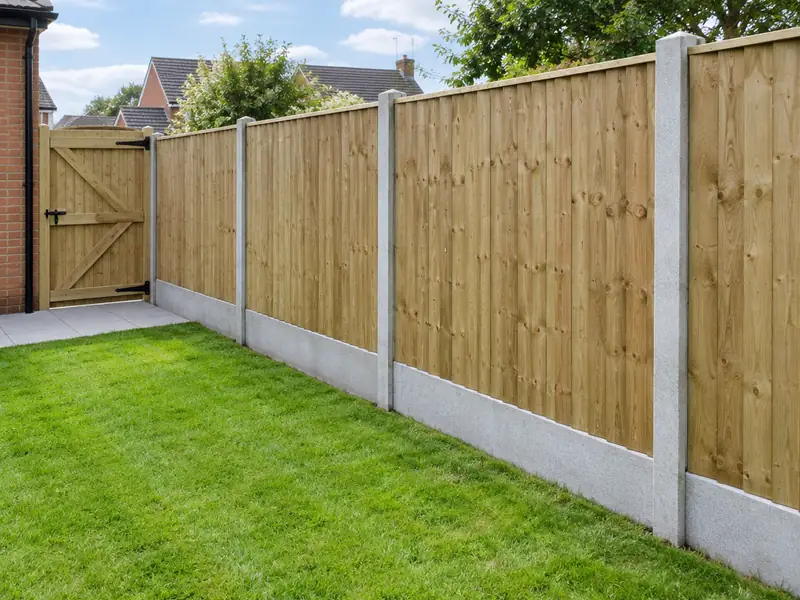
Fencing installation is setting fence posts into the ground, usually in concrete, and fixing panels or boards between them to mark a boundary, add privacy or keep children and pets in, with gates fitted where access is needed.
Every house in Bishop Auckland is a little different, so we never price new fencing and gates from a brochure. We look at the structure, access and existing finishes first, then put in writing a fixed figure for the scope we settle on. As a rough steer, homeowners in the North East should budget £1,100–£2,700 including VAT, with work typically taking 1–3 days for a typical garden.
- Guide price
- £1,100–£2,700 inc VAT
- Time on site
- 1–3 days for a typical garden
- Postcodes
- DL4 and DL14
- Planning rules
- England
- Local area
- County Durham
- Survey
- Free, with a written quote
Fencing and gates prices in Bishop Auckland
What will new fencing and gates cost in Bishop Auckland? Our guide range is £1,100–£2,700 including VAT. That figure is adjusted for the North East, about 10% below the national guide, and is intended for planning a budget. A firm written price for your chosen specification follows a free survey at your home.
| Type of job | What it usually involves | Guide in Bishop Auckland |
|---|---|---|
| Repairs or a short run | Replacing a few panels and posts, or a short run of up to about 6m. | £250–£800 |
| Typical garden boundary | About 20m of panel or closeboard fencing with concrete posts and gravel boards. | £1,100–£2,700 |
| Composite or long runs with gates | Composite or premium fencing, longer runs, or a driveway gate. | £2,700–£6,300 |
The main things that change the figure:
- Total length and height of fencing
- Post type: concrete, timber or aluminium
- Ground conditions, slopes and removal of the old fence
- Number, size and type of gates
Scope of the work
- Measured survey of each fence run, levels and slopes
- Removal and disposal of the old fence and posts
- Concrete or timber posts set in concrete
- Concrete or timber gravel boards to keep panels off the soil
- Post caps and capping rails where specified
- Gates hung with hinges, latches and locks
What are homes like around Bishop Auckland?
Colliery villages across County Durham are lined with brick and stone terraces, many built for mining families. Durham City has Georgian and Victorian streets, Darlington has Victorian terraces and villas, and Peterlee and Newton Aycliffe were planned as post-war new towns. Dales farmhouses in Weardale and Teesdale are stone, often under stone or slate roofs.
Colliery terraces commonly suit loft rooms, rear extensions and window replacement, and many need repointing. New-town homes often benefit from rendering or cladding upgrades and roofline renewal, while stone farmhouses may need lime work.
Whatever era your Bishop Auckland home dates from, we plan new fencing and gates around how it is actually built rather than a one-size-fits-all specification.
Planning and building rules in Bishop Auckland
Planning law differs across the UK. For a home in Bishop Auckland, it is the England rules below that count, and we check them with the council ahead of any quote.
In England, fences, walls and gates up to 2 m high are usually permitted development, or up to 1 m where they are next to a road used by vehicles or its footpath. Listed buildings, conservation areas and estates with planning conditions can be stricter.
Building Regulations do not apply to ordinary garden fences, but boundary lines should be agreed with your neighbour first.
Rules change and every property is different, so we check the planning history and constraints for your address before we quote.
What happens after you get in touch?
We look at the job
We begin by looking at the job in person. During the free survey we discuss options, materials and budget for new fencing and gates, and photograph or measure anything the quote needs to reflect.
Price and scope agreed
We turn the survey notes into a written quote. The price is fixed for the specification we agree, and the document sets out materials, scope and payment stages in plain language.
Getting ready
We handle the paperwork side: checking whether planning permission or building control approval is needed, submitting applications where they are, and scheduling the trades and materials around your dates.
The work itself
On site, the agreed plan is followed and any change is put in writing first. At completion we do a final clean, go through the snagging list with you and leave you with the relevant documents.
What you can expect from us
Common questions
Who do I deal with during the job?
One point of contact manages your project from survey to handover. They schedule the trades working under our contract, keep you updated on progress, and are the person to call with any question. You don't need to coordinate builders, electricians or decorators separately, because that is part of what we do.
Which postcodes in Bishop Auckland do you cover?
We cover DL4 and DL14, along with the rest of County Durham. If your postcode is not listed, get in touch anyway: our coverage is UK-wide, and we can usually arrange a survey wherever you live. Enter your postcode in the guide-price tool or contact form and we will confirm.
How do I make my fence last longer?
A fence lasts longer when timber is kept off the soil and protected from moisture. Gravel boards beneath the panels, concrete posts and keeping plants and soil away from the fence all help. Treat timber with a preservative or stain every few years, and replace damaged boards promptly. Composite fencing needs only occasional washing.
How long does it take to replace a fence?
Replacing a typical 20m garden fence usually takes one to two days, including taking down the old fence, setting posts in concrete and fitting panels or boards. Longer runs, slopes, hard ground and gates take longer. Post concrete needs time to set before panels are fully loaded. We give you an expected timeline with your quote.
Are concrete posts better than timber?
Concrete posts do not rot and are the most durable choice for panel fences, especially on exposed sites. They are heavier and more utilitarian in appearance. Timber posts look more natural and suit closeboard and featheredge fences, but they eventually rot at ground level, even when treated. Aluminium posts suit composite systems. We recommend posts based on your fence style and exposure.
Near Bishop Auckland
Addresses in DL4 and DL14 are all covered for Bishop Auckland, along with Newton Aycliffe, Durham and Darlington close by. Give us your postcode when you get in touch and we will confirm the details.