
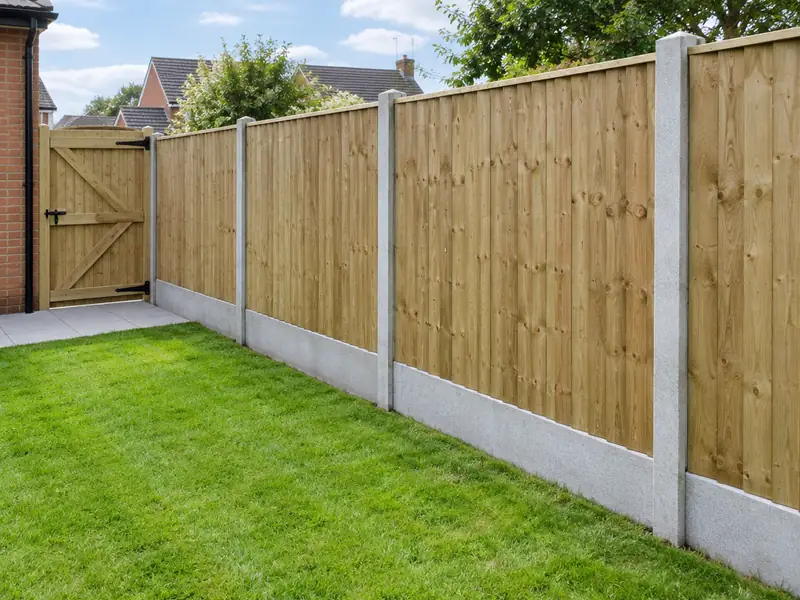
Fencing installation is setting fence posts into the ground, usually in concrete, and fixing panels or boards between them to mark a boundary, add privacy or keep children and pets in, with gates fitted where access is needed.
We take on new fencing and gates throughout Dungannon and the surrounding BT71 postcodes, as well as in Cookstown, Armagh and Portadown. The guide range for this work in Northern Ireland is £1,050–£2,600 including VAT; where your project falls depends on its size, the materials you pick and how easy the site is to reach. A free survey turns that range into a fixed figure.
- Guide price
- £1,050–£2,600 inc VAT
- Time on site
- 1–3 days for a typical garden
- Postcodes
- BT71
- Planning rules
- Northern Ireland
- Local area
- County Tyrone
- Survey
- Free, with a written quote
What should you budget for new fencing and gates in Dungannon?
Below is a breakdown of typical costs for new fencing and gates in Dungannon. Because rates in Northern Ireland are about 14% below the national guide, the overall guide comes to £1,050–£2,600, including VAT. Size, materials and access move the figure, and a free-of-charge survey settles it.
| Type of job | What it usually involves | Guide in Dungannon |
|---|---|---|
| Repairs or a short run | Replacing a few panels and posts, or a short run of up to about 6m. | £250–£750 |
| Typical garden boundary | About 20m of panel or closeboard fencing with concrete posts and gravel boards. | £1,050–£2,600 |
| Composite or long runs with gates | Composite or premium fencing, longer runs, or a driveway gate. | £2,600–£6,000 |
Your price depends mostly on:
- Total length and height of fencing
- Fence style and material: panels, closeboard or composite
- Post type: concrete, timber or aluminium
- Ground conditions, slopes and removal of the old fence
What’s included?
- Measured survey of each fence run, levels and slopes
- Removal and disposal of the old fence and posts
- Concrete or timber gravel boards to keep panels off the soil
- Post caps and capping rails where specified
- Gates hung with hinges, latches and locks
- Site cleared and waste removed
Homes in County Tyrone
Tyrone is largely rural, with detached houses and bungalows on individual plots across the countryside, many finished in render or roughcast. Omagh, Dungannon, Cookstown and Strabane have Victorian terraced streets, post-war estates and newer developments, and stone farmhouses survive in older rural areas.
Rural detached homes commonly take extensions, loft rooms, porches and driveways, and older houses may need re-roofing and re-rendering. Town terraces suit rear extensions and window replacement.
Whatever era your Dungannon home dates from, we plan new fencing and gates around how it is actually built rather than a one-size-fits-all specification.
Permissions for new fencing and gates in Dungannon
England, Wales, Scotland and Northern Ireland each handle planning a little differently. Dungannon comes under Northern Ireland, covered below, and we raise any questions with the council before your quote is finalised.
In Northern Ireland, fences, walls and gates have similar height limits under permitted development, lower next to a road.
Building control approval is not needed for ordinary fences.
Rules change and every property is different, so we check the planning history and constraints for your address before we quote.
From survey to handover
We look at the job
We begin by looking at the job in person. During the free survey we discuss options, materials and budget for new fencing and gates, and photograph or measure anything the quote needs to reflect.
Quote in writing
After the survey we send a quote for new fencing and gates that fixes the price for the scope we've agreed. If you want to change materials or scope, we revise it in writing before anything is booked.
Dates and permissions
Before anyone starts, we confirm the programme in writing, check whether consents are required and arrange deliveries. If a skip or scaffolding on the road needs a permit, we apply for it.
On site to finish
Our trades complete new fencing and gates while your point of contact keeps you updated. When everything is finished, we clear the site, take away waste and go through the result with you before handover.
Why homeowners choose us
Common questions
What happens at the survey?
We visit your home at a time that suits you, look at the area involved, take measurements and check access, condition and any services that might be affected. We talk through what you want from new fencing and gates, explain the options and answer questions. There is no charge and no obligation; afterwards we send a written quote.
Who owns the fence between me and my neighbour?
Fence ownership is usually shown on the title plan or deeds, sometimes with a T mark on the side of the owner. If it is unclear, it may be shared. Even on your own boundary, it is sensible to talk to neighbours before replacing a fence, agree access and confirm the line. We fit the fence on the line you confirm and can face the good side outwards if you wish.
What kind of gate do I need?
The right gate depends on its job. A side gate for access to the back garden is usually timber or metal, around 0.9m to 1m wide, with a secure lock. Driveway gates are wider, often in pairs, and need strong posts. Composite and metal gates resist warping. We measure the opening, check posts and suggest hinges, latches and locks for security.
Can I stay at home during the work?
In most cases, yes. Most people can live at home throughout, and we plan the work to keep disruption down by protecting floors, agreeing working hours and keeping access routes clear. Bigger jobs affecting kitchens, bathrooms or heating may mean a short spell with reduced facilities, and we talk this through with you at the survey.
How high can my fence be?
Fence height limits depend on planning rules, your home's location, whether it is listed or in a conservation area, and which UK nation you live in. In England, fences up to 2m high are usually permitted development, reduced to 1m next to a road used by vehicles. Higher fences need planning permission. We check the rules for your boundary before quoting.
Also covering areas around Dungannon
Dungannon and its BT71 postcodes are part of our coverage. Homeowners in Cookstown, Armagh and Portadown can also book a free survey with us and receive a written price for their job.