
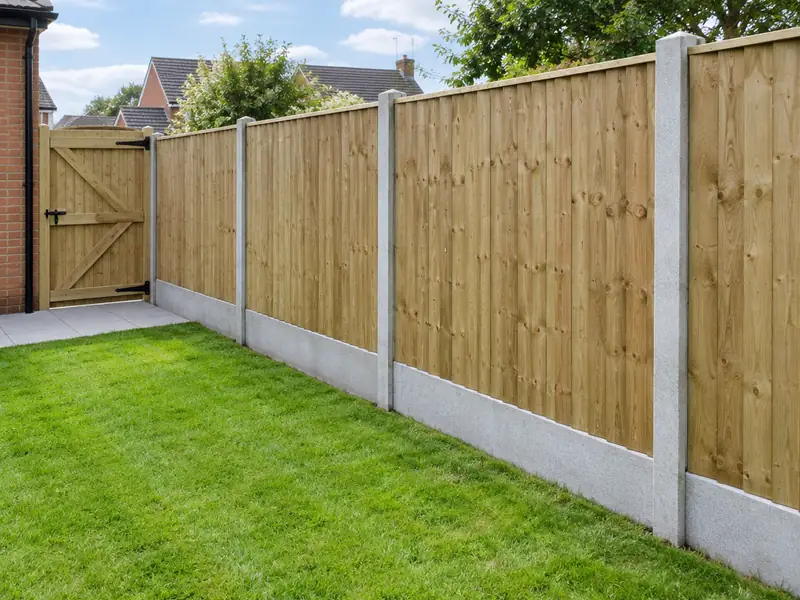
Fencing installation is setting fence posts into the ground, usually in concrete, and fixing panels or boards between them to mark a boundary, add privacy or keep children and pets in, with gates fitted where access is needed.
If you live in Vale of Leven and are weighing up new fencing and gates, the starting point is a visit to measure up and talk through what you want, which costs nothing. We cover homes across G82, and a typical project of this kind in Scotland lands somewhere in the £1,150–£2,900 bracket, including VAT. The exact figure depends on size, access and the finish you choose.
- Guide price
- £1,150–£2,900 inc VAT
- Time on site
- 1–3 days for a typical garden
- Postcodes
- G82
- Planning rules
- Scotland
- Local area
- West Dunbartonshire
- Survey
- Free, with a written quote
How much do new fencing and gates cost in Vale of Leven?
Below is a breakdown of typical costs for new fencing and gates in Vale of Leven. Because rates in Scotland are about 4% below the national guide, the overall guide comes to £1,150–£2,900, including VAT. Size, materials and access move the figure, and a free-of-charge survey settles it.
| Type of job | What it usually involves | Guide in Vale of Leven |
|---|---|---|
| Repairs or a short run | Replacing a few panels and posts, or a short run of up to about 6m. | £300–£850 |
| Typical garden boundary | About 20m of panel or closeboard fencing with concrete posts and gravel boards. | £1,150–£2,900 |
| Composite or long runs with gates | Composite or premium fencing, longer runs, or a driveway gate. | £2,900–£6,700 |
Your price depends mostly on:
- Total length and height of fencing
- Fence style and material: panels, closeboard or composite
- Post type: concrete, timber or aluminium
- Number, size and type of gates
What do you get?
- Measured survey of each fence run, levels and slopes
- Removal and disposal of the old fence and posts
- Concrete or timber posts set in concrete
- Concrete or timber gravel boards to keep panels off the soil
- Post caps and capping rails where specified
- Site cleared and waste removed
What are homes like around Vale of Leven?
Clydebank was heavily rebuilt after wartime bombing and has tenements and post-war estates, while Dumbarton has sandstone tenements and Victorian housing. Bearsden and Milngavie are known for Victorian villas and interwar bungalows, and Kirkintilloch mixes older terraces with post-war semis and newer developments.
Bungalows commonly suit loft conversions with dormers, and villas often take kitchen extensions and landscaping. Tenement flats may need window replacement, and harled homes often need re-rendering.
These patterns matter for new fencing and gates: older walls, roofs and floors in Vale of Leven can need different materials or extra preparation compared with newer homes.
Planning and building rules in Vale of Leven
Vale of Leven is in Scotland, so the planning and building rules set out below are the ones that apply. We confirm the details with the council before we quote.
In Scotland, gates, fences and walls up to 2 m high are usually permitted development, with a 1 m limit in front of the house or next to a road.
A building warrant is not needed for ordinary garden fences.
Rules change and every property is different, so we check the planning history and constraints for your address before we quote.
How does the job run?
We look at the job
Book a visit and we'll come to you. The survey covers measurements, the state of what's there now and any obvious constraints, so the price that follows is based on your actual home, not an average.
Price and scope agreed
You get the price in writing, itemised so you can see where the money goes. As long as the specification stays the same, that is the price you pay for new fencing and gates.
Plan and prepare
Before anyone starts, we confirm the programme in writing, check whether consents are required and arrange deliveries. If a skip or scaffolding on the road needs a permit, we apply for it.
The work itself
Work goes ahead as scheduled and you deal with one contact throughout. When the last trade leaves, we clear and clean the site, talk you through what has been done and pass on any certificates and care instructions.
Working with SK Home Improvements
Common questions
Can you combine new fencing and gates with other work?
Yes. Because we manage several trades under one contract, we can plan new fencing and gates alongside other work on your Vale of Leven home, such as new windows with rendering, or a kitchen refit with an extension. Combining jobs can reduce repeat set-up such as scaffolding, skips and access, and every element is listed and priced in the same written quote.
Is the price fixed?
Yes, for the specification we agree. Your written quote sets out exactly what is included at a fixed price. It only changes if you ask for something different, or if a problem the survey could not reasonably reveal later needs extra work. In either case we explain the change and confirm it in writing before going ahead.
How do I make my fence last longer?
A fence lasts longer when timber is kept off the soil and protected from moisture. Gravel boards beneath the panels, concrete posts and keeping plants and soil away from the fence all help. Treat timber with a preservative or stain every few years, and replace damaged boards promptly. Composite fencing needs only occasional washing.
How do you fence a sloping garden?
On a sloping garden, fence panels are usually stepped, so each panel is level and set slightly higher or lower than the one before, with the gap below filled by a gravel board. Closeboard fences can instead follow the slope, giving a smooth top line. The choice depends on how steep the slope is and the look you want. We discuss both at the survey.
How long does it take to replace a fence?
Replacing a typical 20m garden fence usually takes one to two days, including taking down the old fence, setting posts in concrete and fitting panels or boards. Longer runs, slopes, hard ground and gates take longer. Post concrete needs time to set before panels are fully loaded. We give you an expected timeline with your quote.
Also covering areas around Vale of Leven
We survey and quote throughout Vale of Leven's G82 postcodes and in surrounding places such as Dumbarton, Helensburgh and Erskine. The process and pricing approach are identical in each of them.