
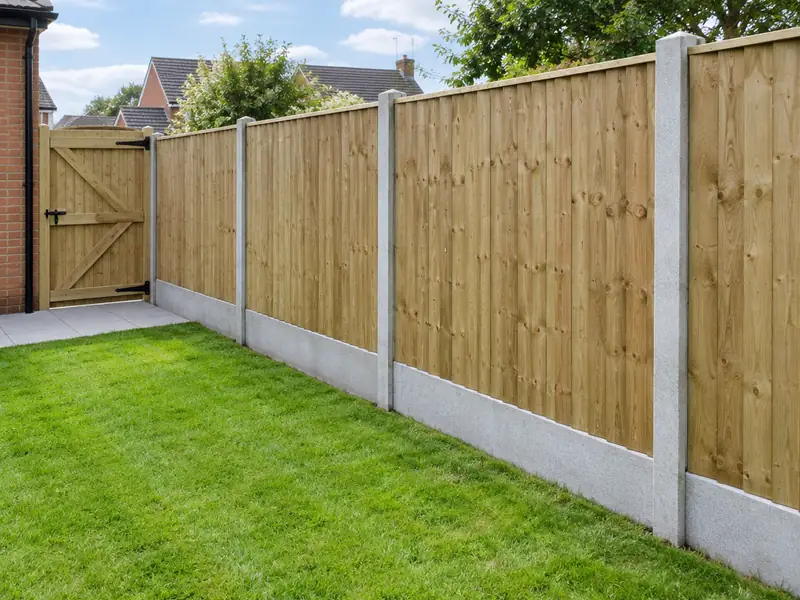
Fencing installation is setting fence posts into the ground, usually in concrete, and fixing panels or boards between them to mark a boundary, add privacy or keep children and pets in, with gates fitted where access is needed.
Every house in Newport, Gwent is a little different, so we never price new fencing and gates from a brochure. We look at the structure, access and existing finishes first, then put in writing a fixed figure for the scope we settle on. As a rough steer, homeowners in Wales should budget £1,100–£2,800 including VAT, with work typically taking 1–3 days for a typical garden.
- Guide price
- £1,100–£2,800 inc VAT
- Time on site
- 1–3 days for a typical garden
- Postcodes
- NP10, NP19 and NP20
- Planning rules
- Wales
- Local area
- Newport
- Survey
- Free, with a written quote
Fencing and gates prices in Newport, Gwent
The table below shows guide prices for new fencing and gates in Newport, Gwent. They are based on rates in Wales, which run about 8% below the national guide, giving an overall range of £1,100–£2,800. All figures include VAT and are firmed up after a free site survey.
| Type of job | What it usually involves | Guide in Newport |
|---|---|---|
| Repairs or a short run | Replacing a few panels and posts, or a short run of up to about 6m. | £300–£850 |
| Typical garden boundary | About 20m of panel or closeboard fencing with concrete posts and gravel boards. | £1,100–£2,800 |
| Composite or long runs with gates | Composite or premium fencing, longer runs, or a driveway gate. | £2,800–£6,400 |
The main things that change the figure:
- Total length and height of fencing
- Fence style and material: panels, closeboard or composite
- Post type: concrete, timber or aluminium
- Ground conditions, slopes and removal of the old fence
What do you get?
- Measured survey of each fence run, levels and slopes
- Removal and disposal of the old fence and posts
- Concrete or timber gravel boards to keep panels off the soil
- Panels or boards fixed level or stepped to follow the ground
- Post caps and capping rails where specified
- Gates hung with hinges, latches and locks
Homes in Gwent
Newport has Victorian and Edwardian terraces and interwar suburbs, while valley towns such as Ebbw Vale, Abertillery and Blaenavon have stone terraces stepped along steep hillsides. Monmouth and Abergavenny keep Georgian centres, and Cwmbran was built as a post-war new town with planned estates.
Valley terraces commonly need repointing, roof work and window replacement, and steep plots can make extensions more involved. Newport terraces suit loft rooms, while Cwmbran homes often take garage conversions and cladding upgrades.
That variety is why a guide price for new fencing and gates in Newport, Gwent is only a starting point; the survey shows what your particular property needs.
Do you need permission in Newport, Gwent?
Because Newport, Gwent falls under Wales's rules, the guidance below is the version relevant to you. Before sending a price, we check your property's position with the council.
In Wales, fences, walls and gates up to 2 m high (1 m next to a road) are usually permitted development.
Building Regulations do not apply to ordinary fences.
Rules change and every property is different, so we check the planning history and constraints for your address before we quote.
The four stages
We look at the job
We arrange a free site survey on a date convenient to you. We measure up, look at the existing structure and access, and discuss your plans for new fencing and gates so the price reflects your home.
Written quote
The quote arrives in writing, not over the phone. It covers the full scope, the finishes you've chosen, any exclusions and the payment schedule, with a fixed price tied to that specification.
Dates and permissions
Once you accept, we agree start dates, order materials and deal with any planning, building control or neighbour notices the job needs. You'll know who is coming and when before work begins.
The work itself
During the work we protect the areas around it and tidy up at the end of each day. Once complete, we check the finish, remove our materials and hand over paperwork such as building control sign-off where it applies.
What you can expect from us
Frequently asked questions
Can I stay at home during the work?
In most cases, yes. Most people can live at home throughout, and we plan the work to keep disruption down by protecting floors, agreeing working hours and keeping access routes clear. Bigger jobs affecting kitchens, bathrooms or heating may mean a short spell with reduced facilities, and we talk this through with you at the survey.
How much does a new fence cost?
About 20m of new panel or closeboard fencing with concrete posts costs £1,100–£2,800, including removal of the old fence. As a guide, allow roughly £55–£130 per metre plus a small fixed cost for removal and waste. Lap panels sit at the lower end, while closeboard, slatted and composite fencing cost more. Gates, slopes and hard ground add to the price. We confirm a fixed price after measuring.
How high can my fence be?
Fence height limits depend on planning rules, your home's location, whether it is listed or in a conservation area, and which UK nation you live in. In England, fences up to 2m high are usually permitted development, reduced to 1m next to a road used by vehicles. Higher fences need planning permission. We check the rules for your boundary before quoting.
How do you fence a sloping garden?
On a sloping garden, fence panels are usually stepped, so each panel is level and set slightly higher or lower than the one before, with the gap below filled by a gravel board. Closeboard fences can instead follow the slope, giving a smooth top line. The choice depends on how steep the slope is and the look you want. We discuss both at the survey.
Do I need planning permission in Newport, Gwent?
It depends on the work, the size of the project, your property type and whether the building is listed or in a conservation area. Newport, Gwent is in Wales, so Wales's rules apply. Many smaller jobs need no planning application, but some still need building control approval. We check what applies to your address before quoting.
Nearby towns
From NP10, NP19 and NP20 to the edges of Newport, Gwent and on into Risca, Cwmbran and Pontypool, we can arrange a site visit and a written quote for your project, planned around dates that work for you.