
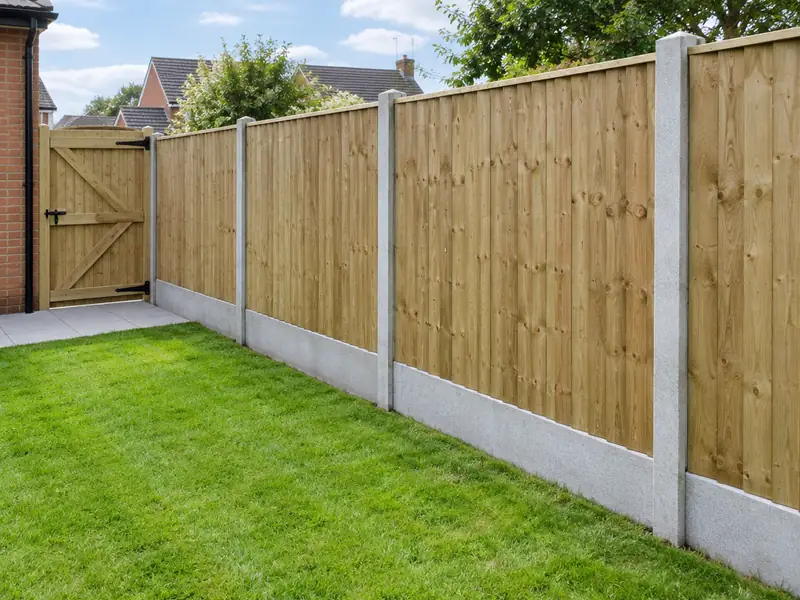
Fencing installation is setting fence posts into the ground, usually in concrete, and fixing panels or boards between them to mark a boundary, add privacy or keep children and pets in, with gates fitted where access is needed.
If you live in Dalserf and are weighing up new fencing and gates, the starting point is a visit to measure up and talk through what you want, which costs nothing. We cover homes across ML9, and a typical project of this kind in Scotland lands somewhere in the £1,150–£2,900 bracket, including VAT. The exact figure depends on size, access and the finish you choose.
- Guide price
- £1,150–£2,900 inc VAT
- Time on site
- 1–3 days for a typical garden
- Postcodes
- ML9
- Planning rules
- Scotland
- Local area
- South Lanarkshire
- Survey
- Free, with a written quote
What should you budget for new fencing and gates in Dalserf?
The costs listed here are typical for new fencing and gates around Dalserf and include VAT. They reflect labour and material costs in Scotland, about 4% below the national guide, giving a range of £1,150–£2,900. Exact pricing depends on your home, so we only fix it once a free site survey is done.
| Type of job | What it usually involves | Guide in Dalserf |
|---|---|---|
| Repairs or a short run | Replacing a few panels and posts, or a short run of up to about 6m. | £300–£850 |
| Typical garden boundary | About 20m of panel or closeboard fencing with concrete posts and gravel boards. | £1,150–£2,900 |
| Composite or long runs with gates | Composite or premium fencing, longer runs, or a driveway gate. | £2,900–£6,700 |
The main things that change the figure:
- Total length and height of fencing
- Post type: concrete, timber or aluminium
- Ground conditions, slopes and removal of the old fence
- Number, size and type of gates
What do you get?
- Measured survey of each fence run, levels and slopes
- Concrete or timber posts set in concrete
- Concrete or timber gravel boards to keep panels off the soil
- Panels or boards fixed level or stepped to follow the ground
- Gates hung with hinges, latches and locks
- Site cleared and waste removed
Local housing and new fencing and gates
Lanarkshire mixes sandstone tenements and terraces in Hamilton, Motherwell, Airdrie and Coatbridge with former miners' rows and large post-war estates, many finished in roughcast. East Kilbride and Cumbernauld were developed as post-war new towns, and newer private estates surround most towns.
Roughcast homes commonly need re-rendering, window replacement and roof work. Semis and bungalows suit extensions and loft conversions, and new-town houses often take garage conversions and driveways.
Knowing the typical building types in Lanarkshire helps, but a survey of your own home in Dalserf is what decides the right approach to new fencing and gates.
Permissions for new fencing and gates in Dalserf
The notes below cover Scotland, which is where Dalserf sits. Rules change and every property is different, so we speak to the council before pricing your job.
In Scotland, gates, fences and walls up to 2 m high are usually permitted development, with a 1 m limit in front of the house or next to a road.
A building warrant is not needed for ordinary garden fences.
Rules change and every property is different, so we check the planning history and constraints for your address before we quote.
The four stages
Survey and measure
Book a visit and we'll come to you. The survey covers measurements, the state of what's there now and any obvious constraints, so the price that follows is based on your actual home, not an average.
Price and scope agreed
After the survey we send a quote for new fencing and gates that fixes the price for the scope we've agreed. If you want to change materials or scope, we revise it in writing before anything is booked.
Plan and prepare
Next comes planning the work itself. We set a start date that suits you, line up the right trades, and make sure any approvals for new fencing and gates are in place before the first day on site.
Finish and handover
The job proceeds in the order set out in the programme, with dust and debris kept under control. Finally we tidy away, inspect the work together and pass the finished project over to you with its paperwork.
Working with SK Home Improvements
Common questions
How much does a new fence cost?
About 20m of new panel or closeboard fencing with concrete posts costs £1,150–£2,900, including removal of the old fence. As a guide, allow roughly £55–£130 per metre plus a small fixed cost for removal and waste. Lap panels sit at the lower end, while closeboard, slatted and composite fencing cost more. Gates, slopes and hard ground add to the price. We confirm a fixed price after measuring.
How high can my fence be?
Fence height limits depend on planning rules, your home's location, whether it is listed or in a conservation area, and which UK nation you live in. In England, fences up to 2m high are usually permitted development, reduced to 1m next to a road used by vehicles. Higher fences need planning permission. We check the rules for your boundary before quoting.
How do I make my fence last longer?
A fence lasts longer when timber is kept off the soil and protected from moisture. Gravel boards beneath the panels, concrete posts and keeping plants and soil away from the fence all help. Treat timber with a preservative or stain every few years, and replace damaged boards promptly. Composite fencing needs only occasional washing.
Which postcodes in Dalserf do you cover?
We cover ML9, along with the rest of Lanarkshire. If your postcode is not listed, get in touch anyway: our coverage is UK-wide, and we can usually arrange a survey wherever you live. Enter your postcode in the guide-price tool or contact form and we will confirm.
What happens at the survey?
We visit your home at a time that suits you, look at the area involved, take measurements and check access, condition and any services that might be affected. We talk through what you want from new fencing and gates, explain the options and answer questions. There is no charge and no obligation; afterwards we send a written quote.
Nearby towns
We cover every part of Dalserf, including ML9, and nearby Larkhall, Wishaw and Meikle Earnock. Wherever you are within that patch, the survey is free and the quote comes to you in writing.