
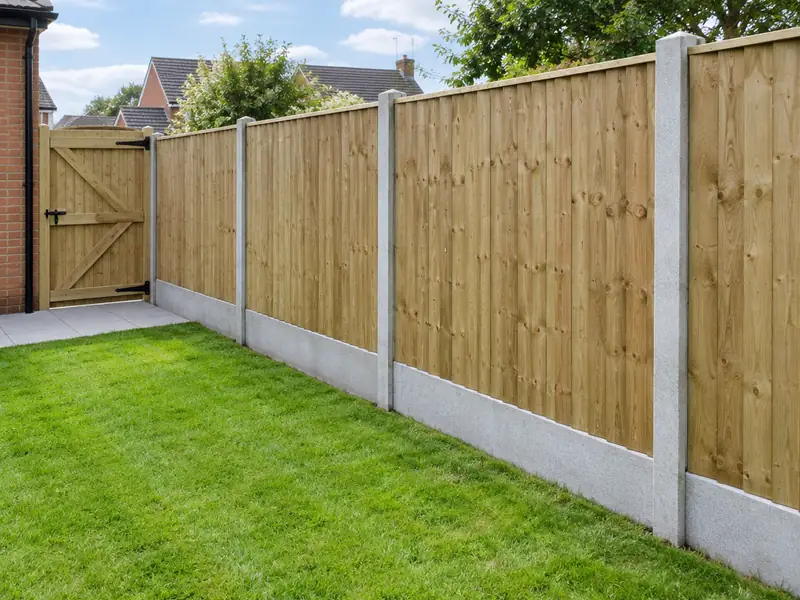
Fencing installation is setting fence posts into the ground, usually in concrete, and fixing panels or boards between them to mark a boundary, add privacy or keep children and pets in, with gates fitted where access is needed.
Pinner sits within our coverage for new fencing and gates, as do neighbouring Wealdstone, Ruislip and Harrow. Before giving a price we want to see the property: the condition of what's there now, the access, and anything that might need extra work. The guide range for London is £1,550–£3,900 including VAT, and your written quote will spell out exactly what that covers.
- Guide price
- £1,550–£3,900 inc VAT
- Time on site
- 1–3 days for a typical garden
- Postcodes
- HA1, HA2, HA4, HA5 and HA6
- Planning rules
- England
- Local area
- Greater London
- Survey
- Free, with a written quote
How much do new fencing and gates cost in Pinner?
To help you plan, we show what new fencing and gates typically costs in Pinner instead of holding figures back for a sales call. The range is £1,550–£3,900 with VAT, using rates in London that are about 30% above the national guide. A free survey then fixes your actual price.
| Type of job | What it usually involves | Guide in Pinner |
|---|---|---|
| Repairs or a short run | Replacing a few panels and posts, or a short run of up to about 6m. | £400–£1,150 |
| Typical garden boundary | About 20m of panel or closeboard fencing with concrete posts and gravel boards. | £1,550–£3,900 |
| Composite or long runs with gates | Composite or premium fencing, longer runs, or a driveway gate. | £3,900–£9,100 |
The main things that change the figure:
- Total length and height of fencing
- Fence style and material: panels, closeboard or composite
- Ground conditions, slopes and removal of the old fence
- Number, size and type of gates
What do you get?
- Measured survey of each fence run, levels and slopes
- Concrete or timber posts set in concrete
- Panels or boards fixed level or stepped to follow the ground
- Post caps and capping rails where specified
- Gates hung with hinges, latches and locks
- Site cleared and waste removed
Homes in London
London's housing is dominated by Victorian and Edwardian terraces, often in yellow London stock brick, with Georgian terraces in central districts and mansion blocks across many inner areas. Outer boroughs have large belts of interwar semis, and there are extensive post-war council estates. Many houses have been split into flats, and conservation areas are widespread.
London Clay shrinks and swells with the seasons, and street trees close to houses can contribute to movement, which affects foundation design.
If your house in Pinner fits one of these patterns, it helps us anticipate what new fencing and gates will involve, though we always confirm the details on site.
Permissions for new fencing and gates in Pinner
Planning law differs across the UK. For a home in Pinner, it is the England rules below that count, and we check them with the council ahead of any quote.
In England, fences, walls and gates up to 2 m high are usually permitted development, or up to 1 m where they are next to a road used by vehicles or its footpath. Listed buildings, conservation areas and estates with planning conditions can be stricter.
Building Regulations do not apply to ordinary garden fences, but boundary lines should be agreed with your neighbour first.
Rules change and every property is different, so we check the planning history and constraints for your address before we quote.
From survey to handover
Free site survey
We arrange a free site survey on a date convenient to you. We measure up, look at the existing structure and access, and discuss your plans for new fencing and gates so the price reflects your home.
Your fixed price
We turn the survey notes into a written quote. The price is fixed for the specification we agree, and the document sets out materials, scope and payment stages in plain language.
Dates and permissions
Before anyone starts, we confirm the programme in writing, check whether consents are required and arrange deliveries. If a skip or scaffolding on the road needs a permit, we apply for it.
On site to finish
Our trades complete new fencing and gates while your point of contact keeps you updated. When everything is finished, we clear the site, take away waste and go through the result with you before handover.
Why homeowners choose us
Common questions
How high can my fence be?
Fence height limits depend on planning rules, your home's location, whether it is listed or in a conservation area, and which UK nation you live in. In England, fences up to 2m high are usually permitted development, reduced to 1m next to a road used by vehicles. Higher fences need planning permission. We check the rules for your boundary before quoting.
How do I make my fence last longer?
A fence lasts longer when timber is kept off the soil and protected from moisture. Gravel boards beneath the panels, concrete posts and keeping plants and soil away from the fence all help. Treat timber with a preservative or stain every few years, and replace damaged boards promptly. Composite fencing needs only occasional washing.
How much will new fencing and gates cost in Pinner?
As a guide, expect to pay £1,550–£3,900 including VAT for new fencing and gates in Pinner. That range is adjusted for London, which runs about 30% above the national guide. Where your project lands depends on size, materials, access and the condition of what is already there. We confirm a fixed price in writing after a free survey of your home.
Which postcodes in Pinner do you cover?
We cover HA1, HA2, HA4 and HA5, along with the rest of London. If your postcode is not listed, get in touch anyway: our coverage is UK-wide, and we can usually arrange a survey wherever you live. Enter your postcode in the guide-price tool or contact form and we will confirm.
How do you fence a sloping garden?
On a sloping garden, fence panels are usually stepped, so each panel is level and set slightly higher or lower than the one before, with the gap below filled by a gravel board. Closeboard fences can instead follow the slope, giving a smooth top line. The choice depends on how steep the slope is and the look you want. We discuss both at the survey.
Nearby towns
If your address falls within HA1, HA2, HA4 and HA5, we cover it. The same goes for neighbouring Wealdstone, Ruislip and Harrow, which we include alongside Pinner when arranging surveys and quotes.