
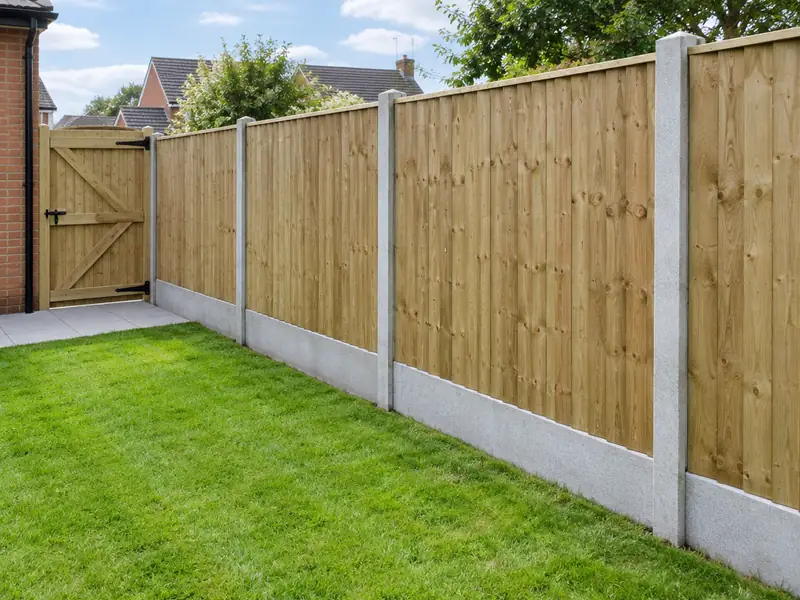
Fencing installation is setting fence posts into the ground, usually in concrete, and fixing panels or boards between them to mark a boundary, add privacy or keep children and pets in, with gates fitted where access is needed.
We take on new fencing and gates throughout Peebles and the surrounding EH45 postcodes, as well as in Penicuik, Galashiels and Bonnyrigg. The guide range for this work in Scotland is £1,150–£2,900 including VAT; where your project falls depends on its size, the materials you pick and how easy the site is to reach. A free survey turns that range into a fixed figure.
- Guide price
- £1,150–£2,900 inc VAT
- Time on site
- 1–3 days for a typical garden
- Postcodes
- EH45
- Planning rules
- Scotland
- Local area
- The Scottish Borders
- Survey
- Free, with a written quote
What should you budget for new fencing and gates in Peebles?
Budgeting for new fencing and gates in Peebles? The numbers below include VAT and are adjusted for Scotland, where costs are about 4% below the national guide. The headline range is £1,150–£2,900. Nothing is final until we have measured up at a free survey and agreed the specification with you.
| Type of job | What it usually involves | Guide in Peebles |
|---|---|---|
| Repairs or a short run | Replacing a few panels and posts, or a short run of up to about 6m. | £300–£850 |
| Typical garden boundary | About 20m of panel or closeboard fencing with concrete posts and gravel boards. | £1,150–£2,900 |
| Composite or long runs with gates | Composite or premium fencing, longer runs, or a driveway gate. | £2,900–£6,700 |
Expect these to shape the final quote:
- Total length and height of fencing
- Fence style and material: panels, closeboard or composite
- Post type: concrete, timber or aluminium
- Ground conditions, slopes and removal of the old fence
What do you get?
- Measured survey of each fence run, levels and slopes
- Removal and disposal of the old fence and posts
- Concrete or timber posts set in concrete
- Post caps and capping rails where specified
- Gates hung with hinges, latches and locks
- Site cleared and waste removed
Building in Peebles
Mill towns such as Hawick, Galashiels and Selkirk have stone terraces and tenements from the textile industry, Melrose and Kelso have older sandstone centres, and farmhouses and cottages across the Borders are built of whinstone or sandstone under slate roofs. Post-war and newer estates surround the larger towns.
Cold winters with frost and snow on higher ground, and the Tweed and Teviot can flood low-lying properties.
That mix of housing shapes how we approach new fencing and gates in Peebles: the age and construction of your home affect the materials, the method and, in the end, the price.
Permissions for new fencing and gates in Peebles
The notes below cover Scotland, which is where Peebles sits. Rules change and every property is different, so we speak to the council before pricing your job.
In Scotland, gates, fences and walls up to 2 m high are usually permitted development, with a 1 m limit in front of the house or next to a road.
A building warrant is not needed for ordinary garden fences.
Rules change and every property is different, so we check the planning history and constraints for your address before we quote.
How does the job run?
Free site survey
First, someone visits your home in Peebles to see the space, take measurements and note anything that could affect the work, such as access or the condition of what is there. There is no charge for this visit.
Quote in writing
We put everything into a written, fixed-price quote: the specification, what's excluded, staged payments and the expected time on site. Take whatever time you need to decide; there's no pressure to commit.
Getting ready
Preparation matters as much as the build. We agree access, parking and working hours with you, order materials in good time, and confirm any permissions so the job isn't held up once it starts.
The work itself
Work goes ahead as scheduled and you deal with one contact throughout. When the last trade leaves, we clear and clean the site, talk you through what has been done and pass on any certificates and care instructions.
Why homeowners choose us
Frequently asked questions
Do you cover Penicuik, Galashiels and Bonnyrigg?
Yes. As well as Peebles, we cover Penicuik, Galashiels and Bonnyrigg and the rest of Scottish Borders. Our coverage is UK-wide, so the process is the same wherever you are: a free site survey, a quote in writing that fixes the price for the agreed scope, and one point of contact while the work is planned and carried out.
Can I stay at home during the work?
In most cases, yes. Most people can live at home throughout, and we plan the work to keep disruption down by protecting floors, agreeing working hours and keeping access routes clear. Bigger jobs affecting kitchens, bathrooms or heating may mean a short spell with reduced facilities, and we talk this through with you at the survey.
Are concrete posts better than timber?
Concrete posts do not rot and are the most durable choice for panel fences, especially on exposed sites. They are heavier and more utilitarian in appearance. Timber posts look more natural and suit closeboard and featheredge fences, but they eventually rot at ground level, even when treated. Aluminium posts suit composite systems. We recommend posts based on your fence style and exposure.
How do I make my fence last longer?
A fence lasts longer when timber is kept off the soil and protected from moisture. Gravel boards beneath the panels, concrete posts and keeping plants and soil away from the fence all help. Treat timber with a preservative or stain every few years, and replace damaged boards promptly. Composite fencing needs only occasional washing.
How high can my fence be?
Fence height limits depend on planning rules, your home's location, whether it is listed or in a conservation area, and which UK nation you live in. In England, fences up to 2m high are usually permitted development, reduced to 1m next to a road used by vehicles. Higher fences need planning permission. We check the rules for your boundary before quoting.
Nearby towns
Coverage for Peebles spans EH45. Close by, Penicuik, Galashiels and Bonnyrigg are covered too, and the rest of our UK-wide area follows the same survey-then-quote process from start to finish.