
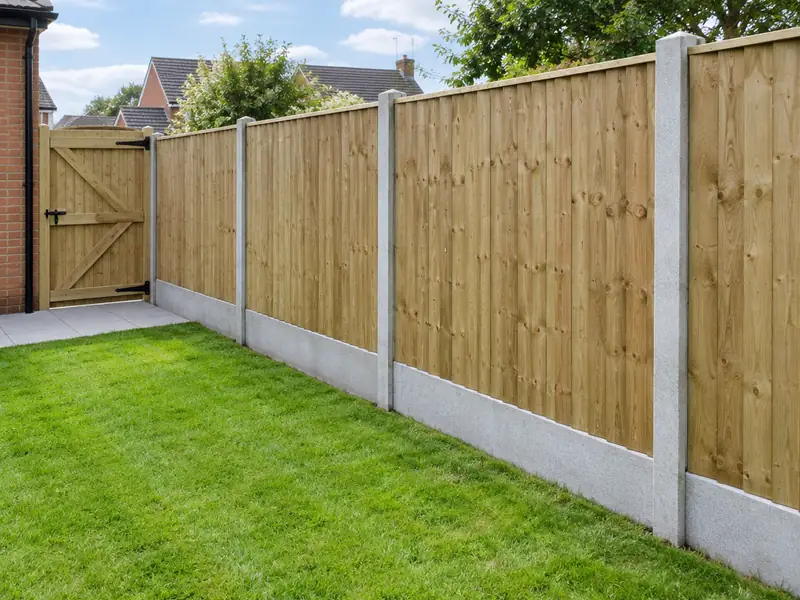
Fencing installation is setting fence posts into the ground, usually in concrete, and fixing panels or boards between them to mark a boundary, add privacy or keep children and pets in, with gates fitted where access is needed.
Thinking about new fencing and gates in Bury St Edmunds? We take charge of the whole project, co-ordinating every trade involved, and one person keeps you updated. Guide prices for the East of England sit at £1,250–£3,200 including VAT, and a typical job takes 1–3 days for a typical garden. Your own figure depends on what the survey finds and the specification you settle on.
- Guide price
- £1,250–£3,200 inc VAT
- Time on site
- 1–3 days for a typical garden
- Postcodes
- IP32 and IP33
- Planning rules
- England
- Local area
- Suffolk
- Survey
- Free, with a written quote
How much do new fencing and gates cost in Bury St Edmunds?
To help you plan, we show what new fencing and gates typically costs in Bury St Edmunds instead of holding figures back for a sales call. The range is £1,250–£3,200 with VAT, using rates in the East of England that are about 5% above the national guide. A free survey then fixes your actual price.
| Type of job | What it usually involves | Guide in Bury St Edmunds |
|---|---|---|
| Repairs or a short run | Replacing a few panels and posts, or a short run of up to about 6m. | £300–£950 |
| Typical garden boundary | About 20m of panel or closeboard fencing with concrete posts and gravel boards. | £1,250–£3,200 |
| Composite or long runs with gates | Composite or premium fencing, longer runs, or a driveway gate. | £3,200–£7,400 |
The main things that change the figure:
- Total length and height of fencing
- Post type: concrete, timber or aluminium
- Ground conditions, slopes and removal of the old fence
- Number, size and type of gates
What do you get?
- Measured survey of each fence run, levels and slopes
- Removal and disposal of the old fence and posts
- Concrete or timber posts set in concrete
- Concrete or timber gravel boards to keep panels off the soil
- Post caps and capping rails where specified
- Gates hung with hinges, latches and locks
Local housing and new fencing and gates
Suffolk villages are full of timber-framed cottages, many limewashed in traditional colours such as Suffolk pink, with pargeting and thatch in places. Flint and pale gault brick are common too. Ipswich has Victorian terraces and interwar estates, Bury St Edmunds has Georgian streets, and Lowestoft and Felixstowe mix Victorian seaside housing with newer estates.
Timber-framed buildings need breathable lime plaster and render, and roof repairs that suit the original materials. Terraces suit loft conversions and rear extensions, while newer homes commonly take garage conversions and porches.
For new fencing and gates in Bury St Edmunds, this means checking things like wall construction, roof structure and existing services before we put a figure on paper.
Planning and building rules in Bury St Edmunds
Each UK nation sets its own consent rules, and Bury St Edmunds is in England. What follows is a plain summary; we check the specifics for your property with the council before pricing anything.
In England, fences, walls and gates up to 2 m high are usually permitted development, or up to 1 m where they are next to a road used by vehicles or its footpath. Listed buildings, conservation areas and estates with planning conditions can be stricter.
Building Regulations do not apply to ordinary garden fences, but boundary lines should be agreed with your neighbour first.
Rules change and every property is different, so we check the planning history and constraints for your address before we quote.
From survey to handover
Free site survey
We arrange a free site survey on a date convenient to you. We measure up, look at the existing structure and access, and discuss your plans for new fencing and gates so the price reflects your home.
Written quote
After the survey we send a quote for new fencing and gates that fixes the price for the scope we've agreed. If you want to change materials or scope, we revise it in writing before anything is booked.
Booking the work
Once you accept, we agree start dates, order materials and deal with any planning, building control or neighbour notices the job needs. You'll know who is coming and when before work begins.
Build and hand over
Our trades complete new fencing and gates while your point of contact keeps you updated. When everything is finished, we clear the site, take away waste and go through the result with you before handover.
How we work
Common questions
What happens at the survey?
We visit your home at a time that suits you, look at the area involved, take measurements and check access, condition and any services that might be affected. We talk through what you want from new fencing and gates, explain the options and answer questions. There is no charge and no obligation; afterwards we send a written quote.
Are concrete posts better than timber?
Concrete posts do not rot and are the most durable choice for panel fences, especially on exposed sites. They are heavier and more utilitarian in appearance. Timber posts look more natural and suit closeboard and featheredge fences, but they eventually rot at ground level, even when treated. Aluminium posts suit composite systems. We recommend posts based on your fence style and exposure.
What kind of gate do I need?
The right gate depends on its job. A side gate for access to the back garden is usually timber or metal, around 0.9m to 1m wide, with a secure lock. Driveway gates are wider, often in pairs, and need strong posts. Composite and metal gates resist warping. We measure the opening, check posts and suggest hinges, latches and locks for security.
Which postcodes in Bury St Edmunds do you cover?
We cover IP32 and IP33, along with the rest of Suffolk. If your postcode is not listed, get in touch anyway: our coverage is UK-wide, and we can usually arrange a survey wherever you live. Enter your postcode in the guide-price tool or contact form and we will confirm.
How do I make my fence last longer?
A fence lasts longer when timber is kept off the soil and protected from moisture. Gravel boards beneath the panels, concrete posts and keeping plants and soil away from the fence all help. Treat timber with a preservative or stain every few years, and replace damaged boards promptly. Composite fencing needs only occasional washing.
Near Bury St Edmunds
If your address falls within IP32 and IP33, we cover it. The same goes for neighbouring Thetford, Stowmarket and Newmarket, which we include alongside Bury St Edmunds when arranging surveys and quotes.