
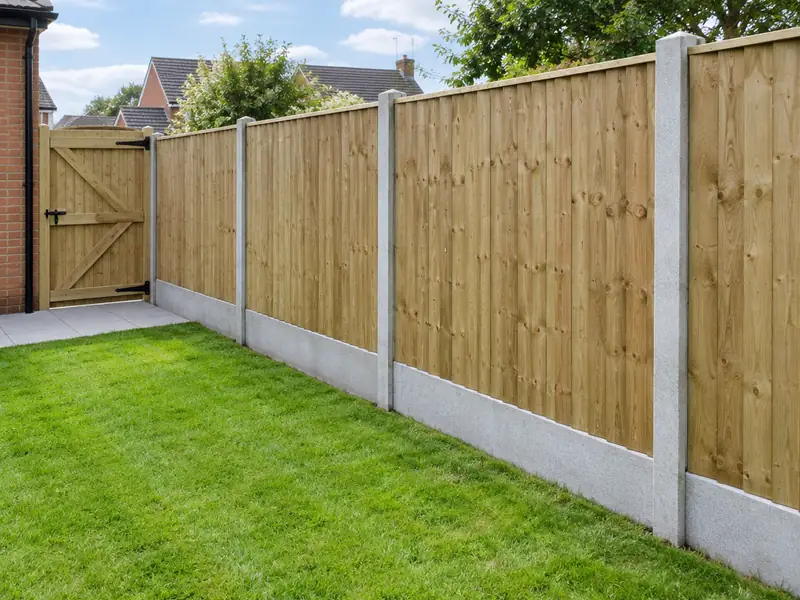
Fencing installation is setting fence posts into the ground, usually in concrete, and fixing panels or boards between them to mark a boundary, add privacy or keep children and pets in, with gates fitted where access is needed.
Every house in Shoreham-by-Sea is a little different, so we never price new fencing and gates from a brochure. We look at the structure, access and existing finishes first, then put in writing a fixed figure for the scope we settle on. As a rough steer, homeowners in the South East should budget £1,350–£3,400 including VAT, with work typically taking 1–3 days for a typical garden.
- Guide price
- £1,350–£3,400 inc VAT
- Time on site
- 1–3 days for a typical garden
- Postcodes
- BN42 and BN43
- Planning rules
- England
- Local area
- West Sussex
- Survey
- Free, with a written quote
What should you budget for new fencing and gates in Shoreham-by-Sea?
These are guide costs, not quotes. For new fencing and gates in Shoreham-by-Sea the range is £1,350–£3,400, VAT included, reflecting prices in the South East that are about 12% above the national guide. Once we have visited for a free survey, you get a firm figure for the scope you approve.
| Type of job | What it usually involves | Guide in Shoreham-by-Sea |
|---|---|---|
| Repairs or a short run | Replacing a few panels and posts, or a short run of up to about 6m. | £350–£1,000 |
| Typical garden boundary | About 20m of panel or closeboard fencing with concrete posts and gravel boards. | £1,350–£3,400 |
| Composite or long runs with gates | Composite or premium fencing, longer runs, or a driveway gate. | £3,400–£7,800 |
Your price depends mostly on:
- Fence style and material: panels, closeboard or composite
- Post type: concrete, timber or aluminium
- Ground conditions, slopes and removal of the old fence
- Number, size and type of gates
What does the job include in Shoreham-by-Sea?
- Measured survey of each fence run, levels and slopes
- Removal and disposal of the old fence and posts
- Concrete or timber gravel boards to keep panels off the soil
- Panels or boards fixed level or stepped to follow the ground
- Post caps and capping rails where specified
- Gates hung with hinges, latches and locks
Local housing and new fencing and gates
Chichester has Georgian brick streets, Downland villages use flint and brick, and Horsham stone slabs cover some older roofs. Worthing and Bognor Regis have interwar and post-war bungalows and semis, Crawley was planned as a post-war new town, and Wealden villages to the north feature tile-hanging and timber framing.
Bungalows commonly suit loft conversions and extensions; new-town homes often take window, roofline and cladding renewal. Flint and stone properties need lime repointing, and coastal homes may need external decorating more often.
Building traditions across West Sussex also raise conservation and planning questions, so we check those for new fencing and gates in Shoreham-by-Sea at the survey stage.
Do you need permission in Shoreham-by-Sea?
For anyone in Shoreham-by-Sea, the relevant framework is England's. The summary below is general, so we always contact the council about your address before putting a price in writing.
In England, fences, walls and gates up to 2 m high are usually permitted development, or up to 1 m where they are next to a road used by vehicles or its footpath. Listed buildings, conservation areas and estates with planning conditions can be stricter.
Building Regulations do not apply to ordinary garden fences, but boundary lines should be agreed with your neighbour first.
Rules change and every property is different, so we check the planning history and constraints for your address before we quote.
How does the job run?
A visit to your home
We begin by looking at the job in person. During the free survey we discuss options, materials and budget for new fencing and gates, and photograph or measure anything the quote needs to reflect.
Your fixed price
Next you receive a written quote with a fixed price for the agreed specification. It lists what is included, what is not, and how payments are staged, so you can compare it properly.
Plan and prepare
With the quote agreed, we book the work in and handle preparation: permissions where needed, building control notifications, material orders and access arrangements for your Shoreham-by-Sea property.
Build and hand over
The job proceeds in the order set out in the programme, with dust and debris kept under control. Finally we tidy away, inspect the work together and pass the finished project over to you with its paperwork.
Why homeowners choose us
Questions about new fencing and gates in Shoreham-by-Sea
How long will new fencing and gates take?
On a typical home, allow 1–3 days for a typical garden. Larger projects, older buildings and extra work found once things are opened up can extend that, while simpler jobs may be shorter. Your quote includes an estimate of time on site, and your point of contact keeps you updated on the programme as the work progresses.
Do I need planning permission in Shoreham-by-Sea?
It depends on the work, the size of the project, your property type and whether the building is listed or in a conservation area. Shoreham-by-Sea is in England, so England's rules apply. Many smaller jobs need no planning application, but some still need building control approval. We check what applies to your address before quoting.
What kind of gate do I need?
The right gate depends on its job. A side gate for access to the back garden is usually timber or metal, around 0.9m to 1m wide, with a secure lock. Driveway gates are wider, often in pairs, and need strong posts. Composite and metal gates resist warping. We measure the opening, check posts and suggest hinges, latches and locks for security.
How do you fence a sloping garden?
On a sloping garden, fence panels are usually stepped, so each panel is level and set slightly higher or lower than the one before, with the gap below filled by a gravel board. Closeboard fences can instead follow the slope, giving a smooth top line. The choice depends on how steep the slope is and the look you want. We discuss both at the survey.
Are concrete posts better than timber?
Concrete posts do not rot and are the most durable choice for panel fences, especially on exposed sites. They are heavier and more utilitarian in appearance. Timber posts look more natural and suit closeboard and featheredge fences, but they eventually rot at ground level, even when treated. Aluminium posts suit composite systems. We recommend posts based on your fence style and exposure.
Also covering areas around Shoreham-by-Sea
From BN42 and BN43 to the edges of Shoreham-by-Sea and on into Lancing, Portslade and Worthing, we can arrange a site visit and a written quote for your project, planned around dates that work for you.