
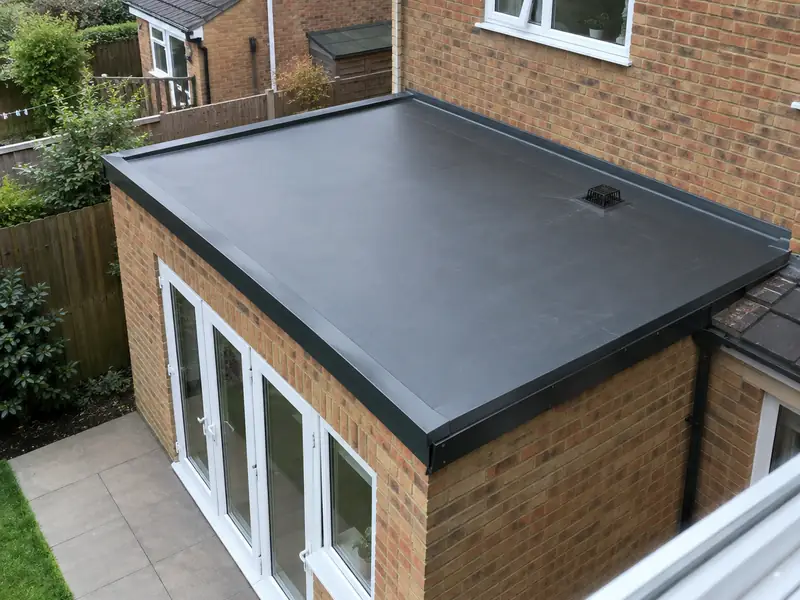
A flat roof replacement strips the old covering from a low-pitched roof and lays a new waterproof system, usually EPDM rubber, GRP fibreglass or torch-on felt, over a sound deck with correct falls, upstands, trims and outlets so rainwater drains away.
We offer a new flat roof across County Durham, and Durham is one of the places we cover, along with nearby Chester-le-Street, Houghton-Le-Spring and Stanley. Before anything is agreed we visit, check the existing structure and talk through your options. You then receive a written quote setting out the full scope; for most homes in the North East it sits within £1,800–£4,000 including VAT.
- Guide price
- £1,800–£4,000 inc VAT
- Time on site
- 1–3 days for most roofs
- Postcodes
- DH1
- Planning rules
- England
- Local area
- County Durham
- Survey
- Free, with a written quote
Flat roofs prices in Durham
Prices for a new flat roof vary from house to house, but in Durham most projects fall within £1,800–£4,000 including VAT. That reflects costs in the North East, about 10% below the national guide. Treat the table as a budgeting aid; the written figure follows a survey we carry out for free.
| Type of job | What it usually involves | Guide in Durham |
|---|---|---|
| Small roof (up to 8m²) | A dormer, bay, porch or small garage roof re-covered in EPDM or GRP. | £700–£1,800 |
| Extension or garage (15–25m²) | A typical extension or single garage roof stripped and re-covered. | £1,800–£4,000 |
| Large or new warm roof | Larger roofs, or roofs needing a new deck and insulation build-up. | £3,600–£8,100 |
The main things that change the figure:
- Roof area and access to the roof
- Condition of the deck and joists underneath
- Insulation upgrades and changes to roof height at edges
- Number of rooflights, pipes and upstands to detail
What’s included?
- Survey of the covering, deck, falls, upstands and drainage
- Stripping and disposal of the old roof covering
- Replacement of rotten or soft deck boards
- Upstands, flashings and drip edges finished neatly
- New trims, outlets and gutter connections
- Rooflights refitted or replaced where required
Building in Durham
Colliery villages across County Durham are lined with brick and stone terraces, many built for mining families. Durham City has Georgian and Victorian streets, Darlington has Victorian terraces and villas, and Peterlee and Newton Aycliffe were planned as post-war new towns. Dales farmhouses in Weardale and Teesdale are stone, often under stone or slate roofs.
Colliery terraces commonly suit loft rooms, rear extensions and window replacement, and many need repointing. New-town homes often benefit from rendering or cladding upgrades and roofline renewal, while stone farmhouses may need lime work.
That mix of housing shapes how we approach a new flat roof in Durham: the age and construction of your home affect the materials, the method and, in the end, the price.
Do you need permission in Durham?
Planning law differs across the UK. For a home in Durham, it is the England rules below that count, and we check them with the council ahead of any quote.
Re-roofing a house with similar materials does not usually need planning permission in England. Listed buildings and conservation areas may need consent if the covering changes.
Replacing more than a quarter of a roof’s covering counts as renovation under Building Regulations, so the work is notified and the roof insulation may need upgrading. Bats are protected across the UK; if they roost under roof tiles, soffits or fascias, work stops and a licensed ecologist advises before it restarts.
Rules change and every property is different, so we check the planning history and constraints for your address before we quote.
What happens after you get in touch?
We look at the job
We arrange a free site survey on a date convenient to you. We measure up, look at the existing structure and access, and discuss your plans for a new flat roof so the price reflects your home.
Price and scope agreed
You get the price in writing, itemised so you can see where the money goes. As long as the specification stays the same, that is the price you pay for a new flat roof.
Plan and prepare
We handle the paperwork side: checking whether planning permission or building control approval is needed, submitting applications where they are, and scheduling the trades and materials around your dates.
The work itself
Our trades complete a new flat roof while your point of contact keeps you updated. When everything is finished, we clear the site, take away waste and go through the result with you before handover.
How we work
Flat roofs in Durham: questions
How long does a flat roof last?
A well-installed EPDM or GRP flat roof can last 25 years or more, while torch-on felt systems typically last around 15–25 years, depending on quality and exposure. Lifespan depends on correct falls, good detailing at edges and upstands, and keeping outlets clear. Foot traffic, ponding and poor ventilation shorten it. Annual checks help catch small problems early.
Should I insulate my flat roof when it is replaced?
Replacing a flat roof is the most cost-effective time to add insulation, because the covering is already off. A warm roof, with insulation laid above the deck, keeps the structure warm and reduces condensation risk. Building regulations may require insulation when a large part of the roof is renewed. It raises the roof height slightly, which affects trims and upstands.
Can you combine a new flat roof with other work?
Yes. Because we manage several trades under one contract, we can plan a new flat roof alongside other work on your Durham home, such as new windows with rendering, or a kitchen refit with an extension. Combining jobs can reduce repeat set-up such as scaffolding, skips and access, and every element is listed and priced in the same written quote.
Is a flat roof suitable for a roof terrace?
A flat roof can only be used as a terrace if it is designed for it, with joists strong enough for people and furniture, a hard-wearing surface, safe edge protection and correct drainage. Using a standard extension roof as a terrace can damage it and may need planning permission and building regulations approval. We can advise on what a conversion would involve.
Can I stay at home during the work?
In most cases, yes. Most people can live at home throughout, and we plan the work to keep disruption down by protecting floors, agreeing working hours and keeping access routes clear. Bigger jobs affecting kitchens, bathrooms or heating may mean a short spell with reduced facilities, and we talk this through with you at the survey.
Nearby towns
Live in Durham? Our coverage takes in the DH1 postcode areas and reaches out to Chester-le-Street, Houghton-Le-Spring and Stanley, so homes on the outskirts and in the next town along are included.