
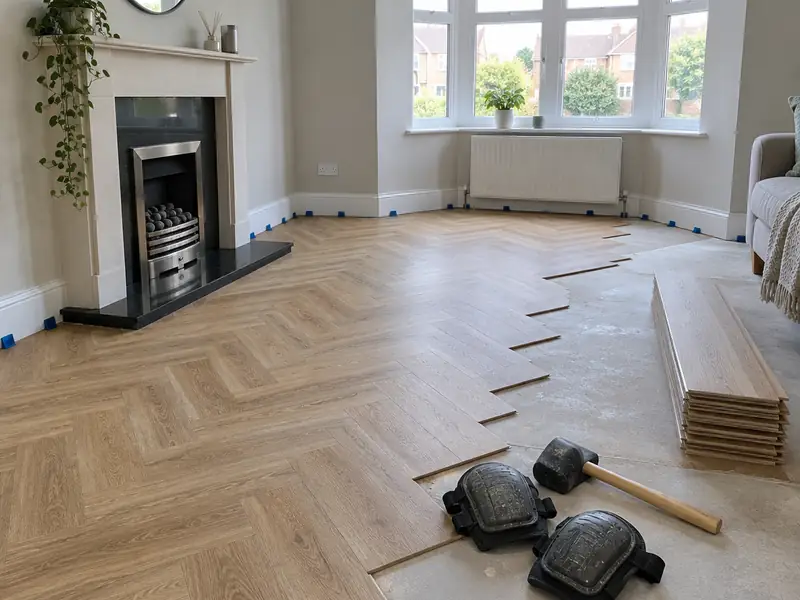
Flooring installation is the supply and fitting of a new floor finish, such as laminate, luxury vinyl tile, engineered wood or solid wood, over a properly levelled and prepared subfloor, with underlay, trims and thresholds finished neatly.
Anyone planning new flooring in Nelson wants three things: a clear price, a realistic timetable and a tidy job. We publish a guide of £1,150–£3,800 including VAT for the North West up front, explain that work normally takes 1–2 days per room, longer if levelling is needed, and confirm both in writing after a free survey of your property.
- Guide price
- £1,150–£3,800 inc VAT
- Time on site
- 1–2 days per room, longer if levelling is needed
- Postcodes
- BB8, BB9 and BB10
- Planning rules
- England
- Local area
- Lancashire
- Survey
- Free, with a written quote
Flooring prices in Nelson
What will new flooring cost in Nelson? Our guide range is £1,150–£3,800 including VAT. That figure is adjusted for the North West, about 5% below the national guide, and is intended for planning a budget. A firm written price for your chosen specification follows a free survey at your home.
| Type of job | What it usually involves | Guide in Nelson |
|---|---|---|
| Laminate in one room | Around 15–20m² of laminate with underlay, trims and door trimming. | £550–£1,700 |
| LVT or engineered wood | Around 20–25m² of LVT or engineered wood, with levelling and moisture protection. | £1,150–£3,300 |
| Whole floor or solid wood | An open-plan ground floor, solid wood or herringbone, with extensive preparation. | £3,300–£8,600 |
Your price depends mostly on:
- Floor area and the number of rooms, stairs and doorways
- Flooring type, plank size and laying pattern
- Condition of the subfloor and any levelling needed
- Underfloor heating, moisture barriers and acoustic underlay
What’s included?
- Measured survey of each room and checks on the subfloor
- Lifting and disposal of old carpet, laminate or vinyl
- Subfloor repairs, levelling compound or plywood overlay where needed
- Damp-proof membrane and suitable underlay for your floor type
- Door trimming so doors clear the new floor
- Furniture moved within the room where agreed
Local housing and new flooring
East Lancashire mill towns such as Burnley, Blackburn and Accrington have long rows of stone and brick terraces, while Preston is mostly red brick. Lancaster uses sandstone for its Georgian centre, Blackpool and the Fylde coast have guest-house terraces and many bungalows, and interwar and newer estates surround most towns.
Mill-town terraces commonly suit attic conversions, kitchen extensions and repointing. Bungalows on the coast often take loft rooms and porches, and stone properties may need lime pointing and roof repairs.
Knowing the typical building types in Lancashire helps, but a survey of your own home in Nelson is what decides the right approach to new flooring.
Permissions for new flooring in Nelson
The notes below cover England, which is where Nelson sits. Rules change and every property is different, so we speak to the council before pricing your job.
Internal work such as a new kitchen, bathroom, flooring, plastering or decorating does not need planning permission in England, unless the house is listed, when listed building consent may be needed even for internal changes.
Some internal work is covered by Building Regulations: new electrical circuits and work in bathrooms (Part P), new drainage, structural changes, extractor ventilation and any new window. Notifiable work is certified by a registered installer or by building control.
Rules change and every property is different, so we check the planning history and constraints for your address before we quote.
The four stages
We look at the job
First, someone visits your home in Nelson to see the space, take measurements and note anything that could affect the work, such as access or the condition of what is there. There is no charge for this visit.
Written quote
We turn the survey notes into a written quote. The price is fixed for the specification we agree, and the document sets out materials, scope and payment stages in plain language.
Dates and permissions
Next comes planning the work itself. We set a start date that suits you, line up the right trades, and make sure any approvals for new flooring are in place before the first day on site.
The work itself
The work is carried out to the agreed specification, with floors and furniture protected and the site kept tidy. At the end we clean up, walk through the finished job with you and hand over any certificates.
Why homeowners choose us
Frequently asked questions
How do I look after a new floor?
Looking after a new floor is mostly about keeping grit off it, because grit acts like sandpaper. Use doormats, sweep or vacuum regularly and clean with a damp, not wet, mop using a cleaner made for that floor type. Put felt pads under furniture legs. Oiled wood floors need occasional re-oiling, while lacquered wood, laminate and LVT just need regular cleaning.
What do I need to do before the fitters arrive?
Before fitting day, clear small items, ornaments and anything fragile from the room, and empty cupboards and wardrobes that stand on the floor. Let us know about heavy furniture so we can agree who moves it. Make sure the heating is set to a normal temperature so the flooring acclimatises properly. If you have pets, keep them out of the room while we work.
Who do I deal with during the job?
One point of contact manages your project from survey to handover. They schedule the trades working under our contract, keep you updated on progress, and are the person to call with any question. You don't need to coordinate builders, electricians or decorators separately, because that is part of what we do.
How long will new flooring take?
On a typical home, allow 1–2 days per room, longer if levelling is needed. Larger projects, older buildings and extra work found once things are opened up can extend that, while simpler jobs may be shorter. Your quote includes an estimate of time on site, and your point of contact keeps you updated on the programme as the work progresses.
Which flooring is right for a kitchen or bathroom?
Luxury vinyl tile, or LVT, is usually the most practical choice for kitchens and bathrooms, because it is water-resistant, warm underfoot and comfortable to stand on. Porcelain tiles also suit wet areas. Standard laminate and solid wood can swell if water sits on them, though some water-resistant laminates are available. We recommend a floor based on how the room is used.
Also covering areas around Nelson
Homes across BB8, BB9 and BB10 in Nelson are within our coverage, as are those in Colne, Burnley and Accrington. If you are just outside these areas, ask anyway, because we work right across the UK.