
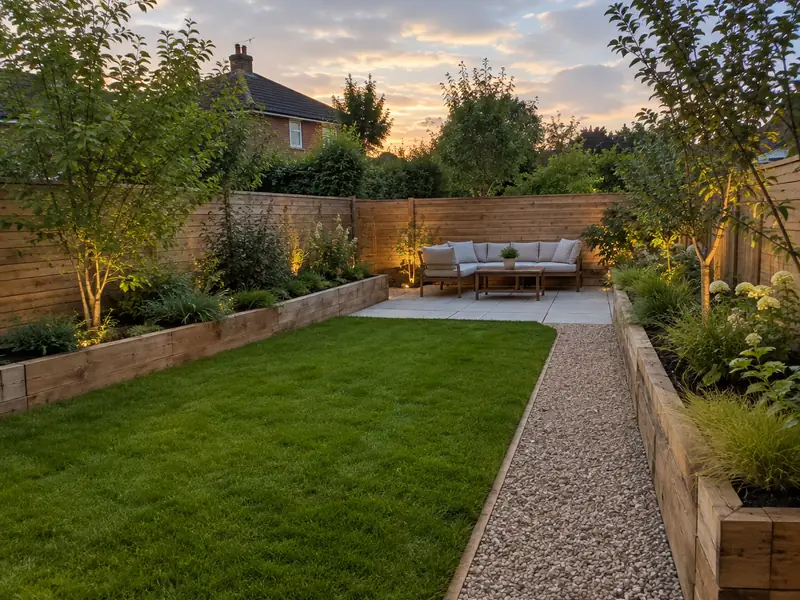
Garden landscaping is designing and building an outdoor space as a whole, combining hard landscaping such as patios, paths, walls and steps with soft landscaping such as lawns, planting and beds, plus drainage and lighting, so the garden works for how you live.
Cost is usually the first question about garden landscaping, so here is the guide for the North East: £5,400–£13,500 including VAT. We cover the whole of County Durham, with Darlington, Hartlepool, Stockton-on-Tees and Durham among the main centres. Because each UK nation sets its own rules, we check the requirements in England for your property, then put a firm price on paper following a free survey.
- Guide price
- £5,400–£13,500 inc VAT
- Time on site
- 1–4 weeks on site, depending on scope
- Planning rules
- England
- Price level
- About 10% below the national guide
- Towns listed
- 12
- Survey
- Free, with a written quote
Garden landscaping prices in County Durham
These are guide costs, not quotes. For garden landscaping in County Durham the range is £5,400–£13,500, VAT included, reflecting prices in the North East that are about 10% below the national guide. Once we have visited for a free survey, you get a firm figure for the scope you approve.
| Type of job | What it usually involves | Guide in County Durham |
|---|---|---|
| Garden refresh | Clearance, new turf, edging, bark or gravel and some planting. | £1,350–£4,500 |
| Typical garden makeover | A new patio, lawn, borders, paths and planting in a typical rear garden. | £5,400–£13,500 |
| Full redesign | Levels, retaining walls, large patios, lighting and drainage for larger or sloping gardens. | £13,500–£31,500 |
The main things that change the figure:
- Garden size, access and the amount of clearance needed
- Ratio of hard landscaping to lawn and planting
- Levels, slopes, retaining walls and steps
- Drainage, soil quality and ground conditions
Scope of the work
- Survey of size, levels, soil, drainage and access
- Layout plan agreed with you before work starts
- Groundworks, levelling and drainage
- Patios, paths, steps and edging laid on proper bases
- Raised beds, low walls or sleepers built to the agreed design
- Planting, bark or gravel finishing and outdoor lighting where included
Homes in County Durham
Colliery villages across County Durham are lined with brick and stone terraces, many built for mining families. Durham City has Georgian and Victorian streets, Darlington has Victorian terraces and villas, and Peterlee and Newton Aycliffe were planned as post-war new towns. Dales farmhouses in Weardale and Teesdale are stone, often under stone or slate roofs.
Colliery terraces commonly suit loft rooms, rear extensions and window replacement, and many need repointing. New-town homes often benefit from rendering or cladding upgrades and roofline renewal, while stone farmhouses may need lime work.
Winters are cold and the upland dales see snow and strong winds; former coal workings mean ground checks can be needed before building extensions.
Do you need permission in County Durham?
Because County Durham falls under England's rules, the guidance below is the version relevant to you. Before sending a price, we check your property's position with the council.
Most garden landscaping in England needs no planning permission. Trees protected by a Tree Preservation Order, or trees in a conservation area, need the council’s consent or notice before work; outbuildings and raised platforms have their own limits.
Building Regulations rarely apply to landscaping, though new drainage and garden electrics must comply.
Rules change and every property is different, so we check the planning history and constraints for your address before we quote.
How does the job run?
Free site survey
Book a visit and we'll come to you. The survey covers measurements, the state of what's there now and any obvious constraints, so the price that follows is based on your actual home, not an average.
Written quote
We put everything into a written, fixed-price quote: the specification, what's excluded, staged payments and the expected time on site. Take whatever time you need to decide; there's no pressure to commit.
Getting ready
We handle the paperwork side: checking whether planning permission or building control approval is needed, submitting applications where they are, and scheduling the trades and materials around your dates.
Build and hand over
During the work we protect the areas around it and tidy up at the end of each day. Once complete, we check the finish, remove our materials and hand over paperwork such as building control sign-off where it applies.
How we work
Questions about garden landscaping in County Durham
Do I need planning permission for landscaping?
Most garden landscaping does not need planning permission, but it depends on the work, your home's location, whether it is listed or in a conservation area, and which UK nation you are in. Raised decking or patios, high walls and front garden paving can need permission, as can work affecting protected trees. We check the rules for your garden before quoting.
Is the price fixed?
Yes, for the specification we agree. Your written quote sets out exactly what is included at a fixed price. It only changes if you ask for something different, or if a problem the survey could not reasonably reveal later needs extra work. In either case we explain the change and confirm it in writing before going ahead.
What can be done about a waterlogged garden?
A waterlogged garden is usually caused by heavy clay soil, compacted ground or water running off from hard surfaces. Solutions include French drains, soakaways, improving soil with organic matter, and making new paving permeable or directing its run-off to drains. Raised beds help plants in wet areas. We look at the cause during the survey and include drainage in the design.
Who do I deal with during the job?
One point of contact manages your project from survey to handover. They schedule the trades working under our contract, keep you updated on progress, and are the person to call with any question. You don't need to coordinate builders, electricians or decorators separately, because that is part of what we do.
How can I make my garden low maintenance?
A low-maintenance garden reduces mowing, weeding and watering. Paving or porcelain patios, gravel areas on a weed membrane, artificial grass and raised beds with hardy, slow-growing plants all help. Mulching borders with bark suppresses weeds and holds moisture. Some planting keeps the space feeling green and supports wildlife. We balance hard and soft areas to suit the time you want to spend.
Towns in County Durham
Below is our list of County Durham towns for garden landscaping. If yours isn't shown, we may still cover it, so it is worth asking us directly.