
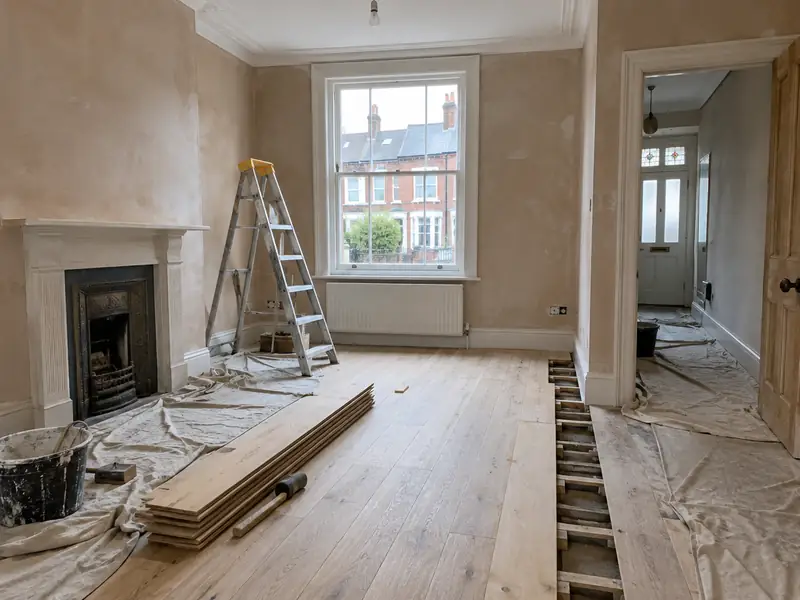
A whole-house renovation is a planned refurbishment of an entire home, typically combining rewiring, heating, plastering, new kitchen and bathroom, flooring and decoration, and sometimes layout changes, carried out in a logical order under one project.
Whatever prompted you to look into a whole-house renovation, whether wear and tear, a growing family or plans to move, we can survey your Holyhead home and give you a price in writing. Homes in Wales typically come in at £41,500–£110,000, VAT included, for this kind of work. We also cover Caernarfon, Bangor, Gwynedd and Llandudno, and the same steps apply wherever you are in Gwynedd.
- Guide price
- £41,500–£110,000 inc VAT
- Time on site
- 8–24 weeks on site, depending on scope
- Postcodes
- LL65
- Planning rules
- Wales
- Local area
- Isle of Anglesey
- Survey
- Free, with a written quote
Whole-house renovations prices in Holyhead
Below is a breakdown of typical costs for a whole-house renovation in Holyhead. Because rates in Wales are about 8% below the national guide, the overall guide comes to £41,500–£110,000, including VAT. Size, materials and access move the figure, and a free-of-charge survey settles it.
| Type of job | What it usually involves | Guide in Holyhead |
|---|---|---|
| Light refurbishment | Decoration, flooring, minor repairs and perhaps one new kitchen or bathroom. | £14,000–£41,500 |
| Full refurbishment | Rewire, heating, plastering, new kitchen and bathroom, flooring and decoration throughout a 3-bed house. | £41,500–£110,000 |
| Renovation with structural changes | A full refurbishment plus wall removal, layout changes or extra bathrooms. | £92,000–£166,000 |
What moves the price up or down:
- Size of the house and number of rooms being renovated
- Kitchen and bathroom specification
- Structural or layout changes and associated approvals
- Hidden problems such as damp, rot or outdated drainage
What’s included?
- Room-by-room survey and a planned order of works
- Strip-out of old kitchens, bathrooms, flooring and finishes
- Rewiring and new consumer unit by qualified electricians, with certificates
- Heating and plumbing upgrades by qualified engineers
- New kitchen and bathroom fitted to your chosen specification
- Flooring, internal doors, skirting and joinery
What are homes like around Holyhead?
Slate defines much of Gwynedd, from quarrying villages such as Bethesda and Blaenau Ffestiniog with their stone terraces to slate roofs across the county. Bangor and Caernarfon have Victorian and Georgian streets, Anglesey has stone cottages and bungalows, and resorts such as Pwllheli and Barmouth have Victorian terraces and newer bungalows.
Eryri (Snowdonia) is among the wettest areas in the UK, and exposed coasts take strong wind and salt, so render and roof details need to be robust.
Whatever era your Holyhead home dates from, we plan a whole-house renovation around how it is actually built rather than a one-size-fits-all specification.
Do you need permission in Holyhead?
Holyhead is in Wales, so the planning and building rules set out below are the ones that apply. We confirm the details with the council before we quote.
Internal improvements do not need planning permission in Wales unless the building is listed.
Building Regulations in Wales cover notifiable electrical work, drainage, ventilation and any structural change.
Rules change and every property is different, so we check the planning history and constraints for your address before we quote.
The four stages
A visit to your home
Book a visit and we'll come to you. The survey covers measurements, the state of what's there now and any obvious constraints, so the price that follows is based on your actual home, not an average.
Your fixed price
The quote arrives in writing, not over the phone. It covers the full scope, the finishes you've chosen, any exclusions and the payment schedule, with a fixed price tied to that specification.
Dates and permissions
Preparation matters as much as the build. We agree access, parking and working hours with you, order materials in good time, and confirm any permissions so the job isn't held up once it starts.
The work itself
On site, the agreed plan is followed and any change is put in writing first. At completion we do a final clean, go through the snagging list with you and leave you with the relevant documents.
Working with SK Home Improvements
Common questions
What happens at the survey?
We visit your home at a time that suits you, look at the area involved, take measurements and check access, condition and any services that might be affected. We talk through what you want from a whole-house renovation, explain the options and answer questions. There is no charge and no obligation; afterwards we send a written quote.
Do I need planning permission to renovate?
Most internal renovation work does not need planning permission, but it depends on what changes, your home's location, whether it is listed or in a conservation area, and which UK nation you are in. Listed buildings usually need consent for internal and external changes. Altering windows, adding dormers or changing the outside appearance in a conservation area may also need permission. We check before quoting.
Can I stay at home during the work?
In most cases, yes. Most people can live at home throughout, and we plan the work to keep disruption down by protecting floors, agreeing working hours and keeping access routes clear. Bigger jobs affecting kitchens, bathrooms or heating may mean a short spell with reduced facilities, and we talk this through with you at the survey.
What happens if you find damp or rot?
If we find damp or rot during a renovation, we stop that area, show you the problem and explain the likely cause, such as a leaking gutter, bridged damp-proof course or poor ventilation. We then give you a written price to fix the cause and repair the damage before carrying on. Treating the cause matters more than treating the symptom, so we focus on that first.
In what order should renovation work be done?
A renovation should follow a set order so finished work is never damaged by later trades. It usually runs from roof and structural repairs, through strip-out, first-fix electrics and plumbing, then plastering, second-fix electrics and plumbing, kitchen and bathroom fitting, flooring and finally decoration. Windows are usually fitted before plastering. We plan the programme around this sequence so each trade follows on smoothly.
Nearby towns
From LL65 to the edges of Holyhead and on into Caernarfon, Bangor, Gwynedd and Llandudno, we can arrange a site visit and a written quote for your project, planned around dates that work for you.