
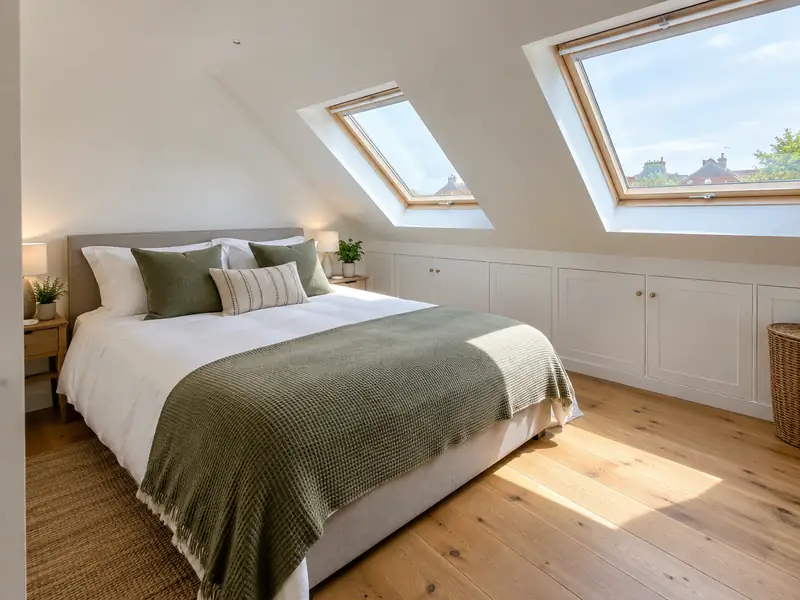
A loft conversion turns unused roof space into a habitable room such as a bedroom, bathroom or office, with a proper staircase, insulation, fire protection and natural light from rooflights or a dormer.
Thinking about a loft conversion in Cardiff? We take charge of the whole project, co-ordinating every trade involved, and one person keeps you updated. Guide prices for Wales sit at £27,500–£60,000 including VAT, and a typical job takes 6–10 weeks on site. Your own figure depends on what the survey finds and the specification you settle on.
- Guide price
- £27,500–£60,000 inc VAT
- Time on site
- 6–10 weeks on site
- Postcodes
- CF10, CF11 and CF24
- Planning rules
- Wales
- Local area
- South Glamorgan
- Survey
- Free, with a written quote
How much does a loft conversion cost in Cardiff?
Here is how the guide price for a loft conversion breaks down in Cardiff. We start from national figures and adjust for Wales, which comes out about 8% below the national guide. The resulting range, VAT included, is £27,500–£60,000, and a survey, at no cost to you, firms it up.
| Type of job | What it usually involves | Guide in Cardiff |
|---|---|---|
| Rooflight conversion | Rooflights in the existing slope, a new floor, staircase and insulation, where head height already works. | £18,500–£32,000 |
| Dormer conversion | A rear dormer adding headroom and floor space, often with a bedroom and shower room. | £29,500–£55,000 |
| Hip-to-gable or mansard | Larger structural changes to the roof for the maximum usable space. | £46,000–£78,000 |
What moves the price up or down:
- Conversion type: rooflight, dormer, hip-to-gable or mansard
- Floor area, existing head height and roof structure
- Steelwork and any strengthening of walls below
- Adding a shower room or en-suite in the roof
Scope of the work
- Structural calculations and steel beams where needed
- New floor joists strong enough for a habitable room
- Dormer, hip-to-gable or rooflight structure as agreed
- Staircase designed to fit your landing and meet regulations
- Insulation to walls, roof slope and floor
- Electrics, heating and plumbing by qualified trades, with certificates
Building in Cardiff
Cardiff has large areas of bay-fronted Victorian and Edwardian terraces in districts such as Roath, Canton and Cathays, plus interwar suburbs, post-war estates and modern flats around Cardiff Bay. Penarth has Victorian villas, Barry mixes terraces with newer estates, and Vale of Glamorgan villages are often built of local limestone.
Terraces commonly suit loft conversions, side-return and rear extensions, and bay window renewal. Suburban semis take side extensions and driveways, and stone village homes need lime-based repairs.
Knowing the typical building types in South Glamorgan helps, but a survey of your own home in Cardiff is what decides the right approach to a loft conversion.
Planning and building rules in Cardiff
Cardiff is in Wales, so the planning and building rules set out below are the ones that apply. We confirm the details with the council before we quote.
In Wales, loft conversions and dormers can be permitted development within volume and position limits (for example, dormers on rear-facing slopes and set back from the eaves). Conservation areas and listed buildings need planning permission.
Building Regulations approval is needed in Wales, and the Party Wall etc. Act 1996 applies to work on shared walls.
Rules change and every property is different, so we check the planning history and constraints for your address before we quote.
From survey to handover
A visit to your home
It starts with a survey at the property, free of charge. We check condition, access and services, ask how you want the finished result to look, and answer any questions you have about a loft conversion.
Your fixed price
After the survey we send a quote for a loft conversion that fixes the price for the scope we've agreed. If you want to change materials or scope, we revise it in writing before anything is booked.
Booking the work
With the quote agreed, we book the work in and handle preparation: permissions where needed, building control notifications, material orders and access arrangements for your Cardiff property.
On site to finish
Our trades complete a loft conversion while your point of contact keeps you updated. When everything is finished, we clear the site, take away waste and go through the result with you before handover.
How we work
Loft conversions in Cardiff: questions
What happens at the survey?
We visit your home at a time that suits you, look at the area involved, take measurements and check access, condition and any services that might be affected. We talk through what you want from a loft conversion, explain the options and answer questions. There is no charge and no obligation; afterwards we send a written quote.
Is my loft suitable for conversion?
A loft is usually suitable for conversion if there is enough head height, a roof structure that can be adapted and space for a staircase. A common rule of thumb is at least 2.2m from the top of the ceiling joists to the underside of the ridge, though dormers and mansards can create height where it is short. Modern trussed roofs need more structural work. We check all of this at the survey.
Does the Party Wall Act apply to a loft conversion?
The Party Wall etc. Act 1996 applies in England and Wales only, and loft conversions on terraced and semi-detached houses often fall within it, because steel beams are usually set into the shared wall. You must serve notice on the neighbour before work starts, and they can agree or appoint a surveyor. Scotland and Northern Ireland have no equivalent Act. We tell you during the survey whether notices are likely.
Where will the new staircase go?
The new staircase usually sits above the existing stairs, rising from the landing so it uses space that is already circulation. Sometimes it needs to come from a small bedroom or box room, which reduces that room's size. Building regulations set rules on headroom, step size and handrails, with some flexibility for lofts. We look at options at the survey and show you how each affects the floor below.
Which postcodes in Cardiff do you cover?
We cover CF10, CF11 and CF24, along with the rest of South Glamorgan. If your postcode is not listed, get in touch anyway: our coverage is UK-wide, and we can usually arrange a survey wherever you live. Enter your postcode in the guide-price tool or contact form and we will confirm.
Near Cardiff
Live in Cardiff? Our coverage takes in the CF10, CF11 and CF24 postcode areas and reaches out to Penarth, Caerphilly and Barry, so homes on the outskirts and in the next town along are included.