
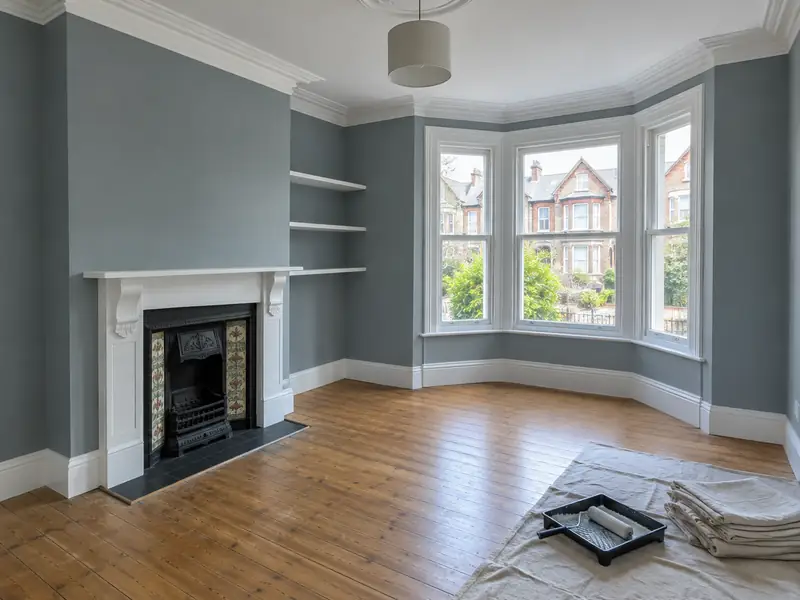
Painting and decorating is preparing and finishing the surfaces of a home, including filling, sanding, priming and painting walls, ceilings and woodwork, hanging wallpaper and painting exterior walls and joinery, to protect them and refresh how rooms look.
Whatever prompted you to look into painting and decorating, whether wear and tear, a growing family or plans to move, we can survey your Clydebank home and give you a price in writing. Homes in Scotland typically come in at £1,150–£2,900, VAT included, for this kind of work. We also cover Erskine, Renfrew and Bearsden, and the same steps apply wherever you are in Dunbartonshire.
- Guide price
- £1,150–£2,900 inc VAT
- Time on site
- 1–2 days per room; 3–7 days for a house exterior
- Postcodes
- G60 and G81
- Planning rules
- Scotland
- Local area
- West Dunbartonshire
- Survey
- Free, with a written quote
Painting and decorating prices in Clydebank
Here is how the guide price for painting and decorating breaks down in Clydebank. We start from national figures and adjust for Scotland, which comes out about 4% below the national guide. The resulting range, VAT included, is £1,150–£2,900, and a survey, at no cost to you, firms it up.
| Type of job | What it usually involves | Guide in Clydebank |
|---|---|---|
| Single room | Walls, ceiling and woodwork in one average bedroom or living room. | £350–£850 |
| House exterior | Masonry and joinery on a typical semi, including access equipment. | £2,400–£5,800 |
| Whole interior of a 3-bed house | Every room, hallway, stairs and landing, including woodwork. | £2,900–£6,200 |
What moves the price up or down:
- Number and size of rooms, including ceiling height
- Whether woodwork, doors and wallpaper are included
- Paint quality, colour changes and number of coats
- Exterior access, scaffolding and the condition of surfaces
What’s included?
- Survey of each surface and agreed colours and finishes
- Floors, furniture and fittings protected with dust sheets and masking
- Filling cracks and holes, sanding and spot priming
- Mist coat on new plaster before finishing coats
- Wallpaper stripped or hung where included
- Furniture replaced, waste removed and a final tidy-up
What are homes like around Clydebank?
Clydebank was heavily rebuilt after wartime bombing and has tenements and post-war estates, while Dumbarton has sandstone tenements and Victorian housing. Bearsden and Milngavie are known for Victorian villas and interwar bungalows, and Kirkintilloch mixes older terraces with post-war semis and newer developments.
Bungalows commonly suit loft conversions with dormers, and villas often take kitchen extensions and landscaping. Tenement flats may need window replacement, and harled homes often need re-rendering.
None of this holds for every street in Clydebank, which is why we look at your actual house before pricing painting and decorating rather than assuming from its age alone.
Planning and building rules in Clydebank
For anyone in Clydebank, the relevant framework is Scotland's. The summary below is general, so we always contact the council about your address before putting a price in writing.
Internal improvements do not need planning permission in Scotland unless the building is listed.
Like-for-like kitchen and bathroom replacements do not normally need a building warrant, but structural changes and some drainage or heating alterations do, and electrical work must meet the building standards.
Rules change and every property is different, so we check the planning history and constraints for your address before we quote.
What happens after you get in touch?
We look at the job
First, someone visits your home in Clydebank to see the space, take measurements and note anything that could affect the work, such as access or the condition of what is there. There is no charge for this visit.
Quote in writing
We put everything into a written, fixed-price quote: the specification, what's excluded, staged payments and the expected time on site. Take whatever time you need to decide; there's no pressure to commit.
Getting ready
Preparation matters as much as the build. We agree access, parking and working hours with you, order materials in good time, and confirm any permissions so the job isn't held up once it starts.
The work itself
During the work we protect the areas around it and tidy up at the end of each day. Once complete, we check the finish, remove our materials and hand over paperwork such as building control sign-off where it applies.
How we work
Questions about painting and decorating in Clydebank
Can I stay at home during the work?
In most cases, yes. Most people can live at home throughout, and we plan the work to keep disruption down by protecting floors, agreeing working hours and keeping access routes clear. Bigger jobs affecting kitchens, bathrooms or heating may mean a short spell with reduced facilities, and we talk this through with you at the survey.
Why is preparation so important?
Preparation decides how good the finish looks and how long it lasts. Filling cracks, sanding glossy surfaces, washing greasy areas and priming bare wood all help paint grip and dry evenly. Skipping it leads to visible repairs, peeling and patchy colour. Most of the time on a decorating job goes into preparation, and our quotes always allow for it.
How much does it cost to decorate a room?
Decorating an average room costs roughly £350–£900, covering walls, ceiling and woodwork, while three rooms typically come to £1,150–£2,900. Large living rooms, high ceilings, stairwells and wallpapering cost more, and so do rooms needing a lot of filling and sanding. Strong colour changes may need an extra coat. We confirm a fixed price for the agreed rooms after the survey.
How long will painting and decorating take?
On a typical home, allow 1–2 days per room; 3–7 days for a house exterior. Larger projects, older buildings and extra work found once things are opened up can extend that, while simpler jobs may be shorter. Your quote includes an estimate of time on site, and your point of contact keeps you updated on the programme as the work progresses.
When is the right time to paint the outside of a house?
Exterior painting needs dry weather and mild temperatures, so late spring to early autumn is usually the right time. Paint should not be applied to damp surfaces, in rain or frost, or in strong direct sun. Surfaces need time to dry out after rain before work starts. We plan exterior work around the forecast and pause if conditions turn.
Nearby towns
Addresses in G60 and G81 are all covered for Clydebank, along with Erskine, Renfrew and Bearsden close by. Give us your postcode when you get in touch and we will confirm the details.