
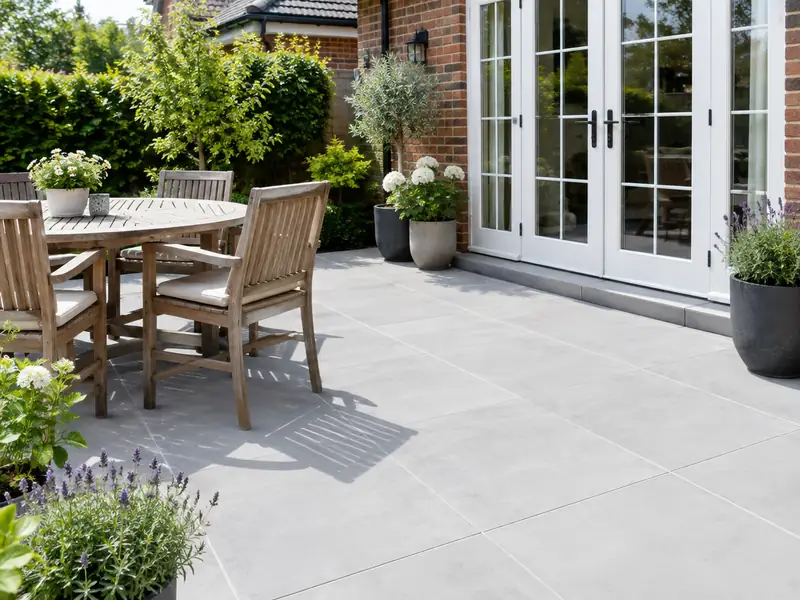
A patio is a paved outdoor area next to the house or in the garden, laid in porcelain, natural stone or concrete slabs on a compacted sub-base and mortar bed, with falls that direct rainwater away from the house.
We take on a new patio throughout Oban and the surrounding PA34 postcodes, as well as in Fort William, Dunoon and Helensburgh. The guide range for this work in Scotland is £2,400–£5,300 including VAT; where your project falls depends on its size, the materials you pick and how easy the site is to reach. A free survey turns that range into a fixed figure.
- Guide price
- £2,400–£5,300 inc VAT
- Time on site
- 3–7 days on site
- Postcodes
- PA34
- Planning rules
- Scotland
- Local area
- Argyll and Bute
- Survey
- Free, with a written quote
How much does a new patio cost in Oban?
Prices for a new patio vary from house to house, but in Oban most projects fall within £2,400–£5,300 including VAT. That reflects costs in Scotland, about 4% below the national guide. Treat the table as a budgeting aid; the written figure follows a survey we carry out for free.
| Type of job | What it usually involves | Guide in Oban |
|---|---|---|
| Small patio or path | Around 10m² of concrete slabs or a garden path. | £950–£2,400 |
| Typical 20m² patio | Sandstone or porcelain on a full sub-base with jointing and edging. | £2,400–£5,300 |
| Large or multi-level patio | Bigger areas, steps, retaining walls or premium stone. | £5,300–£11,500 |
The main things that change the figure:
- Patio area and the amount of excavation
- Slab material, size and laying pattern
- Ground levels, slopes, steps and retaining walls
- Drainage needed to keep water away from the house
What does the job include in Oban?
- Survey of levels, damp-proof course, drainage and access
- Excavation and removal of turf, soil or old paving
- Compacted MOT Type 1 sub-base
- Slabs laid on a full mortar bed with falls away from the house
- Jointing with mortar or a brush-in compound
- Edging and neat cuts around drains and walls
What are homes like around Oban?
Much of Argyll and Bute is rural and coastal, with whitewashed or harled stone cottages, slate roofs and island homes. Helensburgh has Victorian villas, Oban, Dunoon and Rothesay have Victorian seaside terraces, and post-war and newer housing surrounds the main towns.
One of the wettest and windiest parts of the UK, with high exposure on the coast and islands, so roof and render details must suit severe weather.
Building traditions across Argyll and Bute also raise conservation and planning questions, so we check those for a new patio in Oban at the survey stage.
Planning and building rules in Oban
For anyone in Oban, the relevant framework is Scotland's. The summary below is general, so we always contact the council about your address before putting a price in writing.
A ground-level patio does not usually need planning permission in Scotland; raised decking is limited in height under permitted development.
A building warrant is not normally needed for a patio.
Rules change and every property is different, so we check the planning history and constraints for your address before we quote.
From survey to handover
A visit to your home
Book a visit and we'll come to you. The survey covers measurements, the state of what's there now and any obvious constraints, so the price that follows is based on your actual home, not an average.
Price and scope agreed
You get the price in writing, itemised so you can see where the money goes. As long as the specification stays the same, that is the price you pay for a new patio.
Plan and prepare
Preparation matters as much as the build. We agree access, parking and working hours with you, order materials in good time, and confirm any permissions so the job isn't held up once it starts.
On site to finish
The job proceeds in the order set out in the programme, with dust and debris kept under control. Finally we tidy away, inspect the work together and pass the finished project over to you with its paperwork.
Working with SK Home Improvements
Frequently asked questions
What happens if my garden slopes?
A sloping garden can still have a level patio by cutting into the slope, building up with retaining walls, or creating terraces with steps between them. Retaining walls must be built to hold back the soil and allow drainage behind them. This adds cost but creates usable, level space. We look at the slope during the survey and suggest the most practical design.
Does a patio need planning permission?
Most patios do not need planning permission, but it depends on the size, height and location, your home's position, whether it is listed or in a conservation area, and which UK nation you are in. Raised patios or decking more than a small height above the ground may need permission because of overlooking. We check the position for your garden before quoting.
Do you cover Fort William, Dunoon and Helensburgh?
Yes. As well as Oban, we cover Fort William, Dunoon and Helensburgh and the rest of Argyll and Bute. Our coverage is UK-wide, so the process is the same wherever you are: a free site survey, a quote in writing that fixes the price for the agreed scope, and one point of contact while the work is planned and carried out.
How do I clean and look after my patio?
Most patios just need regular sweeping and an occasional wash with water and a mild patio cleaner. Porcelain is the easiest to keep clean. Natural stone benefits from a sealant to reduce staining and from prompt cleaning of spills like oil or wine. Re-point any joints that crack or wash out. Avoid high-pressure jet washing close to joints, which can damage them.
Can you combine a new patio with other work?
Yes. Because we manage several trades under one contract, we can plan a new patio alongside other work on your Oban home, such as new windows with rendering, or a kitchen refit with an extension. Combining jobs can reduce repeat set-up such as scaffolding, skips and access, and every element is listed and priced in the same written quote.
Near Oban
If your address falls within PA34, we cover it. The same goes for neighbouring Fort William, Dunoon and Helensburgh, which we include alongside Oban when arranging surveys and quotes.