
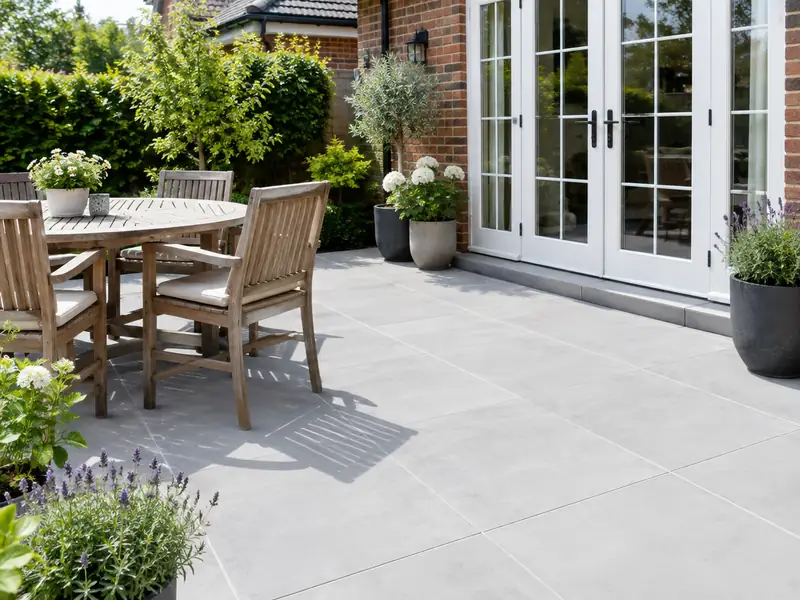
A patio is a paved outdoor area next to the house or in the garden, laid in porcelain, natural stone or concrete slabs on a compacted sub-base and mortar bed, with falls that direct rainwater away from the house.
If you live in Macclesfield and are weighing up a new patio, the starting point is a visit to measure up and talk through what you want, which costs nothing. We cover homes across SK9, SK10 and SK11, and a typical project of this kind in the North West lands somewhere in the £2,400–£5,200 bracket, including VAT. The exact figure depends on size, access and the finish you choose.
- Guide price
- £2,400–£5,200 inc VAT
- Time on site
- 3–7 days on site
- Postcodes
- SK9, SK10 and SK11
- Planning rules
- England
- Local area
- Cheshire East
- Survey
- Free, with a written quote
What should you budget for a new patio in Macclesfield?
Every figure below is a guide for a new patio in Macclesfield, inclusive of VAT. Regional pricing for the North West works out about 5% below the national guide, and the overall span is £2,400–£5,200. The survey costs you nothing, and after it we commit to a firm price for your specification in writing.
| Type of job | What it usually involves | Guide in Macclesfield |
|---|---|---|
| Small patio or path | Around 10m² of concrete slabs or a garden path. | £950–£2,400 |
| Typical 20m² patio | Sandstone or porcelain on a full sub-base with jointing and edging. | £2,400–£5,200 |
| Large or multi-level patio | Bigger areas, steps, retaining walls or premium stone. | £5,200–£11,500 |
The main things that change the figure:
- Patio area and the amount of excavation
- Slab material, size and laying pattern
- Ground levels, slopes, steps and retaining walls
- Drainage needed to keep water away from the house
What does the job include in Macclesfield?
- Survey of levels, damp-proof course, drainage and access
- Excavation and removal of turf, soil or old paving
- Compacted MOT Type 1 sub-base
- Slabs laid on a full mortar bed with falls away from the house
- Jointing with mortar or a brush-in compound
- Site cleared, waste removed and paving cleaned
Local housing and a new patio
Chester mixes Georgian and Victorian terraces with black-and-white revival frontages, and red sandstone shows up across the west of the county. Crewe has railway-era brick terraces, Macclesfield has mill workers' cottages, and Wilmslow, Knutsford and Alderley Edge are known for large detached homes. Interwar semis and newer estates surround Warrington and Northwich.
Terraced and mill-era cottages often need repointing, roof work and loft space. Larger detached homes commonly take on kitchen extensions, bifold doors and garden landscaping, while interwar semis suit side extensions and replacement windows.
With that background in mind, here is how we typically handle a new patio for homes in Macclesfield, from the first visit to the finished result.
Do you need permission in Macclesfield?
Because Macclesfield falls under England's rules, the guidance below is the version relevant to you. Before sending a price, we check your property's position with the council.
A ground-level patio in a back garden does not usually need planning permission in England. Raised decks or platforms more than 30 cm high do.
Building Regulations do not normally apply to patios, but levels must stay below the damp-proof course and drain away from the house.
Rules change and every property is different, so we check the planning history and constraints for your address before we quote.
From survey to handover
A visit to your home
It starts with a survey at the property, free of charge. We check condition, access and services, ask how you want the finished result to look, and answer any questions you have about a new patio.
Quote in writing
After the survey we send a quote for a new patio that fixes the price for the scope we've agreed. If you want to change materials or scope, we revise it in writing before anything is booked.
Booking the work
We handle the paperwork side: checking whether planning permission or building control approval is needed, submitting applications where they are, and scheduling the trades and materials around your dates.
The work itself
Our trades complete a new patio while your point of contact keeps you updated. When everything is finished, we clear the site, take away waste and go through the result with you before handover.
How we work
Patios and paving in Macclesfield: questions
Can I stay at home during the work?
In most cases, yes. Most people can live at home throughout, and we plan the work to keep disruption down by protecting floors, agreeing working hours and keeping access routes clear. Bigger jobs affecting kitchens, bathrooms or heating may mean a short spell with reduced facilities, and we talk this through with you at the survey.
Which postcodes in Macclesfield do you cover?
We cover SK9, SK10 and SK11, along with the rest of Cheshire. If your postcode is not listed, get in touch anyway: our coverage is UK-wide, and we can usually arrange a survey wherever you live. Enter your postcode in the guide-price tool or contact form and we will confirm.
Is porcelain or sandstone better for a patio?
Porcelain is dense, stain-resistant and stays looking clean with little care, making it a good choice if you want a modern, low-maintenance patio. Indian sandstone has natural colour variation and a softer, traditional look, and costs a little less, but it can stain and weather over time and benefits from sealing. Both make durable patios when properly laid. We bring samples to the survey.
How do I clean and look after my patio?
Most patios just need regular sweeping and an occasional wash with water and a mild patio cleaner. Porcelain is the easiest to keep clean. Natural stone benefits from a sealant to reduce staining and from prompt cleaning of spills like oil or wine. Re-point any joints that crack or wash out. Avoid high-pressure jet washing close to joints, which can damage them.
What happens if my garden slopes?
A sloping garden can still have a level patio by cutting into the slope, building up with retaining walls, or creating terraces with steps between them. Retaining walls must be built to hold back the soil and allow drainage behind them. This adds cost but creates usable, level space. We look at the slope during the survey and suggest the most practical design.
Nearby towns
If your address falls within SK9, SK10 and SK11, we cover it. The same goes for neighbouring Wilmslow, Congleton and Cheadle Hulme, which we include alongside Macclesfield when arranging surveys and quotes.