
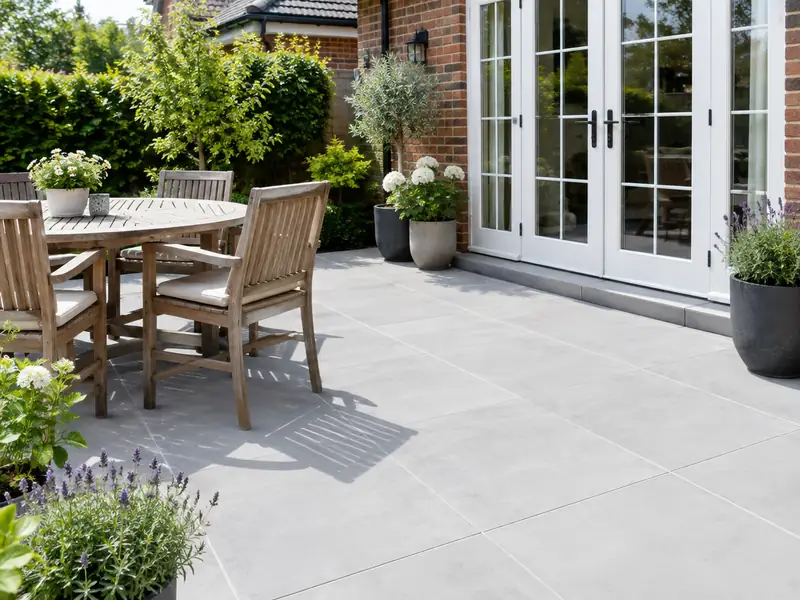
A patio is a paved outdoor area next to the house or in the garden, laid in porcelain, natural stone or concrete slabs on a compacted sub-base and mortar bed, with falls that direct rainwater away from the house.
Planning a new patio for a home in Rhosllannerchrugog means making a handful of decisions about materials, layout, finish and timing. We help you work through them at a free survey, then confirm in writing what it will cost for the options you pick. Most projects of this type need 3–7 days on site, and we cover every LL14 address as well as the rest of Clwyd.
- Guide price
- £2,300–£5,100 inc VAT
- Time on site
- 3–7 days on site
- Postcodes
- LL14
- Planning rules
- Wales
- Local area
- Wrexham
- Survey
- Free, with a written quote
Patios and paving prices in Rhosllannerchrugog
The costs listed here are typical for a new patio around Rhosllannerchrugog and include VAT. They reflect labour and material costs in Wales, about 8% below the national guide, giving a range of £2,300–£5,100. Exact pricing depends on your home, so we only fix it once a free site survey is done.
| Type of job | What it usually involves | Guide in Rhosllannerchrugog |
|---|---|---|
| Small patio or path | Around 10m² of concrete slabs or a garden path. | £900–£2,300 |
| Typical 20m² patio | Sandstone or porcelain on a full sub-base with jointing and edging. | £2,300–£5,100 |
| Large or multi-level patio | Bigger areas, steps, retaining walls or premium stone. | £5,100–£11,000 |
Expect these to shape the final quote:
- Patio area and the amount of excavation
- Slab material, size and laying pattern
- Drainage needed to keep water away from the house
- Access for materials and removing spoil
Scope of the work
- Excavation and removal of turf, soil or old paving
- Compacted MOT Type 1 sub-base
- Slabs laid on a full mortar bed with falls away from the house
- Primer on porcelain slabs for a strong bond
- Jointing with mortar or a brush-in compound
- Edging and neat cuts around drains and walls
Building in Rhosllannerchrugog
Wrexham has Victorian terraces in red Ruabon brick, alongside interwar and post-war estates. The north coast resorts of Rhyl, Prestatyn and Colwyn Bay have Victorian villas, guest-house terraces and bungalows, while Denbighshire and Flintshire villages use local stone under Welsh slate roofs.
Terraces suit loft conversions and rear extensions, and many need repointing and roof work. Coastal bungalows commonly take loft rooms and window renewal, and stone cottages need lime-based repairs.
These patterns matter for a new patio: older walls, roofs and floors in Rhosllannerchrugog can need different materials or extra preparation compared with newer homes.
Permissions for a new patio in Rhosllannerchrugog
Planning law differs across the UK. For a home in Rhosllannerchrugog, it is the Wales rules below that count, and we check them with the council ahead of any quote.
A ground-level patio does not usually need planning permission in Wales; raised platforms are more restricted.
Building Regulations do not normally apply, but levels and drainage must protect the house walls.
Rules change and every property is different, so we check the planning history and constraints for your address before we quote.
What happens after you get in touch?
Free site survey
We begin by looking at the job in person. During the free survey we discuss options, materials and budget for a new patio, and photograph or measure anything the quote needs to reflect.
Price and scope agreed
We turn the survey notes into a written quote. The price is fixed for the specification we agree, and the document sets out materials, scope and payment stages in plain language.
Booking the work
Next comes planning the work itself. We set a start date that suits you, line up the right trades, and make sure any approvals for a new patio are in place before the first day on site.
Finish and handover
On site, the agreed plan is followed and any change is put in writing first. At completion we do a final clean, go through the snagging list with you and leave you with the relevant documents.
How we work
Patios and paving in Rhosllannerchrugog: questions
Which postcodes in Rhosllannerchrugog do you cover?
We cover LL14, along with the rest of Clwyd. If your postcode is not listed, get in touch anyway: our coverage is UK-wide, and we can usually arrange a survey wherever you live. Enter your postcode in the guide-price tool or contact form and we will confirm.
What should I do before the work starts?
Before work starts, clear garden furniture, pots and ornaments from the area and agree where materials will be delivered and stored. We need a route for wheelbarrows and, on larger jobs, a small digger, so let us know about side gates, narrow passages or access through the house. Tell us about any known drains, cables or pipes in the area.
Do you cover Wrexham, Brymbo and Oswestry?
Yes. As well as Rhosllannerchrugog, we cover Wrexham, Brymbo and Oswestry and the rest of Clwyd. Our coverage is UK-wide, so the process is the same wherever you are: a free site survey, a quote in writing that fixes the price for the agreed scope, and one point of contact while the work is planned and carried out.
How do you make sure water drains away from the house?
A patio needs a gentle fall, usually a little over 1 in 80, so rainwater runs away from the house towards the garden, a drain or a soakaway. The surface should also sit well below the damp-proof course. If the patio meets a door threshold, a channel drain may be needed. We set levels with string lines and check falls as we lay each section.
What happens if my garden slopes?
A sloping garden can still have a level patio by cutting into the slope, building up with retaining walls, or creating terraces with steps between them. Retaining walls must be built to hold back the soil and allow drainage behind them. This adds cost but creates usable, level space. We look at the slope during the survey and suggest the most practical design.
Near Rhosllannerchrugog
Our coverage in Rhosllannerchrugog includes LL14. We also travel to Wrexham, Brymbo and Oswestry, so neighbouring addresses are looked after on exactly the same terms as those in town.