
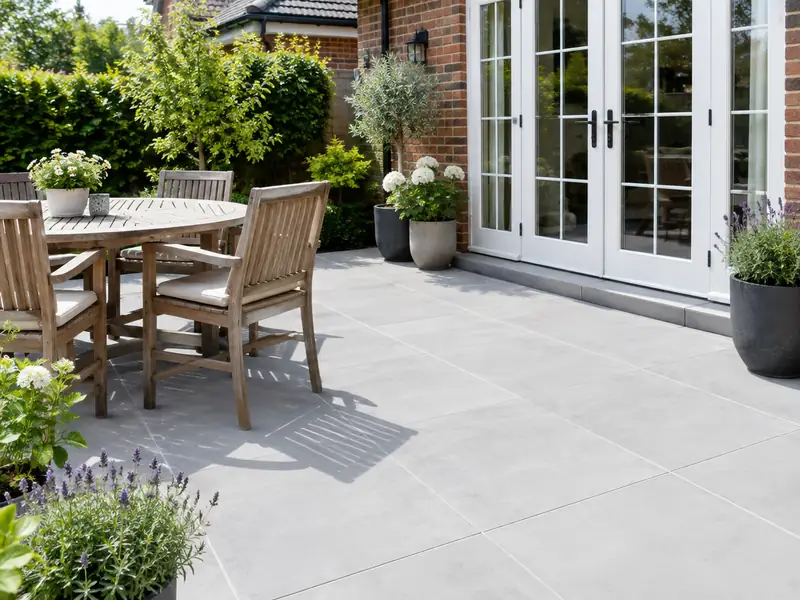
A patio is a paved outdoor area next to the house or in the garden, laid in porcelain, natural stone or concrete slabs on a compacted sub-base and mortar bed, with falls that direct rainwater away from the house.
If you live in Darlington and are weighing up a new patio, the starting point is a visit to measure up and talk through what you want, which costs nothing. We cover homes across DL1, DL2 and DL3, and a typical project of this kind in the North East lands somewhere in the £2,200–£5,000 bracket, including VAT. The exact figure depends on size, access and the finish you choose.
- Guide price
- £2,200–£5,000 inc VAT
- Time on site
- 3–7 days on site
- Postcodes
- DL1, DL2 and DL3
- Planning rules
- England
- Local area
- County Durham
- Survey
- Free, with a written quote
Patios and paving prices in Darlington
In Darlington, guide figures for a new patio sit at £2,200–£5,000, VAT included. We set them using rates for the North East, currently about 10% below the national guide. The table shows what pushes a project towards either end of the range; your own price is set after a free survey.
| Type of job | What it usually involves | Guide in Darlington |
|---|---|---|
| Small patio or path | Around 10m² of concrete slabs or a garden path. | £900–£2,200 |
| Typical 20m² patio | Sandstone or porcelain on a full sub-base with jointing and edging. | £2,200–£5,000 |
| Large or multi-level patio | Bigger areas, steps, retaining walls or premium stone. | £5,000–£11,000 |
What moves the price up or down:
- Patio area and the amount of excavation
- Slab material, size and laying pattern
- Drainage needed to keep water away from the house
- Access for materials and removing spoil
What does the job include in Darlington?
- Excavation and removal of turf, soil or old paving
- Compacted MOT Type 1 sub-base
- Slabs laid on a full mortar bed with falls away from the house
- Jointing with mortar or a brush-in compound
- Edging and neat cuts around drains and walls
- Site cleared, waste removed and paving cleaned
Local housing and a new patio
Colliery villages across County Durham are lined with brick and stone terraces, many built for mining families. Durham City has Georgian and Victorian streets, Darlington has Victorian terraces and villas, and Peterlee and Newton Aycliffe were planned as post-war new towns. Dales farmhouses in Weardale and Teesdale are stone, often under stone or slate roofs.
Colliery terraces commonly suit loft rooms, rear extensions and window replacement, and many need repointing. New-town homes often benefit from rendering or cladding upgrades and roofline renewal, while stone farmhouses may need lime work.
None of this holds for every street in Darlington, which is why we look at your actual house before pricing a new patio rather than assuming from its age alone.
Permissions for a new patio in Darlington
Darlington is in England, so the planning and building rules set out below are the ones that apply. We confirm the details with the council before we quote.
A ground-level patio in a back garden does not usually need planning permission in England. Raised decks or platforms more than 30 cm high do.
Building Regulations do not normally apply to patios, but levels must stay below the damp-proof course and drain away from the house.
Rules change and every property is different, so we check the planning history and constraints for your address before we quote.
From survey to handover
A visit to your home
Book a visit and we'll come to you. The survey covers measurements, the state of what's there now and any obvious constraints, so the price that follows is based on your actual home, not an average.
Your fixed price
After the survey we send a quote for a new patio that fixes the price for the scope we've agreed. If you want to change materials or scope, we revise it in writing before anything is booked.
Plan and prepare
Next comes planning the work itself. We set a start date that suits you, line up the right trades, and make sure any approvals for a new patio are in place before the first day on site.
Finish and handover
The work is carried out to the agreed specification, with floors and furniture protected and the site kept tidy. At the end we clean up, walk through the finished job with you and hand over any certificates.
Why homeowners choose us
Frequently asked questions
Can I stay at home during the work?
In most cases, yes. Most people can live at home throughout, and we plan the work to keep disruption down by protecting floors, agreeing working hours and keeping access routes clear. Bigger jobs affecting kitchens, bathrooms or heating may mean a short spell with reduced facilities, and we talk this through with you at the survey.
How do I clean and look after my patio?
Most patios just need regular sweeping and an occasional wash with water and a mild patio cleaner. Porcelain is the easiest to keep clean. Natural stone benefits from a sealant to reduce staining and from prompt cleaning of spills like oil or wine. Re-point any joints that crack or wash out. Avoid high-pressure jet washing close to joints, which can damage them.
Do I need planning permission in Darlington?
It depends on the work, the size of the project, your property type and whether the building is listed or in a conservation area. Darlington is in England, so England's rules apply. Many smaller jobs need no planning application, but some still need building control approval. We check what applies to your address before quoting.
What should I do before the work starts?
Before work starts, clear garden furniture, pots and ornaments from the area and agree where materials will be delivered and stored. We need a route for wheelbarrows and, on larger jobs, a small digger, so let us know about side gates, narrow passages or access through the house. Tell us about any known drains, cables or pipes in the area.
How long does it take to lay a patio?
Laying a typical 20m² patio takes around three to five days, from excavation and sub-base to laying, jointing and cleaning. Larger or multi-level patios with steps and walls take longer. The mortar bed needs time to set, so light foot traffic is usually fine after a day or two and furniture can go on after about a week. We confirm timings with your quote.
Nearby towns
Darlington and its DL1, DL2 and DL3 postcodes are part of our coverage. Homeowners in Newton Aycliffe, Yarm and Stockton-on-Tees can also book a free survey with us and receive a written price for their job.