
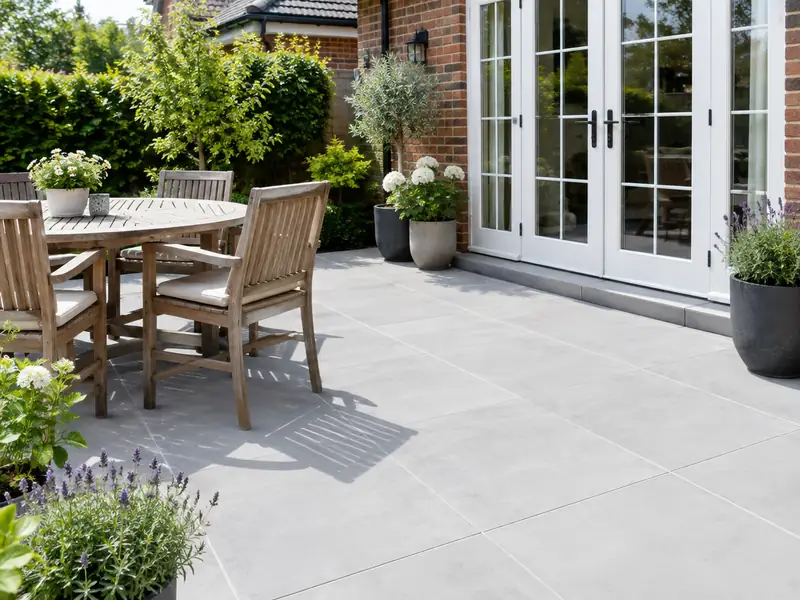
A patio is a paved outdoor area next to the house or in the garden, laid in porcelain, natural stone or concrete slabs on a compacted sub-base and mortar bed, with falls that direct rainwater away from the house.
We take on a new patio throughout Cookstown and the surrounding BT80 postcodes, as well as in Magherafelt, Dungannon and Portadown. The guide range for this work in Northern Ireland is £2,200–£4,700 including VAT; where your project falls depends on its size, the materials you pick and how easy the site is to reach. A free survey turns that range into a fixed figure.
- Guide price
- £2,200–£4,700 inc VAT
- Time on site
- 3–7 days on site
- Postcodes
- BT80
- Planning rules
- Northern Ireland
- Local area
- County Tyrone
- Survey
- Free, with a written quote
Patios and paving prices in Cookstown
No two jobs cost exactly the same, but the ranges below give a fair picture of a new patio in Cookstown. Pricing for Northern Ireland runs about 14% below the national guide, and the overall guide is £2,200–£4,700 with VAT included. We'll confirm your figure after surveying the property for free.
| Type of job | What it usually involves | Guide in Cookstown |
|---|---|---|
| Small patio or path | Around 10m² of concrete slabs or a garden path. | £850–£2,200 |
| Typical 20m² patio | Sandstone or porcelain on a full sub-base with jointing and edging. | £2,200–£4,700 |
| Large or multi-level patio | Bigger areas, steps, retaining walls or premium stone. | £4,700–£10,500 |
What moves the price up or down:
- Patio area and the amount of excavation
- Ground levels, slopes, steps and retaining walls
- Drainage needed to keep water away from the house
- Access for materials and removing spoil
What do you get?
- Survey of levels, damp-proof course, drainage and access
- Excavation and removal of turf, soil or old paving
- Compacted MOT Type 1 sub-base
- Slabs laid on a full mortar bed with falls away from the house
- Primer on porcelain slabs for a strong bond
- Site cleared, waste removed and paving cleaned
What are homes like around Cookstown?
Tyrone is largely rural, with detached houses and bungalows on individual plots across the countryside, many finished in render or roughcast. Omagh, Dungannon, Cookstown and Strabane have Victorian terraced streets, post-war estates and newer developments, and stone farmhouses survive in older rural areas.
Rural detached homes commonly take extensions, loft rooms, porches and driveways, and older houses may need re-roofing and re-rendering. Town terraces suit rear extensions and window replacement.
With that background in mind, here is how we typically handle a new patio for homes in Cookstown, from the first visit to the finished result.
Planning and building rules in Cookstown
The notes below cover Northern Ireland, which is where Cookstown sits. Rules change and every property is different, so we speak to the council before pricing your job.
A ground-level patio does not usually need planning permission in Northern Ireland; raised platforms are more restricted.
Building control approval is not normally needed for a patio.
Rules change and every property is different, so we check the planning history and constraints for your address before we quote.
The four stages
Survey and measure
We arrange a free site survey on a date convenient to you. We measure up, look at the existing structure and access, and discuss your plans for a new patio so the price reflects your home.
Price and scope agreed
You get the price in writing, itemised so you can see where the money goes. As long as the specification stays the same, that is the price you pay for a new patio.
Plan and prepare
With the quote agreed, we book the work in and handle preparation: permissions where needed, building control notifications, material orders and access arrangements for your Cookstown property.
The work itself
The work is carried out to the agreed specification, with floors and furniture protected and the site kept tidy. At the end we clean up, walk through the finished job with you and hand over any certificates.
What you can expect from us
Frequently asked questions
How much does a new patio cost?
A typical 20m² patio in sandstone or porcelain costs £2,200–£4,700, including excavation, sub-base, laying and jointing. As a guide, allow roughly £100–£220 per square metre plus fixed costs for set-up and waste. Concrete slabs cost less, while slate, granite and large-format porcelain cost more. Steps, walls and drainage add to the total. We confirm a fixed price after the survey.
Which postcodes in Cookstown do you cover?
We cover BT80, along with the rest of County Tyrone. If your postcode is not listed, get in touch anyway: our coverage is UK-wide, and we can usually arrange a survey wherever you live. Enter your postcode in the guide-price tool or contact form and we will confirm.
How do I clean and look after my patio?
Most patios just need regular sweeping and an occasional wash with water and a mild patio cleaner. Porcelain is the easiest to keep clean. Natural stone benefits from a sealant to reduce staining and from prompt cleaning of spills like oil or wine. Re-point any joints that crack or wash out. Avoid high-pressure jet washing close to joints, which can damage them.
What should I do before the work starts?
Before work starts, clear garden furniture, pots and ornaments from the area and agree where materials will be delivered and stored. We need a route for wheelbarrows and, on larger jobs, a small digger, so let us know about side gates, narrow passages or access through the house. Tell us about any known drains, cables or pipes in the area.
What happens at the survey?
We visit your home at a time that suits you, look at the area involved, take measurements and check access, condition and any services that might be affected. We talk through what you want from a new patio, explain the options and answer questions. There is no charge and no obligation; afterwards we send a written quote.
Near Cookstown
Coverage for Cookstown spans BT80. Close by, Magherafelt, Dungannon and Portadown are covered too, and the rest of our UK-wide area follows the same survey-then-quote process from start to finish.