
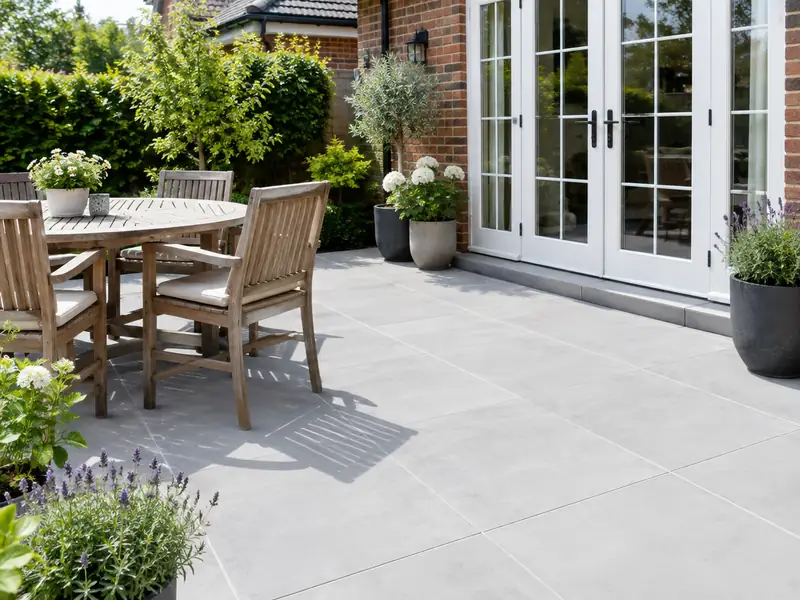
A patio is a paved outdoor area next to the house or in the garden, laid in porcelain, natural stone or concrete slabs on a compacted sub-base and mortar bed, with falls that direct rainwater away from the house.
Paignton sits within our coverage for a new patio, as do neighbouring Torquay, Newton Abbot and Exmouth. Before giving a price we want to see the property: the condition of what's there now, the access, and anything that might need extra work. The guide range for the South West is £2,600–£5,600 including VAT, and your written quote will spell out exactly what that covers.
- Guide price
- £2,600–£5,600 inc VAT
- Time on site
- 3–7 days on site
- Postcodes
- TQ3 and TQ4
- Planning rules
- England
- Local area
- Torbay
- Survey
- Free, with a written quote
How much does a new patio cost in Paignton?
Prices for a new patio vary from house to house, but in Paignton most projects fall within £2,600–£5,600 including VAT. That reflects costs in the South West, about 2% above the national guide. Treat the table as a budgeting aid; the written figure follows a survey we carry out for free.
| Type of job | What it usually involves | Guide in Paignton |
|---|---|---|
| Small patio or path | Around 10m² of concrete slabs or a garden path. | £1,000–£2,600 |
| Typical 20m² patio | Sandstone or porcelain on a full sub-base with jointing and edging. | £2,600–£5,600 |
| Large or multi-level patio | Bigger areas, steps, retaining walls or premium stone. | £5,600–£12,000 |
The main things that change the figure:
- Slab material, size and laying pattern
- Ground levels, slopes, steps and retaining walls
- Drainage needed to keep water away from the house
- Access for materials and removing spoil
What does the job include in Paignton?
- Survey of levels, damp-proof course, drainage and access
- Excavation and removal of turf, soil or old paving
- Compacted MOT Type 1 sub-base
- Primer on porcelain slabs for a strong bond
- Edging and neat cuts around drains and walls
- Site cleared, waste removed and paving cleaned
What are homes like around Paignton?
Devon is known for cob and thatch cottages, especially in mid and east Devon, alongside granite on Dartmoor and red sandstone around Exeter. Exeter and Plymouth have Georgian and Victorian terraces, Plymouth's centre was largely rebuilt after the war, and seaside towns such as Torquay and Exmouth have rendered villas and newer estates.
Mild but wet, with strong coastal winds; exposed elevations need render and pointing specified for driving rain, and cob walls must be kept dry at the base.
So when we survey a Paignton property for a new patio, the first step is working out how it was built and what has been changed since.
Planning and building rules in Paignton
England, Wales, Scotland and Northern Ireland each handle planning a little differently. Paignton comes under England, covered below, and we raise any questions with the council before your quote is finalised.
A ground-level patio in a back garden does not usually need planning permission in England. Raised decks or platforms more than 30 cm high do.
Building Regulations do not normally apply to patios, but levels must stay below the damp-proof course and drain away from the house.
Rules change and every property is different, so we check the planning history and constraints for your address before we quote.
What happens after you get in touch?
Survey and measure
A free survey comes first. It gives us what we need to price a new patio properly, including dimensions, existing materials and access for deliveries, and gives you the chance to ask anything you like.
Price and scope agreed
You get the price in writing, itemised so you can see where the money goes. As long as the specification stays the same, that is the price you pay for a new patio.
Getting ready
With the quote agreed, we book the work in and handle preparation: permissions where needed, building control notifications, material orders and access arrangements for your Paignton property.
On site to finish
The work is carried out to the agreed specification, with floors and furniture protected and the site kept tidy. At the end we clean up, walk through the finished job with you and hand over any certificates.
How we work
Questions about a new patio in Paignton
What happens at the survey?
We visit your home at a time that suits you, look at the area involved, take measurements and check access, condition and any services that might be affected. We talk through what you want from a new patio, explain the options and answer questions. There is no charge and no obligation; afterwards we send a written quote.
Does a patio need planning permission?
Most patios do not need planning permission, but it depends on the size, height and location, your home's position, whether it is listed or in a conservation area, and which UK nation you are in. Raised patios or decking more than a small height above the ground may need permission because of overlooking. We check the position for your garden before quoting.
Do you cover Torquay, Newton Abbot and Exmouth?
Yes. As well as Paignton, we cover Torquay, Newton Abbot and Exmouth and the rest of Devon. Our coverage is UK-wide, so the process is the same wherever you are: a free site survey, a quote in writing that fixes the price for the agreed scope, and one point of contact while the work is planned and carried out.
What should I do before the work starts?
Before work starts, clear garden furniture, pots and ornaments from the area and agree where materials will be delivered and stored. We need a route for wheelbarrows and, on larger jobs, a small digger, so let us know about side gates, narrow passages or access through the house. Tell us about any known drains, cables or pipes in the area.
How long does it take to lay a patio?
Laying a typical 20m² patio takes around three to five days, from excavation and sub-base to laying, jointing and cleaning. Larger or multi-level patios with steps and walls take longer. The mortar bed needs time to set, so light foot traffic is usually fine after a day or two and furniture can go on after about a week. We confirm timings with your quote.
Near Paignton
We cover every part of Paignton, including TQ3 and TQ4, and nearby Torquay, Newton Abbot and Exmouth. Wherever you are within that patch, the survey is free and the quote comes to you in writing.