
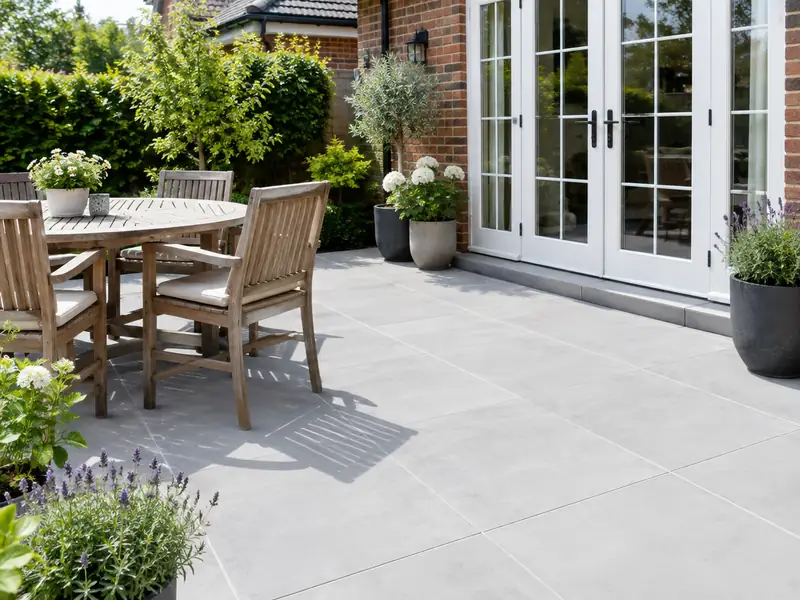
A patio is a paved outdoor area next to the house or in the garden, laid in porcelain, natural stone or concrete slabs on a compacted sub-base and mortar bed, with falls that direct rainwater away from the house.
Addresses across G82 fall within our coverage for a new patio, so if your home is in Vale of Leven we can arrange a survey on a day that works for you. We inspect the existing building, discuss materials and layout, and then price the agreed specification in writing. Expect a guide range of £2,400–£5,300 including VAT before that visit.
- Guide price
- £2,400–£5,300 inc VAT
- Time on site
- 3–7 days on site
- Postcodes
- G82
- Planning rules
- Scotland
- Local area
- West Dunbartonshire
- Survey
- Free, with a written quote
How much does a new patio cost in Vale of Leven?
Below is a breakdown of typical costs for a new patio in Vale of Leven. Because rates in Scotland are about 4% below the national guide, the overall guide comes to £2,400–£5,300, including VAT. Size, materials and access move the figure, and a free-of-charge survey settles it.
| Type of job | What it usually involves | Guide in Vale of Leven |
|---|---|---|
| Small patio or path | Around 10m² of concrete slabs or a garden path. | £950–£2,400 |
| Typical 20m² patio | Sandstone or porcelain on a full sub-base with jointing and edging. | £2,400–£5,300 |
| Large or multi-level patio | Bigger areas, steps, retaining walls or premium stone. | £5,300–£11,500 |
The main things that change the figure:
- Patio area and the amount of excavation
- Slab material, size and laying pattern
- Ground levels, slopes, steps and retaining walls
- Access for materials and removing spoil
What does the job include in Vale of Leven?
- Survey of levels, damp-proof course, drainage and access
- Excavation and removal of turf, soil or old paving
- Compacted MOT Type 1 sub-base
- Slabs laid on a full mortar bed with falls away from the house
- Edging and neat cuts around drains and walls
- Site cleared, waste removed and paving cleaned
Building in Vale of Leven
Clydebank was heavily rebuilt after wartime bombing and has tenements and post-war estates, while Dumbarton has sandstone tenements and Victorian housing. Bearsden and Milngavie are known for Victorian villas and interwar bungalows, and Kirkintilloch mixes older terraces with post-war semis and newer developments.
The west of Scotland gets frequent heavy rain and wind, so driving-rain exposure is a key consideration for render and pointing.
For a new patio in Vale of Leven, this means checking things like wall construction, roof structure and existing services before we put a figure on paper.
Do you need permission in Vale of Leven?
Homes in Vale of Leven come under the regulations for Scotland, summarised below. We don't rely on general rules alone: we confirm the position for your address with the council before a quote goes out.
A ground-level patio does not usually need planning permission in Scotland; raised decking is limited in height under permitted development.
A building warrant is not normally needed for a patio.
Rules change and every property is different, so we check the planning history and constraints for your address before we quote.
From survey to handover
We look at the job
We begin by looking at the job in person. During the free survey we discuss options, materials and budget for a new patio, and photograph or measure anything the quote needs to reflect.
Price and scope agreed
You get the price in writing, itemised so you can see where the money goes. As long as the specification stays the same, that is the price you pay for a new patio.
Booking the work
Preparation matters as much as the build. We agree access, parking and working hours with you, order materials in good time, and confirm any permissions so the job isn't held up once it starts.
On site to finish
The job proceeds in the order set out in the programme, with dust and debris kept under control. Finally we tidy away, inspect the work together and pass the finished project over to you with its paperwork.
What you can expect from us
Frequently asked questions
How long does it take to lay a patio?
Laying a typical 20m² patio takes around three to five days, from excavation and sub-base to laying, jointing and cleaning. Larger or multi-level patios with steps and walls take longer. The mortar bed needs time to set, so light foot traffic is usually fine after a day or two and furniture can go on after about a week. We confirm timings with your quote.
Do you cover Dumbarton, Helensburgh and Erskine?
Yes. As well as Vale of Leven, we cover Dumbarton, Helensburgh and Erskine and the rest of Dunbartonshire. Our coverage is UK-wide, so the process is the same wherever you are: a free site survey, a quote in writing that fixes the price for the agreed scope, and one point of contact while the work is planned and carried out.
How long will a new patio take?
On a typical home, allow 3–7 days on site. Larger projects, older buildings and extra work found once things are opened up can extend that, while simpler jobs may be shorter. Your quote includes an estimate of time on site, and your point of contact keeps you updated on the programme as the work progresses.
Does a patio need planning permission?
Most patios do not need planning permission, but it depends on the size, height and location, your home's position, whether it is listed or in a conservation area, and which UK nation you are in. Raised patios or decking more than a small height above the ground may need permission because of overlooking. We check the position for your garden before quoting.
How much does a new patio cost?
A typical 20m² patio in sandstone or porcelain costs £2,400–£5,300, including excavation, sub-base, laying and jointing. As a guide, allow roughly £100–£220 per square metre plus fixed costs for set-up and waste. Concrete slabs cost less, while slate, granite and large-format porcelain cost more. Steps, walls and drainage add to the total. We confirm a fixed price after the survey.
Nearby towns
We welcome enquiries from all G82 postcodes in Vale of Leven, plus Dumbarton, Helensburgh and Erskine. Each one gets the same survey at no charge and a written price fixed for the work described.