
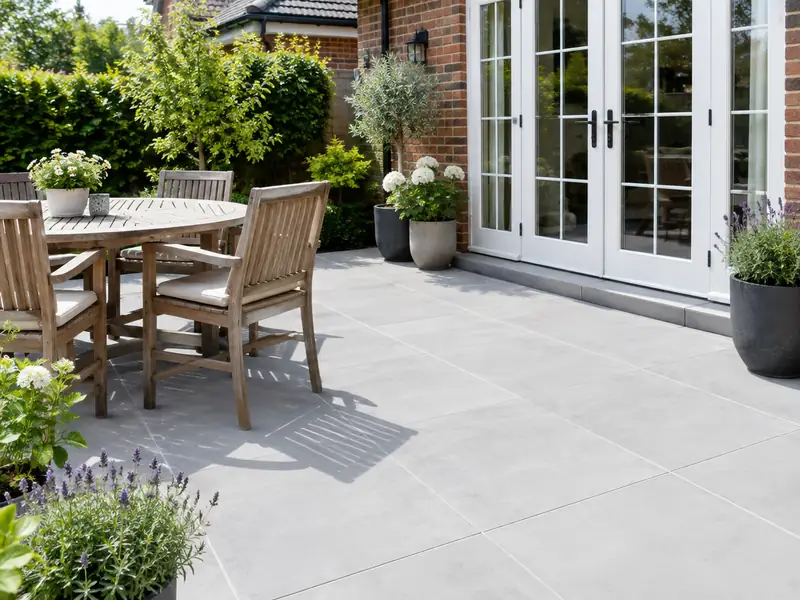
A patio is a paved outdoor area next to the house or in the garden, laid in porcelain, natural stone or concrete slabs on a compacted sub-base and mortar bed, with falls that direct rainwater away from the house.
Getting a new patio right in Harwich starts with understanding the house you already have: its age, how it was built and what has been altered over the years. We survey first, then commit on paper to a price that holds as long as the scope stays the same. Across the East of England, guide prices run at £2,600–£5,800 including VAT, and homes in Felixstowe, Ipswich and Clacton-on-Sea are covered too.
- Guide price
- £2,600–£5,800 inc VAT
- Time on site
- 3–7 days on site
- Postcodes
- CO12
- Planning rules
- England
- Local area
- Essex
- Survey
- Free, with a written quote
How much does a new patio cost in Harwich?
Use the table to gauge the cost of a new patio in Harwich before we visit. Figures include VAT and are scaled for the East of England, coming out about 5% above the national guide, which gives £2,600–£5,800 overall. After a free survey, you receive a fixed written price.
| Type of job | What it usually involves | Guide in Harwich |
|---|---|---|
| Small patio or path | Around 10m² of concrete slabs or a garden path. | £1,050–£2,600 |
| Typical 20m² patio | Sandstone or porcelain on a full sub-base with jointing and edging. | £2,600–£5,800 |
| Large or multi-level patio | Bigger areas, steps, retaining walls or premium stone. | £5,800–£12,500 |
Your price depends mostly on:
- Patio area and the amount of excavation
- Slab material, size and laying pattern
- Ground levels, slopes, steps and retaining walls
- Access for materials and removing spoil
What do you get?
- Excavation and removal of turf, soil or old paving
- Slabs laid on a full mortar bed with falls away from the house
- Primer on porcelain slabs for a strong bond
- Jointing with mortar or a brush-in compound
- Edging and neat cuts around drains and walls
- Site cleared, waste removed and paving cleaned
Homes in Essex
Essex ranges from timber-framed and weatherboarded cottages in the north, some with decorative pargeting, to Victorian terraces in Colchester, Chelmsford and Southend. Basildon and Harlow were built as post-war new towns, much of the south-east has interwar suburbs and bungalows, and large new estates continue to appear around Chelmsford and Braintree.
Essex is one of the driest counties in England, and London Clay in the south shrinks in dry spells, so trees and foundation depth matter.
For a new patio in Harwich, this means checking things like wall construction, roof structure and existing services before we put a figure on paper.
Planning and building rules in Harwich
Each UK nation sets its own consent rules, and Harwich is in England. What follows is a plain summary; we check the specifics for your property with the council before pricing anything.
A ground-level patio in a back garden does not usually need planning permission in England. Raised decks or platforms more than 30 cm high do.
Building Regulations do not normally apply to patios, but levels must stay below the damp-proof course and drain away from the house.
Rules change and every property is different, so we check the planning history and constraints for your address before we quote.
From survey to handover
Survey and measure
A free survey comes first. It gives us what we need to price a new patio properly, including dimensions, existing materials and access for deliveries, and gives you the chance to ask anything you like.
Quote in writing
Next you receive a written quote with a fixed price for the agreed specification. It lists what is included, what is not, and how payments are staged, so you can compare it properly.
Dates and permissions
Next comes planning the work itself. We set a start date that suits you, line up the right trades, and make sure any approvals for a new patio are in place before the first day on site.
Build and hand over
Work goes ahead as scheduled and you deal with one contact throughout. When the last trade leaves, we clear and clean the site, talk you through what has been done and pass on any certificates and care instructions.
Why homeowners choose us
Common questions
What happens at the survey?
We visit your home at a time that suits you, look at the area involved, take measurements and check access, condition and any services that might be affected. We talk through what you want from a new patio, explain the options and answer questions. There is no charge and no obligation; afterwards we send a written quote.
Is porcelain or sandstone better for a patio?
Porcelain is dense, stain-resistant and stays looking clean with little care, making it a good choice if you want a modern, low-maintenance patio. Indian sandstone has natural colour variation and a softer, traditional look, and costs a little less, but it can stain and weather over time and benefits from sealing. Both make durable patios when properly laid. We bring samples to the survey.
Which postcodes in Harwich do you cover?
We cover CO12, along with the rest of Essex. If your postcode is not listed, get in touch anyway: our coverage is UK-wide, and we can usually arrange a survey wherever you live. Enter your postcode in the guide-price tool or contact form and we will confirm.
How do I clean and look after my patio?
Most patios just need regular sweeping and an occasional wash with water and a mild patio cleaner. Porcelain is the easiest to keep clean. Natural stone benefits from a sealant to reduce staining and from prompt cleaning of spills like oil or wine. Re-point any joints that crack or wash out. Avoid high-pressure jet washing close to joints, which can damage them.
Does a patio need planning permission?
Most patios do not need planning permission, but it depends on the size, height and location, your home's position, whether it is listed or in a conservation area, and which UK nation you are in. Raised patios or decking more than a small height above the ground may need permission because of overlooking. We check the position for your garden before quoting.
Near Harwich
Live in Harwich? Our coverage takes in the CO12 postcode areas and reaches out to Felixstowe, Ipswich and Clacton-on-Sea, so homes on the outskirts and in the next town along are included.