
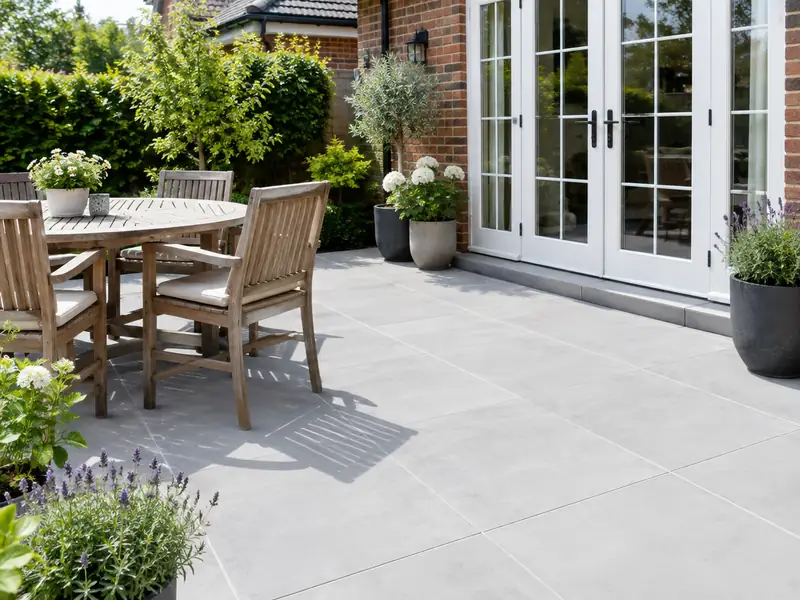
A patio is a paved outdoor area next to the house or in the garden, laid in porcelain, natural stone or concrete slabs on a compacted sub-base and mortar bed, with falls that direct rainwater away from the house.
In Fulham, as anywhere in London, the price of a new patio is driven mainly by size, materials and access. Across London our guide sits at £3,200–£7,200 with VAT, but restricted parking, a narrow side passage or extra preparation can move the figure either way. That is why every price we give follows a visit to the house.
- Guide price
- £3,200–£7,200 inc VAT
- Time on site
- 3–7 days on site
- Postcodes
- SW5, SW6, SW10, W6 and W8
- Planning rules
- England
- Local area
- Greater London
- Survey
- Free, with a written quote
How much does a new patio cost in Fulham?
To help you plan, we show what a new patio typically costs in Fulham instead of holding figures back for a sales call. The range is £3,200–£7,200 with VAT, using rates in London that are about 30% above the national guide. A free survey then fixes your actual price.
| Type of job | What it usually involves | Guide in Fulham |
|---|---|---|
| Small patio or path | Around 10m² of concrete slabs or a garden path. | £1,300–£3,200 |
| Typical 20m² patio | Sandstone or porcelain on a full sub-base with jointing and edging. | £3,200–£7,200 |
| Large or multi-level patio | Bigger areas, steps, retaining walls or premium stone. | £7,200–£15,500 |
What moves the price up or down:
- Patio area and the amount of excavation
- Slab material, size and laying pattern
- Ground levels, slopes, steps and retaining walls
- Drainage needed to keep water away from the house
What do you get?
- Survey of levels, damp-proof course, drainage and access
- Excavation and removal of turf, soil or old paving
- Compacted MOT Type 1 sub-base
- Slabs laid on a full mortar bed with falls away from the house
- Primer on porcelain slabs for a strong bond
- Jointing with mortar or a brush-in compound
Local housing and a new patio
London's housing is dominated by Victorian and Edwardian terraces, often in yellow London stock brick, with Georgian terraces in central districts and mansion blocks across many inner areas. Outer boroughs have large belts of interwar semis, and there are extensive post-war council estates. Many houses have been split into flats, and conservation areas are widespread.
Terraces suit side-return extensions and rear dormer loft conversions; interwar semis commonly take hip-to-gable lofts. Shared party walls, restricted parking and conservation rules often shape the plans and the programme.
With that background in mind, here is how we typically handle a new patio for homes in Fulham, from the first visit to the finished result.
Do you need permission in Fulham?
England, Wales, Scotland and Northern Ireland each handle planning a little differently. Fulham comes under England, covered below, and we raise any questions with the council before your quote is finalised.
A ground-level patio in a back garden does not usually need planning permission in England. Raised decks or platforms more than 30 cm high do.
Building Regulations do not normally apply to patios, but levels must stay below the damp-proof course and drain away from the house.
Rules change and every property is different, so we check the planning history and constraints for your address before we quote.
How does the job run?
Free site survey
We arrange a free site survey on a date convenient to you. We measure up, look at the existing structure and access, and discuss your plans for a new patio so the price reflects your home.
Written quote
After the survey we send a quote for a new patio that fixes the price for the scope we've agreed. If you want to change materials or scope, we revise it in writing before anything is booked.
Booking the work
Next comes planning the work itself. We set a start date that suits you, line up the right trades, and make sure any approvals for a new patio are in place before the first day on site.
Finish and handover
The work is carried out to the agreed specification, with floors and furniture protected and the site kept tidy. At the end we clean up, walk through the finished job with you and hand over any certificates.
Why homeowners choose us
Patios and paving in Fulham: questions
How long will a new patio take?
On a typical home, allow 3–7 days on site. Larger projects, older buildings and extra work found once things are opened up can extend that, while simpler jobs may be shorter. Your quote includes an estimate of time on site, and your point of contact keeps you updated on the programme as the work progresses.
How much does a new patio cost?
A typical 20m² patio in sandstone or porcelain costs £3,200–£7,200, including excavation, sub-base, laying and jointing. As a guide, allow roughly £100–£220 per square metre plus fixed costs for set-up and waste. Concrete slabs cost less, while slate, granite and large-format porcelain cost more. Steps, walls and drainage add to the total. We confirm a fixed price after the survey.
Do you cover Chelsea, Putney and Battersea?
Yes. As well as Fulham, we cover Chelsea, Putney and Battersea and the rest of London. Our coverage is UK-wide, so the process is the same wherever you are: a free site survey, a quote in writing that fixes the price for the agreed scope, and one point of contact while the work is planned and carried out.
Is porcelain or sandstone better for a patio?
Porcelain is dense, stain-resistant and stays looking clean with little care, making it a good choice if you want a modern, low-maintenance patio. Indian sandstone has natural colour variation and a softer, traditional look, and costs a little less, but it can stain and weather over time and benefits from sealing. Both make durable patios when properly laid. We bring samples to the survey.
How do you make sure water drains away from the house?
A patio needs a gentle fall, usually a little over 1 in 80, so rainwater runs away from the house towards the garden, a drain or a soakaway. The surface should also sit well below the damp-proof course. If the patio meets a door threshold, a channel drain may be needed. We set levels with string lines and check falls as we lay each section.
Nearby towns
We survey and quote throughout Fulham's SW5, SW6, SW10 and W6 postcodes and in surrounding places such as Chelsea, Putney and Battersea. The process and pricing approach are identical in each of them.