
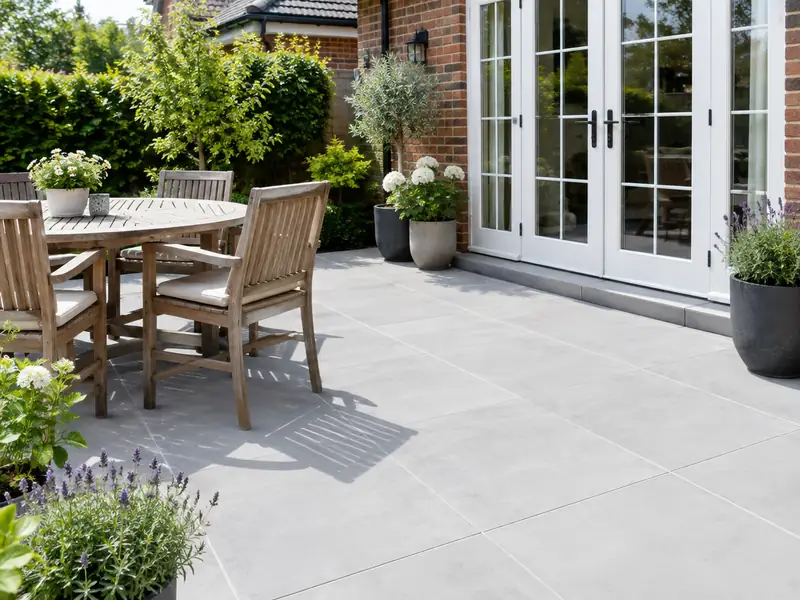
A patio is a paved outdoor area next to the house or in the garden, laid in porcelain, natural stone or concrete slabs on a compacted sub-base and mortar bed, with falls that direct rainwater away from the house.
For a homeowner in Caerphilly, planning a new patio tends to begin with two questions: what will it cost, and how disruptive will it be? Our guide range is £2,300–£5,100 including VAT, and a typical job runs to 3–7 days on site. Both numbers firm up once we have seen the property, measured up and agreed exactly what is included.
- Guide price
- £2,300–£5,100 inc VAT
- Time on site
- 3–7 days on site
- Postcodes
- CF83
- Planning rules
- Wales
- Local area
- Mid Glamorgan
- Survey
- Free, with a written quote
How much does a new patio cost in Caerphilly?
Prices for a new patio vary from house to house, but in Caerphilly most projects fall within £2,300–£5,100 including VAT. That reflects costs in Wales, about 8% below the national guide. Treat the table as a budgeting aid; the written figure follows a survey we carry out for free.
| Type of job | What it usually involves | Guide in Caerphilly |
|---|---|---|
| Small patio or path | Around 10m² of concrete slabs or a garden path. | £900–£2,300 |
| Typical 20m² patio | Sandstone or porcelain on a full sub-base with jointing and edging. | £2,300–£5,100 |
| Large or multi-level patio | Bigger areas, steps, retaining walls or premium stone. | £5,100–£11,000 |
Expect these to shape the final quote:
- Patio area and the amount of excavation
- Slab material, size and laying pattern
- Ground levels, slopes, steps and retaining walls
- Drainage needed to keep water away from the house
What do you get?
- Survey of levels, damp-proof course, drainage and access
- Compacted MOT Type 1 sub-base
- Slabs laid on a full mortar bed with falls away from the house
- Primer on porcelain slabs for a strong bond
- Jointing with mortar or a brush-in compound
- Edging and neat cuts around drains and walls
What are homes like around Caerphilly?
The Rhondda, Cynon and Merthyr valleys are lined with stone terraces built for mining families, stepped along steep hillsides. Pontypridd, Caerphilly and Merthyr Tydfil have Victorian centres, and Bridgend has grown with large modern estates alongside interwar and post-war housing.
Valley terraces commonly need repointing, roof repairs, rendering and window replacement, and loft conversions can add useful space. Newer estate homes often take garage conversions, porches and landscaping.
Knowing the typical building types in Mid Glamorgan helps, but a survey of your own home in Caerphilly is what decides the right approach to a new patio.
Planning and building rules in Caerphilly
Each UK nation sets its own consent rules, and Caerphilly is in Wales. What follows is a plain summary; we check the specifics for your property with the council before pricing anything.
A ground-level patio does not usually need planning permission in Wales; raised platforms are more restricted.
Building Regulations do not normally apply, but levels and drainage must protect the house walls.
Rules change and every property is different, so we check the planning history and constraints for your address before we quote.
The four stages
A visit to your home
First, someone visits your home in Caerphilly to see the space, take measurements and note anything that could affect the work, such as access or the condition of what is there. There is no charge for this visit.
Written quote
After the survey we send a quote for a new patio that fixes the price for the scope we've agreed. If you want to change materials or scope, we revise it in writing before anything is booked.
Booking the work
Next comes planning the work itself. We set a start date that suits you, line up the right trades, and make sure any approvals for a new patio are in place before the first day on site.
Build and hand over
Our trades complete a new patio while your point of contact keeps you updated. When everything is finished, we clear the site, take away waste and go through the result with you before handover.
What you can expect from us
Patios and paving in Caerphilly: questions
How do you make sure water drains away from the house?
A patio needs a gentle fall, usually a little over 1 in 80, so rainwater runs away from the house towards the garden, a drain or a soakaway. The surface should also sit well below the damp-proof course. If the patio meets a door threshold, a channel drain may be needed. We set levels with string lines and check falls as we lay each section.
What should I do before the work starts?
Before work starts, clear garden furniture, pots and ornaments from the area and agree where materials will be delivered and stored. We need a route for wheelbarrows and, on larger jobs, a small digger, so let us know about side gates, narrow passages or access through the house. Tell us about any known drains, cables or pipes in the area.
What happens if my garden slopes?
A sloping garden can still have a level patio by cutting into the slope, building up with retaining walls, or creating terraces with steps between them. Retaining walls must be built to hold back the soil and allow drainage behind them. This adds cost but creates usable, level space. We look at the slope during the survey and suggest the most practical design.
Which postcodes in Caerphilly do you cover?
We cover CF83, along with the rest of Mid Glamorgan. If your postcode is not listed, get in touch anyway: our coverage is UK-wide, and we can usually arrange a survey wherever you live. Enter your postcode in the guide-price tool or contact form and we will confirm.
Do I need planning permission in Caerphilly?
It depends on the work, the size of the project, your property type and whether the building is listed or in a conservation area. Caerphilly is in Wales, so Wales's rules apply. Many smaller jobs need no planning application, but some still need building control approval. We check what applies to your address before quoting.
Near Caerphilly
Whether you're in the centre of Caerphilly or on its outskirts, CF83 addresses are covered. We extend the same service, and the same fixed-price approach, to Risca, Pontypridd and Gelligaer.